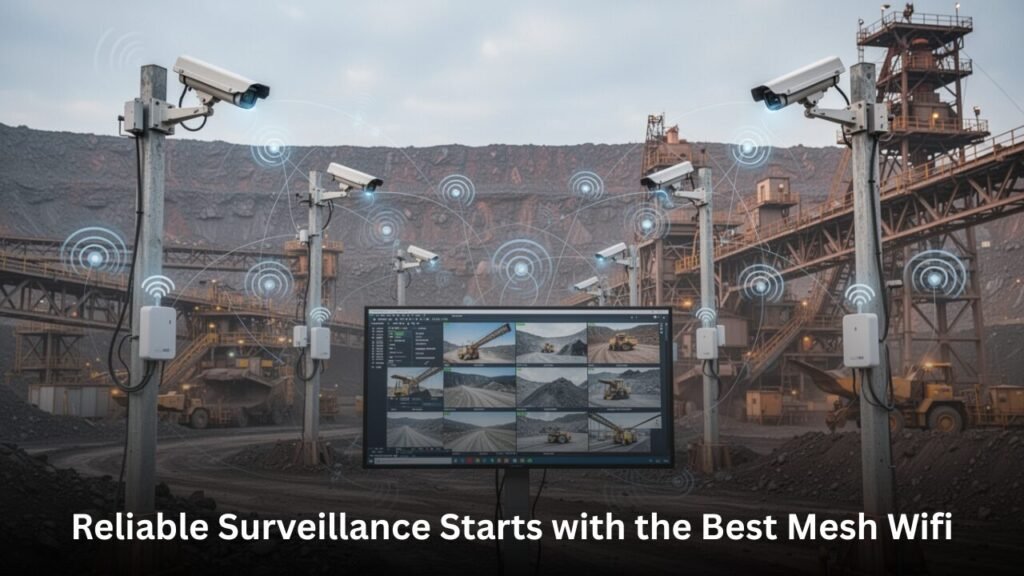
Reliable Wireless Networks for Surveillance and Video Monitoring Systems
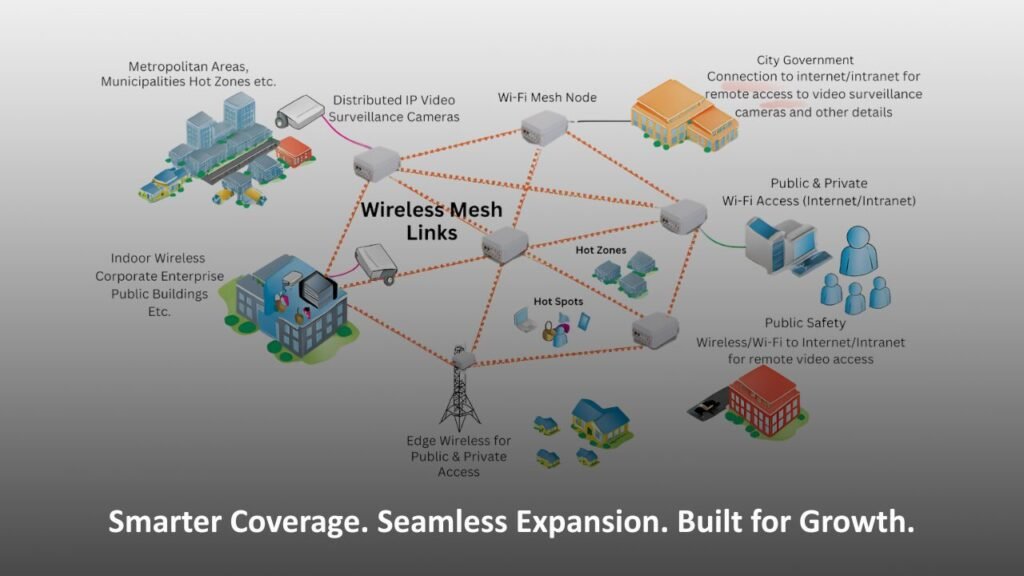
Industrial surveillance systems are no longer optional. From mining corridors in India to global logistics hubs, enterprises depend on uninterrupted video visibility for safety, compliance, and operational intelligence. Yet traditional Wi-Fi often fails in large, rugged, or mobile environments. That is why many IT and OT leaders are evaluating the best mesh wifi architecture for mission-critical video monitoring. A well-designed wireless mesh network delivers resilience, scalability, and predictable performance – even in harsh industrial conditions. Why Surveillance Networks Fail in Industrial Environments Video monitoring systems generate continuous, high-bandwidth traffic. A single HD camera can consume 4-8 Mbps. Multiply that across hundreds of cameras, and the network becomes a critical bottleneck. Common failure points include: Single-point-of-failure access points Congested radio channels High latency during roaming Poor coverage across wide or obstructed areas Limited backhaul capacity In environments such as open-pit mines in India, oil and gas facilities in the Middle East, or container terminals in Southeast Asia, network interruptions directly impact safety and compliance. 0A resilient architecture must address redundancy, mobility, and sustained throughput simultaneously. What Is a Wireless Mesh Network? A wireless mesh network is a decentralized network architecture where multiple nodes connect to each other dynamically instead of relying on a single central controller. Each node acts as both: An access point for client devices like IP cameras A relay point forwarding traffic to other nodes This multi-hop design ensures that if one link fails, traffic automatically reroutes through another path. In simple terms, it creates multiple pathways for data, improving reliability and fault tolerance. How Does the Best Mesh Wifi Architecture Support Video Surveillance? 1. Multi-Path Redundancy Unlike traditional star networks, mesh topology provides alternative data routes. If a node goes offline due to power or interference issues, traffic reroutes instantly. This is critical for: Perimeter security cameras Remote substation monitoring Highway or railway surveillance systems For example, Indian metro rail projects deploy distributed surveillance across long corridors where centralized Wi-Fi would create coverage gaps. 2.Dedicated Backhaul for High-Performance Traffic A High performance wireless mesh network separates client access traffic from backhaul traffic. Backhaul refers to the internal communication between mesh nodes. When dedicated radios handle backhaul: Camera streams do not compete with control traffic Throughput remains consistent Packet loss reduces significantly This separation ensures smoother 4K video transmission in environments like smart city deployments or large manufacturing plants. What Performance Metrics Matter for Video Monitoring? For surveillance systems, performance is not just about speed. CTOs and network architects must evaluate: Latency Latency is the time taken for data to travel from camera to monitoring center. Low latency ensures: Real-time monitoring Faster incident response Accurate PTZ camera control In most industrial surveillance networks, sub-20 ms latency is considered acceptable for live feeds. Throughput Throughput measures how much data the network can carry. High-definition and AI-enabled cameras require significant bandwidth. A scalable mesh must support: 100+ concurrent streams Future upgrades to 4K or AI-based video analytics Redundancy Redundancy prevents downtime. Industrial networks should provide: Automatic failover Self-healing topology Multiple routing paths This is particularly relevant in ports like Mumbai or Rotterdam where downtime can halt logistics operations. Scalability Surveillance systems grow over time. A wireless mesh network allows new nodes to be added without reconfiguring the entire architecture. This supports: Smart factory expansions New warehouse zones Additional perimeter coverage Architecture Considerations for Surveillance Mesh Networks Distributed Topology In distributed mesh architecture: No single controller becomes a bottleneck Nodes dynamically calculate optimal routes Load balancing occurs automatically This approach ensures consistent performance even as camera density increases. Quality of Service – QoS QoS prioritizes critical video packets over less important traffic. For example: Emergency alerts get higher priority Routine background uploads are deprioritized This maintains clarity during peak usage. Spectrum Planning Industrial sites often have RF interference from machinery. Proper spectrum planning includes: Channel optimization Dual or tri-radio configurations Dynamic frequency selection A High performance wireless mesh network must adapt to interference without manual intervention. Industrial Use Cases – India and Global Context Open-Pit Mining in India Mining operations in states like Odisha and Jharkhand require long-range surveillance across uneven terrain. Mesh nodes placed across haul roads and excavation zones: Ensure continuous camera coverage Support vehicle tracking Provide rapid failover during equipment movement Smart Cities and Traffic Monitoring Urban centers deploy surveillance for traffic enforcement and public safety. Mesh networks support: Pole-mounted cameras Edge analytics Integration with command centers This reduces fiber dependency in dense areas. Oil and Gas Refineries Refineries require explosion-safe and redundant connectivity. A wireless mesh network: Minimizes wired infrastructure Provides mobility for inspection units Maintains uninterrupted monitoring in hazardous zones Large Manufacturing Plants Factories integrating Industry 4.0 systems rely on integrated video and sensor monitoring. Mesh architecture: Connects robotic lines Supports AI-powered defect detection Enables flexible plant reconfiguration Why Not Traditional Wi-Fi for Surveillance? Traditional Wi-Fi depends heavily on centralized controllers and single-hop communication. Challenges include: Coverage limitations High roaming delays Complex reconfiguration during expansion Limited resilience during outages In contrast, the best mesh wifi systems are designed for: Wide geographic coverage Continuous uptime High client density Predictable performance For surveillance, predictability matters more than peak theoretical speed. Security Considerations in Surveillance Mesh Networks Video surveillance carries sensitive data. A robust mesh solution should include: End-to-end encryption Secure authentication Network segmentation between camera and enterprise traffic Secure remote management Industrial IoT deployments must also comply with regional data protection requirements, especially in smart city projects. Future-Proofing Surveillance Networks As AI-driven video analytics expands, networks must handle: Edge computing integration Real-time object detection Higher resolution streams Increased camera density A scalable wireless mesh network supports gradual upgrades without forklift replacements. This flexibility makes mesh architecture suitable for long-term infrastructure investments. Conclusion Reliable video monitoring depends on more than camera quality. It requires a resilient, scalable, and intelligently designed network foundation. The best mesh wifi architecture delivers multi-path redundancy, low latency, dedicated backhaul, and seamless scalability – all essential for industrial surveillance environments. For CTOs, network architects, and infrastructure leaders, investing in a High performance wireless mesh network is not about faster internet. It is about uninterrupted visibility, operational continuity, and future-ready infrastructure. FAQs 01 What makes mesh wifi better for surveillance systems? Mesh architecture provides multiple data paths and automatic failover, ensuring continuous video streaming even if one node fails. 02 How much bandwidth does a surveillance camera require? An HD camera typically uses 4-8 Mbps. 4K cameras may require 15-25 Mbps depending on compression. 03 Can a wireless mesh network handle 100+ cameras? Yes, if designed with proper backhaul capacity, QoS, and scalable node placement. 04 Is mesh suitable for outdoor industrial environments? Yes. Industrial-grade mesh nodes are built for harsh conditions and support long-range outdoor deployment. 05 Does mesh reduce latency for live video monitoring? A properly engineered High performance wireless mesh network can maintain low latency suitable for real-time monitoring and PTZ control.