
Why Enterprises Are Choosing Private Wireless Networks
As organizations adopt digital transformation, Industrial IoT, automation, and real-time data applications, network reliability has become a business-critical requirement. Traditional public networks may not always provide the security, coverage, or performance needed for enterprise operations.
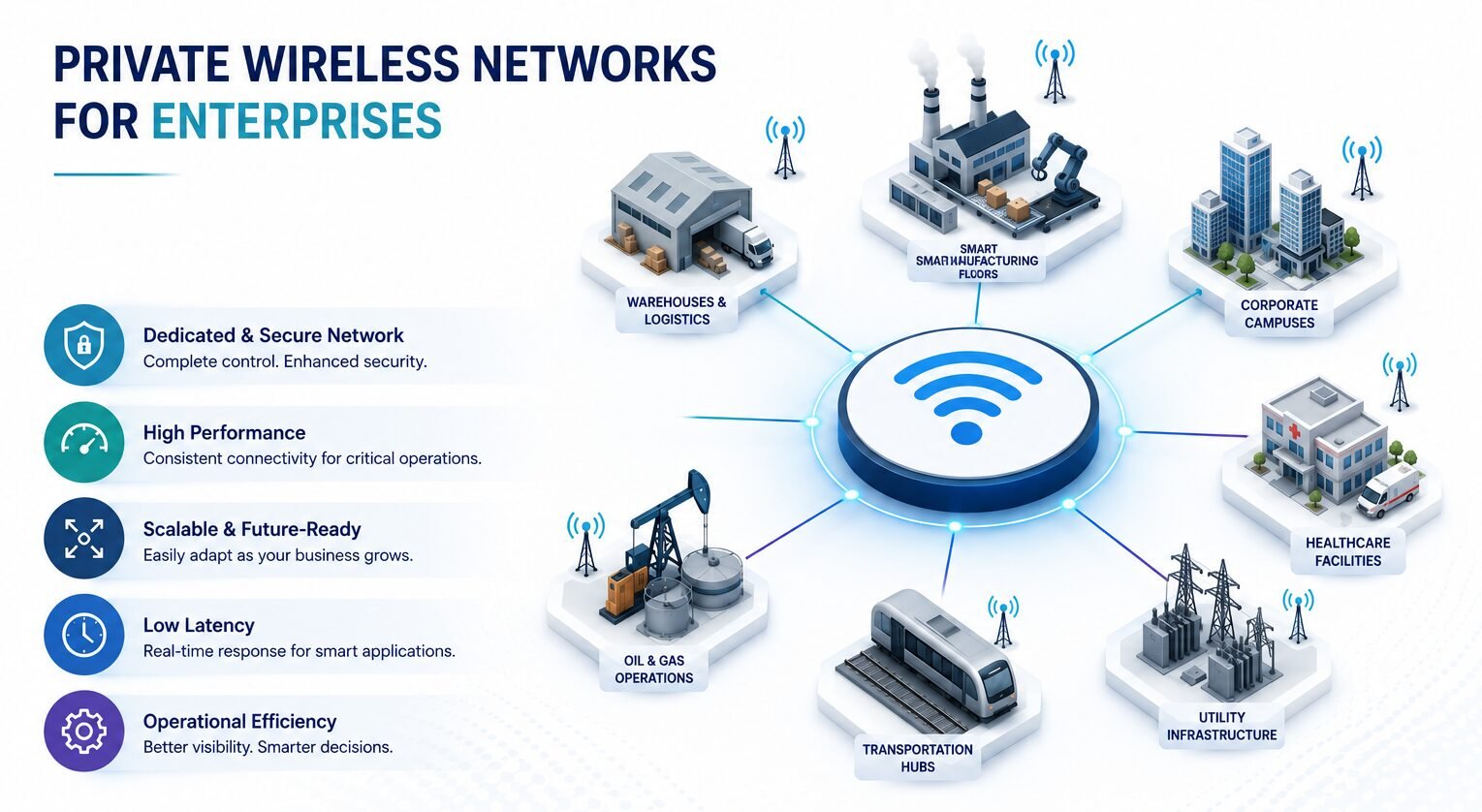
Private wireless networks give organizations complete control over their wireless infrastructure, enabling secure communication, predictable performance, and reliable connectivity across campuses, factories, warehouses, ports, and remote facilities.
Key Benefits of Private Wireless Networks
Enhanced Security
Unlike public networks, private wireless infrastructure is dedicated to a single organization. Businesses have greater control over user authentication, network policies, encryption, and access management, reducing the risk of unauthorized access.
Reliable Network Performance
Private networks minimize congestion because bandwidth is reserved for enterprise users and connected devices. This ensures consistent connectivity for business-critical applications, even during periods of high network activity.
Scalability
As businesses expand operations, private wireless networks can easily accommodate additional users, IoT devices, production equipment, and new facilities without compromising performance.
Low Latency Communication
Applications such as industrial automation, autonomous vehicles, surveillance systems, and real-time monitoring require fast communication. Private wireless networks provide low-latency connectivity that supports these demanding workloads.
Improved Operational Control
Organizations gain centralized visibility into network performance, device management, security policies, and maintenance activities, making it easier to optimize operations and respond to network issues.
Enterprise Use Cases
Private wireless networks are widely deployed across industries where secure and uninterrupted connectivity is essential.
Common applications include:
- Smart manufacturing facilities
- Warehouses and logistics centers
- Oil & gas operations
- Mining sites
- Airports and ports
- Utility infrastructure
- Healthcare campuses
- Smart city projects
- Large corporate campuses
Many organizations implementing wireless infrastructure across Industrial Applications use private wireless networks to support automation, remote monitoring, and mission-critical communication.
Planning a Successful Deployment
Assess Business Requirements
Start by identifying operational goals, coverage requirements, connected devices, user density, and application performance needs.
A detailed assessment helps determine the appropriate network architecture.
Conduct a Wireless Site Survey
A professional site survey identifies interference sources, coverage gaps, equipment placement, and environmental challenges before deployment begins.
Proper planning improves network performance while reducing installation costs.
Choose Enterprise-Grade Infrastructure
Reliable infrastructure is essential for long-term performance. Deploying secure WiFi Access Point / Hotspots Series solutions with centralized management, advanced security, and scalable architecture helps organizations maintain high network availability while simplifying ongoing administration.
Implement Strong Security Policies
Every deployment should include:
- Multi-factor authentication
- Role-based access control
- Network segmentation
- Data encryption
- Continuous monitoring
- Regular firmware updates
Security should be integrated into the network from the initial design stage.
Monitor and Optimize Performance
Continuous monitoring enables IT teams to identify bottlenecks, monitor connected devices, optimize bandwidth usage, and maintain reliable connectivity across the enterprise.
Regular performance reviews help maximize network efficiency over time.
Best Practices for Long-Term Success
To maximize the value of a private wireless network:
- Design for future business growth.
- Select enterprise-grade hardware.
- Conduct routine security audits.
- Monitor network performance continuously.
- Keep firmware and software updated.
- Document network architecture.
- Train IT teams on wireless security and maintenance.
Following these best practices helps ensure reliable performance while supporting evolving business requirements.
Conclusion
Private wireless networks are transforming enterprise connectivity by providing dedicated, secure, and scalable communication infrastructure. They support mission-critical applications, improve operational efficiency, and give organizations greater control over network performance and security.
By carefully assessing business requirements, selecting enterprise-grade infrastructure, and implementing strong security and monitoring practices, enterprises can build wireless networks that deliver long-term value while supporting future digital transformation initiatives.
FAQs
A private wireless network is a dedicated communication network built exclusively for an organization. It provides secure, reliable, and high-performance connectivity for employees, devices, and business-critical applications without relying on public wireless infrastructure.
Private wireless networks offer enhanced security, reliable performance, low latency, centralized management, scalability, and greater control over connected devices. These advantages make them ideal for enterprises that depend on uninterrupted wireless communication.
Industries such as manufacturing, logistics, mining, utilities, healthcare, transportation, ports, airports, government, and smart cities benefit from private wireless networks because they require secure, high-performance connectivity for mission-critical operations.
Organizations should evaluate coverage requirements, device density, application needs, security policies, future scalability, site conditions, and integration with existing IT infrastructure before deploying a private wireless network.
Private wireless networks provide the reliable and secure connectivity needed for Industrial IoT, automation, artificial intelligence, remote monitoring, and smart infrastructure. They enable organizations to deploy new technologies with confidence while maintaining operational efficiency and network security.