Introduction
Industrial organizations are rapidly adopting digital technologies to improve operational efficiency, automation, and decision-making. As businesses implement Industrial IoT, smart manufacturing, predictive maintenance, and remote monitoring systems, the gap between IT (Information Technology) and OT (Operational Technology) networks is shrinking.
Traditionally, IT and OT systems operated separately.
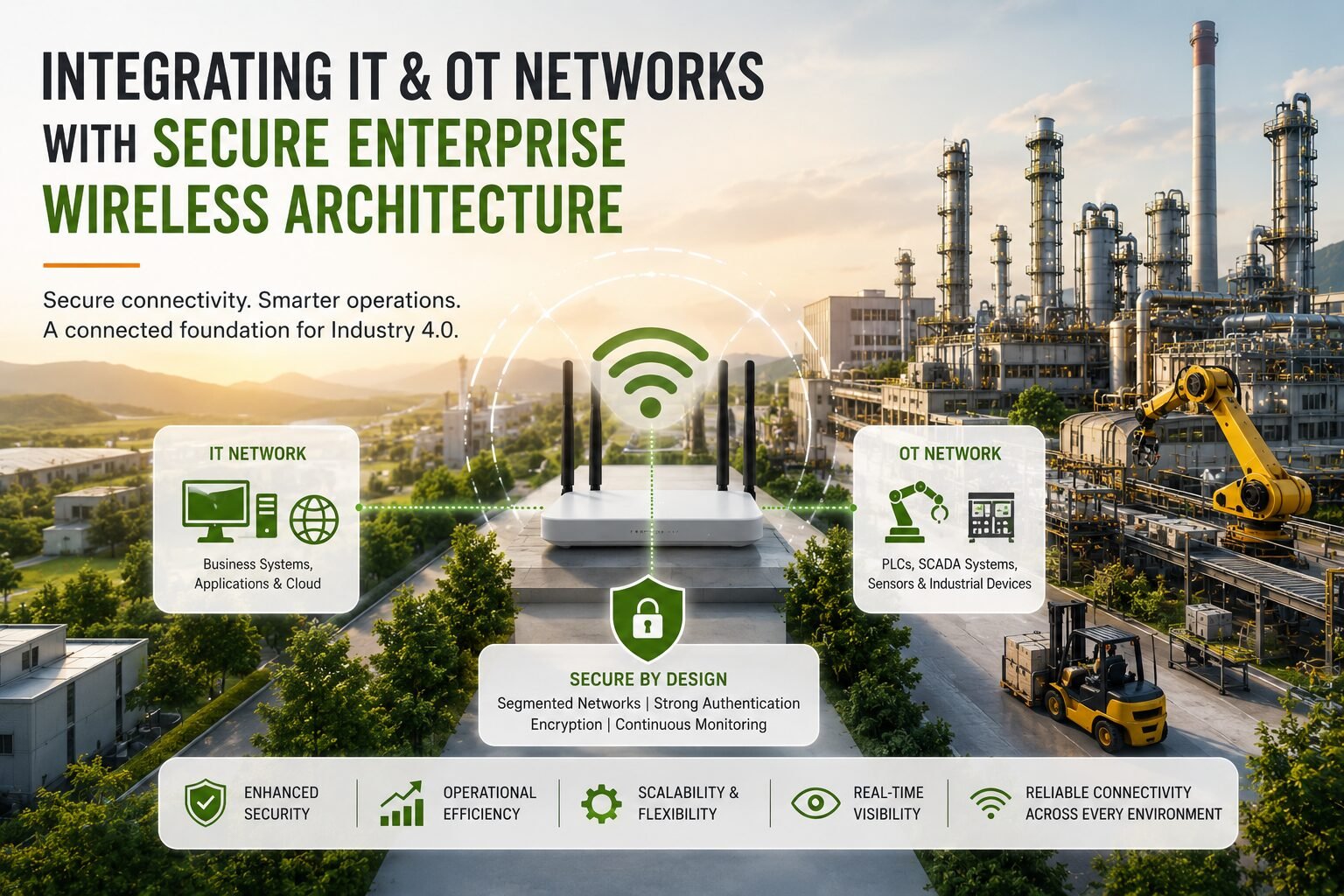
- IT networks handled business applications, cloud platforms, enterprise communication, and data management.
- OT networks controlled industrial equipment, PLCs, SCADA systems, sensors, and production environments.
Today, enterprises need these systems to work together. Management teams want real-time production visibility, maintenance teams require remote diagnostics, and operational data must flow securely between industrial systems and enterprise platforms.
This is where secure enterprise wireless architecture plays a critical role.
Why IT and OT Integration Matters
Integrating IT and OT networks helps organizations improve operational intelligence and business performance.
Real-Time Operational Visibility
Connected environments allow enterprises to monitor:
- Production performance
- Equipment health
- Asset utilization
- Energy consumption
- Operational efficiency
This enables faster and more informed decision-making.
Predictive Maintenance
Industrial IoT devices generate continuous operational data. By integrating OT systems with IT analytics platforms, organizations can identify equipment issues before failures occur.
Practical Example
A manufacturing plant connected machine sensors through a secure wireless network to a centralized analytics dashboard. Maintenance teams received early alerts about motor vibration abnormalities, helping avoid unexpected downtime.
Support for Industry 4.0
Modern technologies such as smart factories, AI-driven automation, robotics, and edge computing require seamless communication between enterprise and operational systems.
Role of Secure Enterprise Wireless Architecture
Traditional wired infrastructure can be difficult to expand across large industrial facilities, outdoor environments, warehouses, or remote operational sites.
Enterprise wireless architecture provides flexible and scalable connectivity for industrial operations.
Key Benefits
Faster Deployment
Wireless infrastructure eliminates many challenges associated with trenching and cable installation.
Organizations can quickly connect:
- Production units
- Warehouses
- Remote facilities
- Surveillance systems
- Industrial IoT devices
Scalability
As enterprises grow, wireless networks allow easier expansion without redesigning the entire infrastructure.
Mobility Support
Wireless connectivity supports:
- Mobile workforce communication
- Industrial tablets
- Automated guided vehicles (AGVs)
- Connected maintenance systems
- Real-time inventory tracking
Connectivity in Harsh Environments
Industrial-grade wireless solutions are designed to operate in:
- High temperatures
- Dusty conditions
- Outdoor environments
- Metal-heavy industrial zones
Security Challenges in IT and OT Convergence
While integration improves efficiency, it also introduces cybersecurity risks.
Historically, OT systems were isolated from external networks. Connecting them to enterprise systems increases exposure to cyber threats.
Common Security Risks
- Unauthorized access to operational systems
- Ransomware attacks
- Legacy OT device vulnerabilities
- Data interception
- Operational disruption
A successful cyberattack can impact production, safety, and business continuity.
Key Components of Secure Wireless Architecture
Network Segmentation
Separating IT and OT traffic helps limit cyber risks.
Technologies such as VLANs, firewalls, and secure gateways help isolate sensitive operational systems.
Strong Authentication
Organizations should implement:
- Multi-factor authentication
- Device authentication
- Role-based access control
This ensures only authorized users and devices can access the network.
End-to-End Encryption
Encryption protects industrial data from interception and unauthorized monitoring.
Continuous Monitoring
Modern enterprise wireless networks should include:
- Real-time monitoring
- Intrusion detection systems
- Automated alerts
- Security analytics
Continuous monitoring helps identify suspicious activity early.
Redundant Network Design
Industrial environments require reliable communication.
Wireless architectures should support:
- Mesh networking
- Self-healing connectivity
- Automatic failover
- Backup communication paths
This minimizes operational downtime.
Best Practices for Successful Integration
To successfully integrate IT and OT networks, organizations should:
- Conduct a complete network assessment
- Define clear security policies
- Use industrial-grade wireless equipment
- Implement Zero Trust security principles
- Train IT and OT teams together
- Continuously monitor network performance
Collaboration between IT and OT teams is essential for maintaining both operational reliability and cybersecurity.

Conclusion
Integrating IT and OT networks is becoming essential for organizations pursuing industrial automation, operational efficiency, and digital transformation.
Secure enterprise wireless architecture provides the scalability, flexibility, and resilience needed to support connected industrial environments across manufacturing, logistics, mining, utilities, and smart infrastructure.
However, successful integration requires more than connectivity alone. Enterprises must prioritize cybersecurity, network segmentation, monitoring, and resilient infrastructure design to protect critical operational systems.
Organizations that invest in secure wireless architecture today will be better prepared for Industry 4.0 innovation and future industrial growth.
FAQs
IT and OT integration connects enterprise business systems with operational technology systems to improve visibility, automation, and operational efficiency.
Wireless infrastructure provides flexible, scalable, and cost-effective connectivity across large industrial facilities and remote operational areas.
Common concerns include ransomware attacks, unauthorized access, legacy device vulnerabilities, and operational disruption.
Organizations can improve security using network segmentation, encryption, authentication controls, monitoring systems, and Zero Trust security strategies.