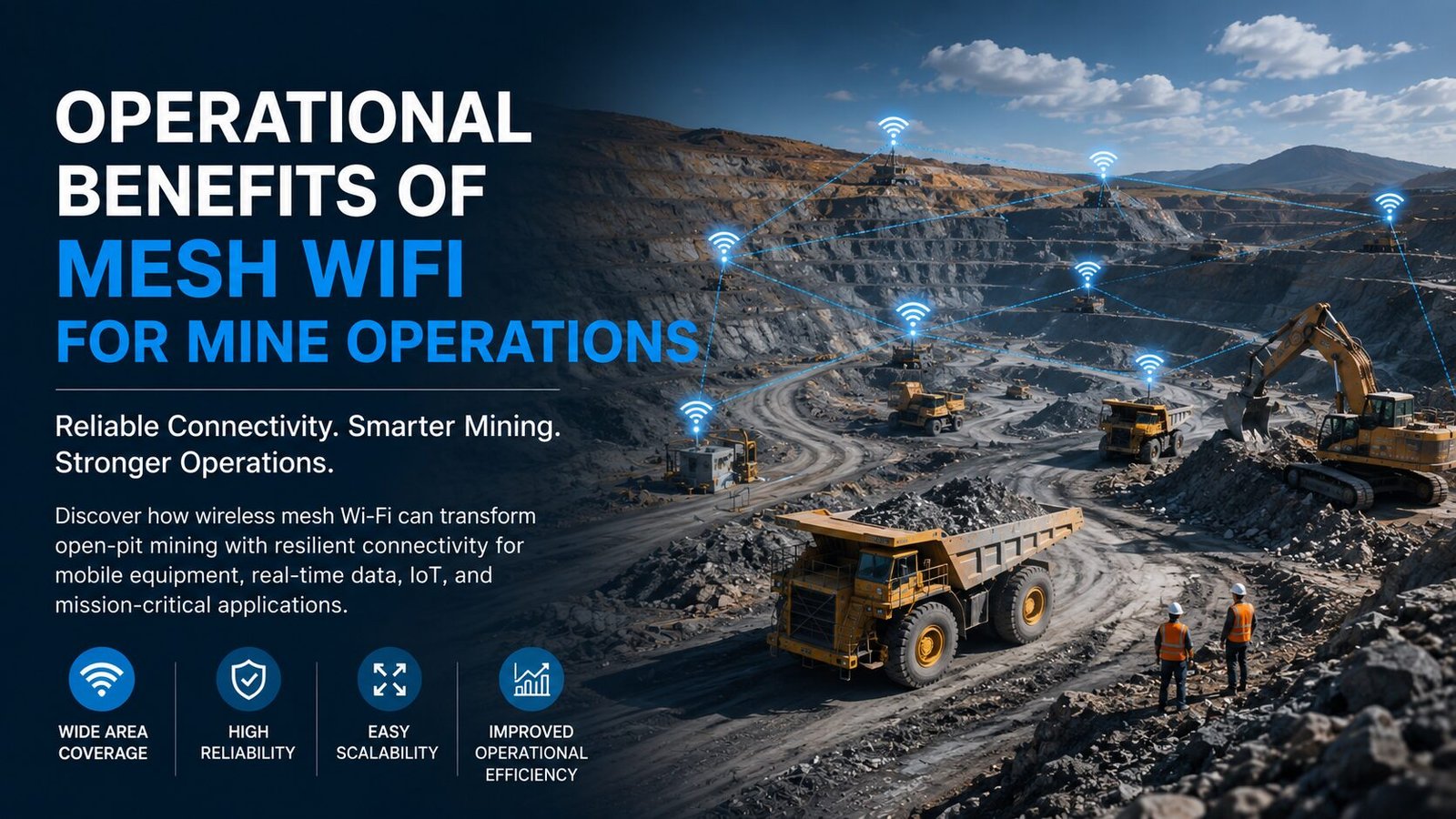
Open-pit mines are among the most demanding environments for wireless connectivity. Large operating areas, moving equipment, changing pit geometry, dust, vibration, and physical obstructions can make conventional wireless infrastructure difficult to maintain. Mesh WiFi for mine environments provides a flexible approach by allowing multiple wireless nodes to work together and create interconnected coverage across operational areas.
Reliable mining connectivity is increasingly important as mines adopt fleet management systems, autonomous and semi-autonomous equipment, real-time telemetry, video monitoring, worker communications, and industrial IoT applications. This article explains ten operational benefits of wireless mesh Wi-Fi for open-pit mining and how it can support more resilient digital operations.
What Is Mesh WiFi for Mine Operations?
Mesh WiFi for mine operations uses multiple interconnected wireless nodes to provide network coverage across large and changing mining environments. Instead of depending entirely on a single access point or a fixed wired connection, mesh nodes can communicate with one another and provide multiple pathways for data.
This architecture is particularly useful in open-pit mines where equipment and operational areas are constantly moving or changing. Haul roads can shift, excavation areas can expand, and temporary work zones can appear as mining progresses.
A well-designed mesh network can extend connectivity across these areas while reducing dependence on extensive cabling. It can also support mobile assets such as haul trucks, excavators, drills, service vehicles, and personnel carrying connected devices.
Key Connectivity Challenges in Open-Pit Mining
Mining environments create several challenges for conventional wireless networks. The physical size of a mine alone can make continuous coverage difficult.
Large pits can also contain benches, stockpiles, rock faces, buildings, machinery, and other obstructions that affect radio propagation. As the mine develops, the location and height of these obstacles can change.
Another challenge is mobility. Mining equipment does not remain in one location. Trucks travel between loading and dumping points, excavators move between benches, and maintenance teams operate throughout the site.
For IT and OT teams, the challenge is therefore not simply providing Wi-Fi coverage. The network must remain useful as mine operations change.
Operational Benefits of Wireless Mesh Wi-Fi for Mining
1. Extended Connectivity Across Large Mine Areas
Open-pit mines can cover extensive areas where traditional wired infrastructure is expensive or impractical to extend.
Wireless mesh nodes can create interconnected coverage zones across haul roads, loading areas, workshops, stockpiles, and other operational locations. Additional nodes can also be introduced as coverage requirements expand.
This makes mesh architecture particularly relevant for mines with large outdoor operating areas.
2. Better Support for Mobile Mining Equipment
Modern mining operations rely heavily on mobile assets. Fleet management systems need consistent communication with vehicles to exchange operational and telemetry data.
A mesh network can help maintain connectivity as trucks and other equipment move between different coverage areas. This supports applications such as fleet tracking, equipment monitoring, dispatch communication, and operational telemetry.
For mobile operations, maintaining network availability can be more valuable than simply achieving high peak bandwidth at a fixed location.
3. Greater Network Resilience
A conventional wireless design may depend heavily on individual access points or specific network paths. If a critical connection fails, part of the operating area may lose connectivity.
Wireless mesh architecture can provide alternative communication paths between nodes. If one path becomes unavailable, traffic can potentially use another available route, depending on network design and configuration.
This resilience is particularly valuable for wireless solutions for mining, where physical access to infrastructure can be difficult.
4. Reduced Dependence on Extensive Cabling
Installing and maintaining cables across an active open-pit mine can be challenging. Roads change, excavation progresses, and equipment constantly moves through operational areas.
Wireless connectivity can reduce the amount of physical cabling required between distributed network points. This can simplify network expansion and make connectivity easier to adapt as the mine develops.
The result is a network architecture that can better accommodate changing operational requirements.
5. Easier Network Expansion
Mining infrastructure rarely remains static. A new haul road, loading zone, workshop, or production area may require additional connectivity.
Mesh networks can be expanded by adding appropriately positioned nodes and integrating them into the existing network architecture.
This modular approach can be useful for mining operators that need connectivity to evolve alongside mine development rather than redesigning the entire network whenever operational boundaries change.
6. Improved Support for Fleet Management Systems
Fleet management is one of the most connectivity-dependent applications in modern mining.
Vehicles can generate continuous streams of information related to location, operating conditions, fuel consumption, utilization, diagnostics, and productivity. Reliable mining connectivity helps transport this information between mobile equipment and backend systems.
A robust wireless network can therefore provide the communication foundation required for more effective fleet visibility and operational decision-making.
7. Support for Real-Time Video and Monitoring
Cameras are increasingly used for safety, security, equipment monitoring, traffic management, and operational visibility.
Wireless mesh infrastructure can provide connectivity for cameras positioned in locations where running dedicated network cables may be difficult. Depending on network capacity and application requirements, this can support video feeds from strategic areas across the mine.
Engineers should, however, evaluate bandwidth, latency, interference, and traffic prioritization before deploying video-heavy applications.
8. Better Connectivity for IoT and Telemetry
Connected sensors and industrial devices are becoming increasingly important in mining. These devices can monitor equipment conditions, environmental parameters, production processes, and other operational variables.
A wireless mesh network can provide the connectivity layer between distributed devices and central systems.
As the number of connected assets grows, having a scalable wireless infrastructure can help mining organizations integrate additional IoT applications without completely redesigning their communications network.
9. Connectivity for Workers and Field Teams
Mining operations also require communication with people working throughout the site. Maintenance teams, supervisors, engineers, contractors, and safety personnel may need access to voice, messaging, operational applications, or other digital resources.
Extending reliable wireless coverage into relevant work zones can improve access to these systems while reducing communication gaps between field teams and control or administrative functions.
10. Greater Flexibility as Mine Geometry Changes
Perhaps the most important operational advantage is adaptability.
An open-pit mine is not a fixed environment. Excavation changes terrain, haul roads are relocated, benches develop, and equipment operating zones shift. A network designed around today’s physical layout may not be optimal several months later.
A properly engineered mesh architecture can provide greater flexibility to adapt coverage as operational requirements change. This makes wireless mesh particularly relevant for mines where network requirements evolve continuously.
Best Practices for Deploying Mesh WiFi in Mines
The effectiveness of a mesh network depends heavily on engineering and deployment planning. Simply installing additional wireless nodes does not guarantee reliable connectivity.
Before deployment, IT and OT teams should evaluate terrain, pit geometry, equipment movement, radio interference, required coverage, bandwidth requirements, and critical application traffic.
Node placement should account for line-of-sight conditions and expected changes in the mining environment. Critical applications should also be evaluated for latency, availability, and traffic prioritization requirements.
Network monitoring is equally important. Visibility into node health, link quality, traffic levels, and connectivity changes can help teams identify problems before they affect critical operations.
Finally, the wireless architecture should be designed around actual operational applications rather than coverage alone. Fleet management, telemetry, video, worker communications, and industrial IoT can have very different networking requirements.
Conclusion
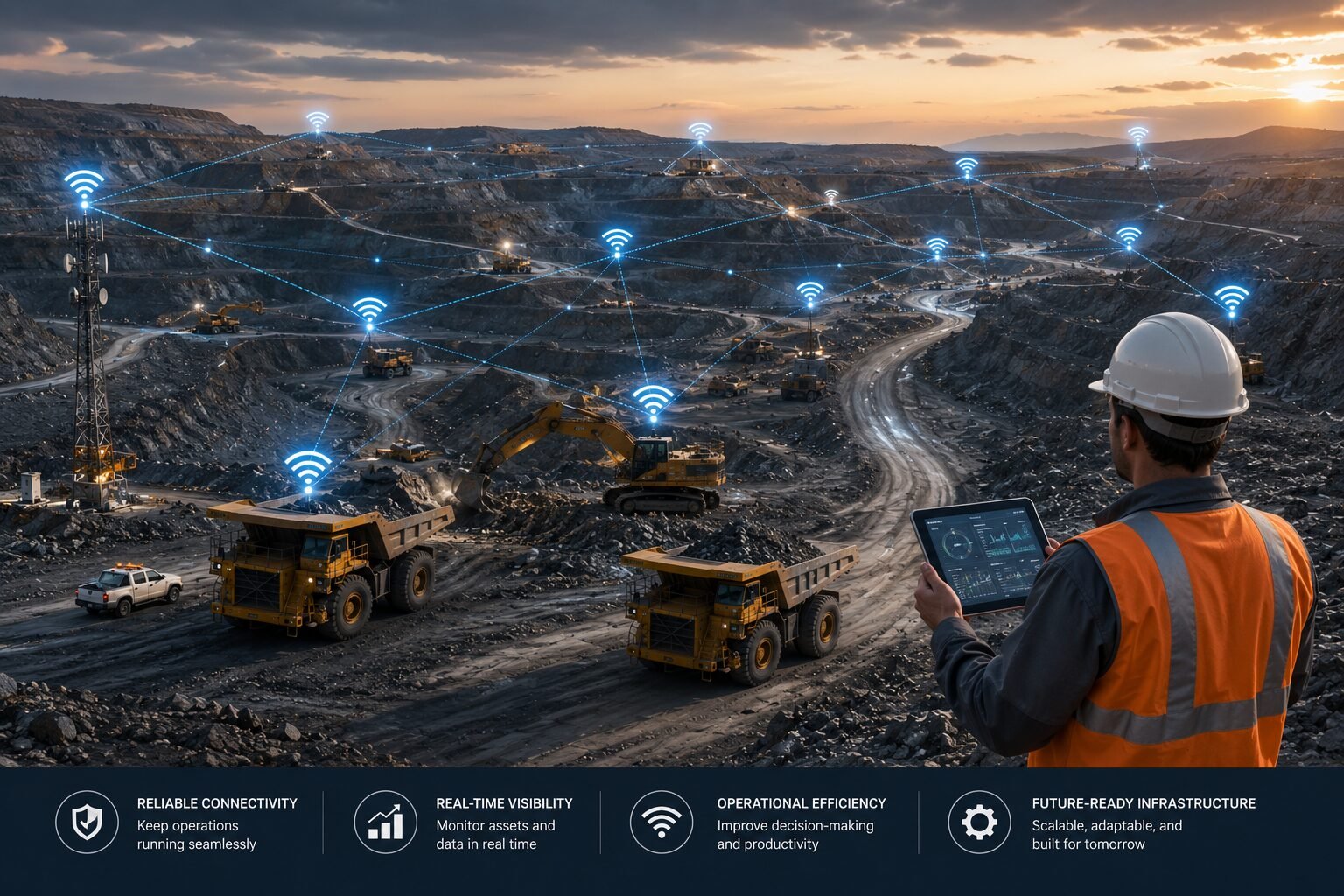
Reliable connectivity is becoming a fundamental part of modern open-pit mining. From fleet management and telemetry to video monitoring and worker communications, digital mining applications depend on a network that can operate across large, dynamic environments.
Mesh WiFi for mine operations provides an adaptable approach by connecting multiple wireless nodes and supporting connectivity across changing operational areas. Its potential benefits include improved mobility support, network resilience, easier expansion, reduced cabling requirements, and better support for connected mining applications.
For mining organizations, the goal should not simply be to deploy more Wi-Fi. The objective is to build a wireless infrastructure that can remain reliable as the mine itself changes.
Frequently Asked Questions
Mesh WiFi for mine operations uses connected wireless nodes to extend coverage across large, changing mining areas. It supports mobile equipment, field teams, sensors, and systems.
It enables fleet management, telemetry, video monitoring, worker communication, and IoT across large mine sites.
Yes. They support trucks, excavators, and other mobile equipment with tracking, telemetry, dispatch, and monitoring.
They offer flexibility, multiple connection paths, easier expansion, and less cabling in changing mine environments.
They should assess terrain, coverage, interference, bandwidth, latency, node placement, and future expansion needs.