Introduction
Surface mining operations rely on continuous coordination between haul trucks, excavators, dozers, graders, and control rooms. However, maintaining reliable communication across vast mining sites remains a significant challenge. Network dead zones, delayed telemetry, and unstable connectivity can reduce fleet visibility, impact productivity, and increase operational risks.
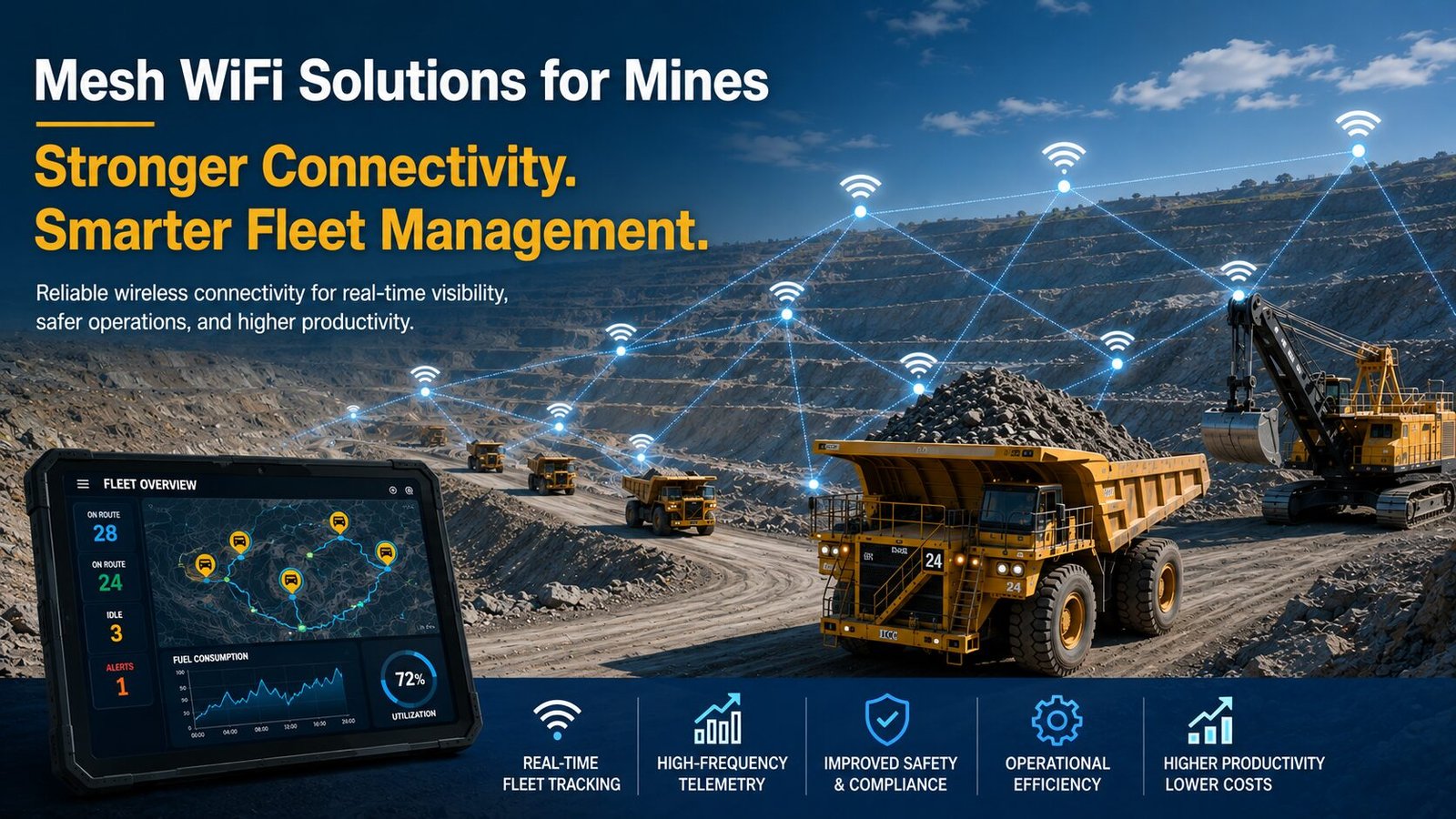
Mesh WiFi solutions for mines address these challenges by creating a resilient wireless network that provides seamless connectivity across dynamic mining environments. Unlike traditional point-to-point or cellular-dependent networks, wireless mesh technology enables vehicles, personnel, and operational systems to remain connected even as equipment moves throughout the mine.
This article explains how wireless mesh networking supports fleet management, the operational benefits it delivers, practical deployment considerations, and why it has become an essential component of modern digital mining operations.
What Are Mesh WiFi Solutions for Mines?
Mesh WiFi solutions for mines are industrial wireless networks built using interconnected wireless nodes that communicate with one another instead of relying on a single central access point. Each node acts as both a client and a router, automatically forwarding data through the most efficient available path.
This self-organizing architecture makes the network highly resilient, allowing communication to continue even if one connection is temporarily interrupted.
In surface mining environments, mesh Wi-Fi can provide reliable connectivity for:
- Fleet management systems
- Dispatch applications
- High-frequency vehicle telemetry
- Equipment health monitoring
- CCTV and surveillance
- Personnel communication
- Environmental monitoring sensors
- Autonomous and semi-autonomous mining equipment
Because the network automatically adapts to changing conditions, it is particularly suitable for mines where roads, excavation areas, and equipment locations constantly change.
Challenges of Wireless Connectivity in Surface Mining
Maintaining dependable communication across a surface mine is more complex than deploying a conventional enterprise Wi-Fi network.
Constantly Changing Mine Layout
Mining operations continuously evolve as excavation progresses. Haul roads are relocated, benches expand, and equipment frequently changes position. Fixed communication infrastructure often struggles to keep pace with these changes.
Large Operational Areas
Surface mines can span several square kilometres. Providing continuous wireless coverage across such vast areas requires a network that can easily expand without extensive cabling.
Harsh Environmental Conditions
Dust, heavy rainfall, vibration, and extreme temperatures can affect communication equipment. Industrial networking infrastructure must be designed specifically for these demanding conditions.
Mobile Fleet Operations
Haul trucks and service vehicles constantly move throughout the mine. Maintaining uninterrupted communication during movement is essential for fleet tracking and operational coordination.
These challenges make traditional wireless architectures less effective, increasing the demand for wireless networking solutions for mining industry applications that offer flexibility and resilience.
How Mesh WiFi Solutions Improve Fleet Management
Reliable connectivity directly influences the performance of modern fleet management systems.
Continuous Vehicle Connectivity
Wireless mesh networks allow moving vehicles to transition seamlessly between network nodes without interrupting communication.
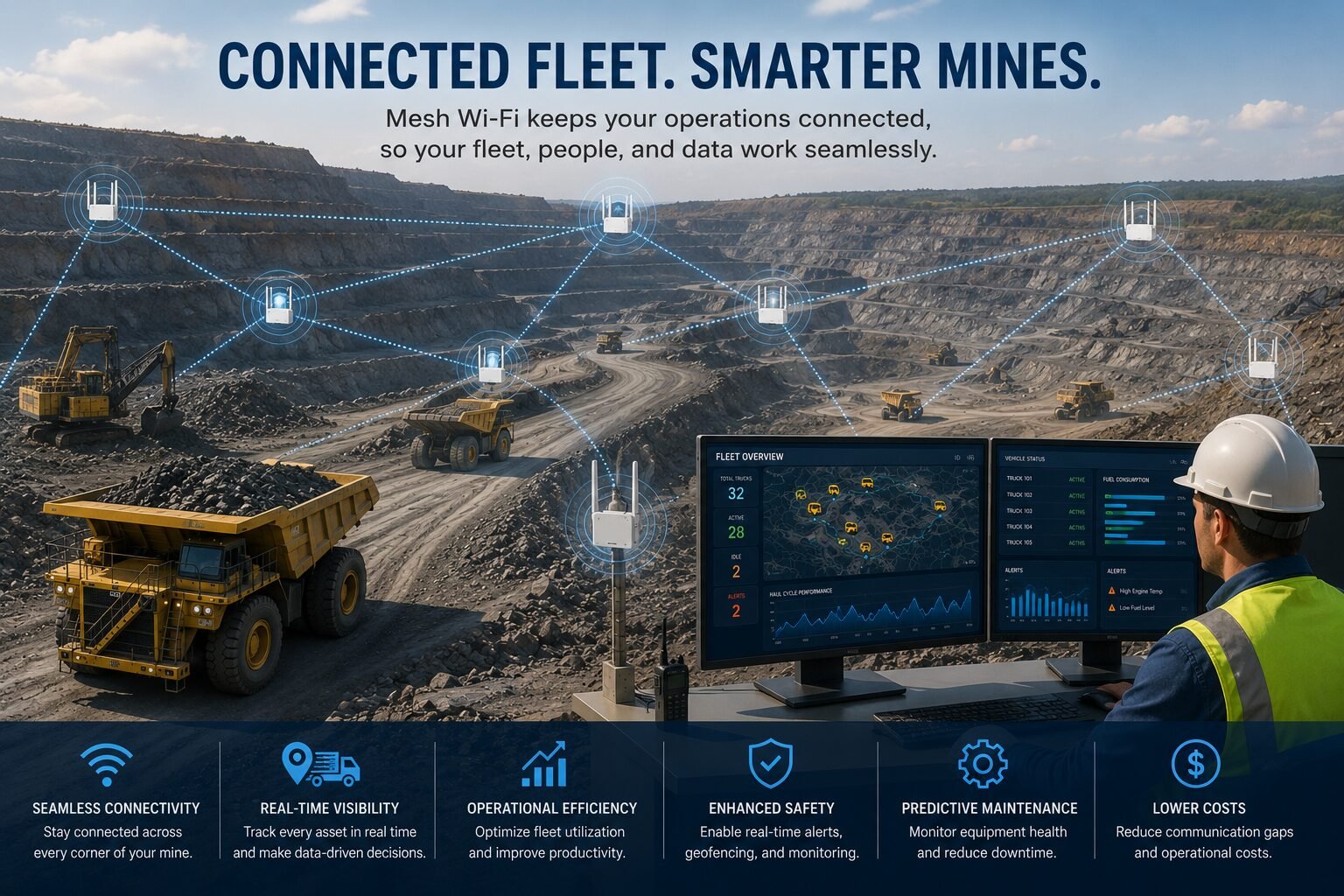
As haul trucks travel between loading zones, haul roads, crushers, and dump sites, telemetry remains uninterrupted, ensuring operational data continues flowing to dispatch systems.
High-Frequency Telemetry
Modern fleet management platforms rely on frequent data updates to make operational decisions.
With stable mesh connectivity, vehicles can transmit:
- GPS location
- Speed
- Fuel consumption
- Payload information
- Engine diagnostics
- Operator status
- Maintenance alerts
More frequent telemetry enables dispatch teams to make faster and better-informed decisions.
Reduced Communication Blackspots
Traditional wireless systems may create coverage gaps when vehicles move beyond the range of a single access point.
Mesh networks overcome this limitation by dynamically routing traffic through neighbouring nodes, reducing communication interruptions across the mining site.
Improved Dispatch Efficiency
Accurate, real-time fleet visibility enables dispatchers to:
- Allocate trucks more efficiently
- Reduce equipment idle time
- Minimize queue formation
- Improve haul cycle consistency
The result is smoother fleet coordination throughout daily mining operations.
Operational Benefits Beyond Fleet Visibility
Reliable wireless infrastructure supports far more than vehicle tracking.
Improved Equipment Utilization
Real-time operational data allows supervisors to identify underutilized equipment and optimize fleet allocation throughout each shift.
Better equipment utilization often leads to improved production efficiency without increasing fleet size.
Faster Maintenance Response
Continuous telemetry allows maintenance teams to detect equipment abnormalities before they develop into major failures.
Instead of reacting after a breakdown occurs, maintenance can often be scheduled during planned downtime, reducing production interruptions.
Enhanced Safety
Reliable connectivity supports various safety applications, including:
- Vehicle-to-vehicle awareness
- Emergency communication
- Geofencing
- Operator monitoring
- CCTV streaming
- Personnel tracking
These capabilities improve situational awareness across the mining site.
Scalability for Future Operations
As mining operations expand, additional mesh nodes can be installed with minimal disruption.
This flexible architecture allows the network to grow alongside mine development without requiring a complete redesign.
Real-World Applications in Surface Mining
Modern wireless networking solutions for mining industry environments support multiple operational systems simultaneously.
Fleet Management
Fleet management systems rely on continuous communication between vehicles and central dispatch to optimize productivity and reduce delays.
Predictive Maintenance
Equipment health data collected through connected sensors enables predictive maintenance strategies that reduce unexpected failures.
Video Surveillance
Wireless mesh networks support IP cameras positioned across haul roads, fuel stations, workshops, and perimeter areas.
Autonomous Mining
Autonomous and semi-autonomous vehicles require reliable, low-latency communication to safely operate across large mining environments.
Environmental Monitoring
Connected sensors can monitor dust levels, weather conditions, water quality, and other environmental parameters, helping mines maintain regulatory compliance.
Best Practices for Deploying Mesh WiFi Solutions for Mines
Successful deployment requires careful planning rather than simply installing wireless equipment.
Perform a Detailed Site Survey
Understanding terrain, elevation changes, haul road layouts, and equipment movement helps determine optimal node placement.
Use Industrial-Grade Hardware
Mining environments require networking equipment designed to withstand dust, vibration, moisture, and extreme temperatures.
Design for Redundancy
Multiple communication paths improve network resilience and minimize service interruptions if one node becomes unavailable.
Plan for Future Expansion
Mining operations evolve over time. Designing the network with scalability in mind allows new operational areas to be integrated efficiently.
Monitor Network Performance
Continuous monitoring helps identify congestion, signal degradation, and hardware issues before they affect fleet operations.
Conclusion
Reliable communication has become a critical requirement for efficient surface mining operations. From real-time fleet tracking and equipment diagnostics to safety applications and predictive maintenance, every connected system depends on stable wireless infrastructure.
Mesh WiFi solutions for mines provide the flexibility, resilience, and scalability needed to support modern fleet management across large and constantly changing mining environments. By reducing communication interruptions, enabling high-frequency telemetry, and supporting operational visibility, mesh networking helps mining organizations improve productivity, enhance safety, and prepare for increasingly digital operations.
As mines continue adopting automation and data-driven decision-making, investing in robust wireless infrastructure will remain a key foundation for long-term operational success.
Frequently Asked Questions
Mesh WiFi solutions for mines use interconnected wireless nodes that automatically route data through multiple paths. This provides reliable connectivity across large mining sites, ensuring fleet management systems, telemetry, and operational applications remain connected even as equipment moves.
Wireless networking solutions for mining industry applications provide real-time communication between equipment, operators, and control centres. Reliable connectivity improves fleet coordination, supports predictive maintenance, enhances safety, and enables efficient data collection across large mining operations.
Mesh Wi-Fi enables continuous vehicle connectivity, high-frequency telemetry, and seamless roaming between network nodes. This allows dispatch teams to monitor equipment in real time, reduce communication gaps, improve truck utilization, and optimize haul cycle efficiency.
Yes. Mesh networks provide the reliable, low-latency communication required for autonomous and semi-autonomous mining equipment. Their self-healing architecture helps maintain connectivity even when network paths change due to equipment movement or environmental conditions.
Yes. One of the biggest advantages of mesh WiFi solutions for mines is scalability. Additional wireless nodes can be integrated into the network as mining operations expand, providing coverage without redesigning the entire communication infrastructure.