
Industrial operations rely on uninterrupted connectivity to support automation, monitoring, communication, and data exchange. Whether it’s a manufacturing plant, mining site, warehouse, or logistics hub, selecting the right wireless architecture directly impacts network performance and operational efficiency. Choosing the wrong solution can lead to limited coverage, network congestion, or costly downtime.
Among the available options, a mesh WiFi router has become increasingly popular for environments that demand flexibility and resilience. However, point-to-point (PtP) and point-to-multipoint (PtMP) networks also offer significant advantages depending on the application. This guide explains how these three wireless networking architectures differ, where each excels, and how to determine the best fit for your industrial environment.
Understanding Point-to-Point, Point-to-Multipoint and Mesh WiFi Router Networks
Wireless network architectures are designed to meet different connectivity requirements. Understanding how each works is the first step toward selecting the right solution.
Point-to-Point (PtP)
A point-to-point network creates a dedicated wireless connection between two locations. It functions like a direct bridge, making it ideal for connecting two buildings, remote control rooms, or production facilities across long distances.
Its simplicity and dedicated bandwidth make it reliable, but communication is limited to just two endpoints.
Point-to-Multipoint (PtMP)
Point-to-multipoint networking enables one central access point to communicate with multiple remote devices. This architecture reduces infrastructure costs while efficiently connecting several locations within a facility.
However, because all remote devices rely on a single central node, network performance can be affected if the central device becomes overloaded or experiences failure.
Mesh Networks
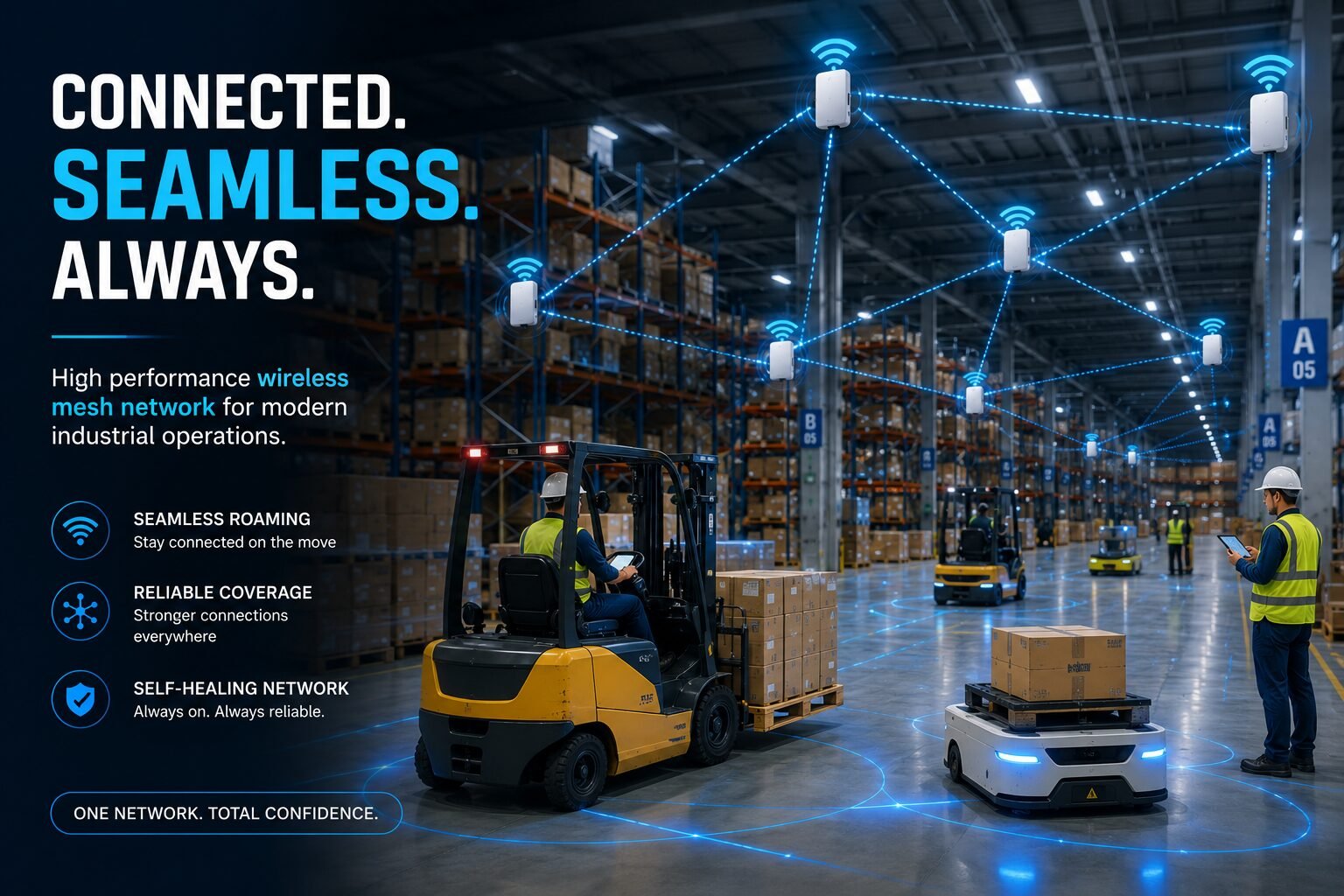
A mesh network consists of multiple interconnected wireless nodes that communicate with one another. Instead of relying on a single communication path, data automatically selects the most efficient available route.
A mesh WiFi router enables this architecture by creating multiple communication paths, improving network reliability and allowing the network to continue operating even if one node fails.
Comparing Network Architectures for Industrial Environments
Each wireless architecture serves different operational requirements.
| Feature | Point-to-Point | Point-to-Multipoint | Mesh Network |
| Coverage | Two locations | Multiple endpoints | Wide-area coverage |
| Scalability | Limited | Moderate | Excellent |
| Reliability | High | Moderate | Very High |
| Redundancy | None | Limited | Multiple paths |
| Failure Recovery | Manual | Centralised | Automatic self-healing |
| Expansion | Difficult | Moderate | Simple |
| Best Applications | Building links | Campus distribution | Large industrial sites |
While PtP and PtMP are effective for fixed communication paths, mesh networks provide greater flexibility for complex industrial environments where layouts and operational demands frequently change.
Why a Mesh WiFi Router Is Ideal for Industrial Connectivity
Industrial facilities often contain machinery, storage racks, metal structures, moving vehicles, and constantly changing work environments. These conditions can disrupt wireless communication if the network lacks redundancy.
A mesh WiFi router addresses these challenges by creating a dynamic network capable of adapting to changing conditions.
Self-Healing Network
When one wireless node becomes unavailable, traffic is automatically redirected through another available path. This self-healing capability helps maintain continuous connectivity without manual intervention.
High Speed Roaming
Large facilities often require workers, forklifts, automated guided vehicles (AGVs), or inspection robots to remain connected while moving.
With High speed roaming, devices transition seamlessly between mesh nodes without noticeable interruptions, ensuring continuous communication for real-time applications.
High Performance Wireless Mesh Network
A High performance wireless mesh network distributes traffic across multiple nodes rather than relying on a single communication point.
This improves bandwidth utilisation, reduces congestion, and supports latency-sensitive industrial applications such as video surveillance, machine monitoring, and industrial IoT systems.
Scalability
Industrial operations rarely remain static. New production lines, warehouses, or operational areas often require additional connectivity.
Mesh networks allow organisations to expand coverage simply by adding new wireless nodes without redesigning the entire network.
Choosing the Right Architecture for Different Industrial Applications
Different environments have different connectivity requirements.
Manufacturing Plants
Manufacturing facilities benefit from mesh networking because machinery layouts frequently change. Continuous wireless connectivity supports production monitoring, quality control, and industrial automation.
Warehouses
Warehouses require uninterrupted connectivity for handheld scanners, inventory systems, autonomous vehicles, and warehouse management software.
A mesh architecture ensures consistent wireless coverage throughout storage aisles and loading areas.
Mining Operations
Mining environments present challenging terrain and constantly changing infrastructure.
Mesh networking enables reliable communication across open-pit mines, underground tunnels, mobile equipment, and temporary operational zones where traditional wireless infrastructure may struggle.
Ports and Logistics Facilities
Ports operate across large outdoor areas with moving vehicles, cranes, and shipping containers that can obstruct wireless signals.
Mesh networking provides resilient coverage while supporting operational systems, surveillance, and fleet communication.
Utility and Smart Infrastructure
Power plants, substations, renewable energy facilities, and municipal infrastructure often require communication across distributed assets.
Depending on the deployment, PtP links may connect remote facilities, while mesh networks provide reliable local connectivity across operational sites.
Best Practices for Selecting the Right Wireless Network
Choosing the right architecture depends on operational goals rather than simply selecting the newest technology.
Consider the following factors:
- Assess current and future coverage requirements.
- Evaluate how frequently the environment changes.
- Consider redundancy requirements for mission-critical operations.
- Plan for future expansion and additional devices.
- Account for physical obstructions that may affect wireless signals.
- Ensure the network supports industrial mobility and High speed roaming.
- Prioritise solutions that minimise downtime and simplify maintenance.
For organisations operating across dynamic industrial environments, a High performance wireless mesh network often provides the greatest balance between reliability, scalability, and operational flexibility.
Conclusion
Point-to-point, point-to-multipoint, and mesh networks each play an important role in industrial wireless connectivity. Point-to-point links offer dedicated communication between two locations, while point-to-multipoint networks efficiently connect multiple endpoints through a central device.
However, for large industrial facilities that require resilience, scalability, mobility, and continuous communication, a mesh WiFi router provides significant advantages. Its self-healing capabilities, support for High speed roaming, and ability to create a High performance wireless mesh network make it well suited for modern manufacturing plants, warehouses, mining operations, ports, and other demanding industrial environments.
Selecting the appropriate architecture based on operational requirements ensures a reliable wireless infrastructure that can support today’s applications while remaining ready for future expansion.
A mesh WiFi router creates a wireless network using multiple interconnected nodes instead of relying on a single access point. This improves coverage, reliability, and network resilience, making it ideal for large industrial and enterprise environments.
Point-to-point networks connect only two locations using a dedicated wireless link. Mesh networks connect multiple nodes, allowing data to travel through different paths. This provides redundancy and reduces the impact of individual node failures.
High speed roaming enables wireless devices to move between access points without losing connectivity. It is particularly important for mobile equipment, autonomous vehicles, and handheld devices operating across large industrial facilities.
Industries should choose a High performance wireless mesh network when they require extensive coverage, high reliability, automatic failover, and support for mobile devices operating across complex or changing environments.