General

Self-Healing & Self-Tuning: The Future of Intelligent WiFi Mesh Networks
22 August 2025 By Aeromesh Team In General
Introduction In today’s always-connected world, downtime is unacceptable. Whether it’s a mining operation running autonomous trucks, a manufacturing plant depending on robotic systems, or a city powering smart infrastructure — network disruptions can cost millions. This is why intelligent WiFi mesh networks with self-healing and self-tuning capabilities are becoming the gold standard. Unlike traditional hotspot-based setups, these networks adapt, recover, and optimize themselves automatically — delivering uninterrupted performance across even the largest deployments. What Does Self-Healing Mean in Wireless Mesh Networks? A self-healing mesh network has the ability to automatically detect failures and reroute traffic through alternative paths. For example: If one node goes down due to power loss, interference, or equipment failure, the system immediately finds another route. Data packets travel seamlessly via neighboring nodes, ensuring zero downtime for users. This creates a resilient wireless mesh network that doesn’t depend on manual intervention to recover. What Is Self-Tuning in WiFi Mesh Networks? Self-tuning refers to the network’s ability to continuously monitor performance and make automatic adjustments. Self-tuning functions include: Scanning available channels and frequencies to avoid interference Selecting the best-performing path for data transmission Balancing load across multiple radios for optimal throughput Minimizing latency by choosing shortest routes dynamically The result: a mesh network that is always optimized, without engineers needing to manually adjust settings. Why Self-Healing & Self-Tuning Are Game-Changers 1. Continuous Connectivity: Unlike traditional WiFi hotspots that collapse when a link fails, multi-hop mesh networks with self-healing keep users connected even in the face of outages. 2. Lower Operational Costs: Service providers don’t need to rush teams to fix every issue. The network handles small failures on its own, reducing manpower costs significantly. 3. High Performance Across Multiple Hops: With multi-radio access points, self-tuning ensures performance remains strong even across 10+ hops — something impossible in older systems. 4. Ideal for Harsh Environments: Industries like mining, seaports, and manufacturing plants demand networks that can handle tough conditions. Self-healing and self-tuning make these deployments reliable and worry-free. Real-World Applications of Intelligent WiFi Mesh Networks Municipalities & Smart Cities – Keep surveillance cameras, IoT devices, and public WiFi online without interruption. Mines & Oilfields – Ensure autonomous vehicles and equipment remain connected even if some nodes fail. Manufacturing Plants – Maintain connectivity for robots and IoT sensors without human troubleshooting. Seaports & Transportation Hubs – Guarantee smooth cargo tracking and logistics with resilient connectivity. Large Enterprises & Campuses – Deliver the best mesh WiFi experience to thousands of employees. Choosing the Best Mesh WiFi Solution with Self-Healing & Self-Tuning When evaluating a mesh WiFi router or mesh network solution, make sure it supports: Multi-hop wireless mesh with dedicated radios Cloud controller integration for easy scaling Built-in self-healing and self-tuning intelligence Mesh WiFi extenders designed for enterprise-grade deployments Conclusion The days of fragile hotspot-based WiFi are over. To power smart cities, industrial operations, and enterprise campuses, you need an intelligent WiFi mesh network that is both self-healing and self-tuning. By automatically recovering from failures and constantly optimizing performance, these networks deliver unmatched reliability, lower operational costs, and the scalability needed for the future. If you’re searching for the best mesh network solution for your business, make sure self-healing and self-tuning are at the top of your checklist.
The Secret Behind High-Performance Mesh Networks: Multi-Radio Access Points Explained
21 August 2025 By Aeromesh Team In General
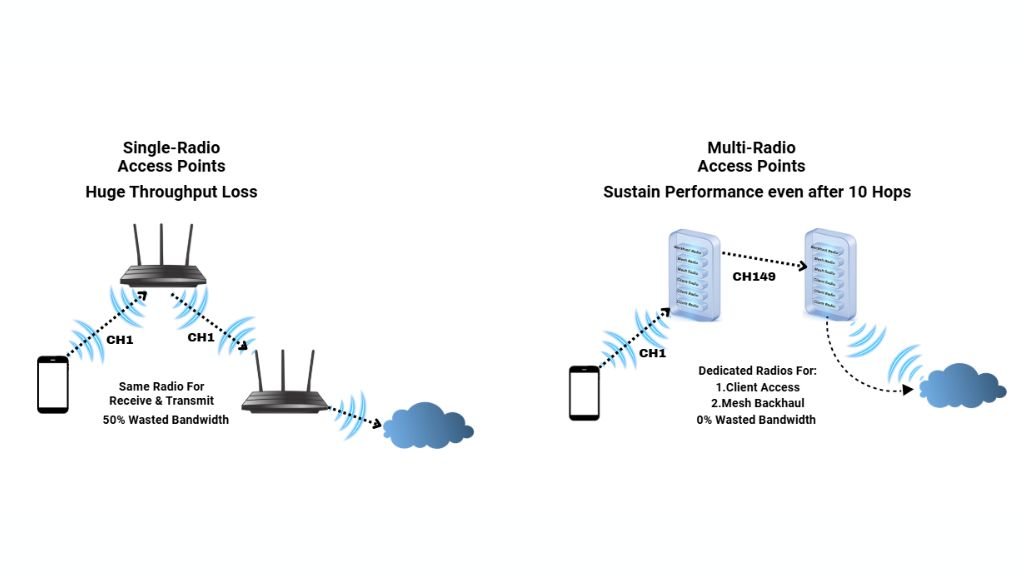
Introduction When it comes to WiFi mesh networks, not all systems are built the same. Many businesses and municipalities make the mistake of thinking that a standard WiFi router or a basic mesh WiFi extender is enough to build a high-performing mesh network. The reality? For true enterprise-grade performance, you need something more advanced: multi-radio access points. These purpose-built devices form the backbone of multi-hop wireless mesh networks, enabling higher throughput, lower latency, and seamless scalability. Let’s explore why multi-radio access points are the secret to the best mesh WiFi performance. Single-Radio vs Multi-Radio: What’s the Difference? High-Performance Mesh Networks Multi-Radio Access Points Explained Single-Radio Access Points One radio handles both backhaul traffic (communication between nodes) and subscriber traffic (internet access for users). Performance drops as more hops are added, since bandwidth gets divided. Suitable only for small home setups — not for municipalities, mining, or enterprise environments. Multi-Radio Access Points Dedicated radios for backhaul: Maintain strong links between mesh nodes. Dedicated radios for client access: Deliver consistent high-speed internet to subscribers. Optional third or fourth radios: Used for monitoring, interference avoidance, or specialized frequency bands. This separation ensures that backhaul performance isn’t compromised by end-user demand. Why Multi-Radio Access Points Matter in Multi-Hop Mesh 1. Sustained High Performance Across Multiple Hops With single-radio systems, performance deteriorates after just 2–3 hops. But with multi-radio mesh, networks can scale up to 10+ hops while still maintaining high throughput. 2. Lower Latency for Mission-Critical Applications In industries like manufacturing, ports, and mining, low-latency communication is vital. Dedicated radios keep delays minimal, ensuring real-time responsiveness. 3. Scalability Without Bottlenecks Multi-radio setups allow providers to keep adding nodes without worrying about congestion. This is what makes them the best mesh network choice for large-scale deployments. 4. Enhanced Reliability Through Redundancy Since radios are separated, the system can intelligently reroute traffic in case of failures — a key feature of self-healing mesh networks. Real-World Benefits of Multi-Radio Access Points Municipalities & Smart Cities – Deliver city-wide WiFi without fiber dependency. Mining Sites – Provide coverage for vehicles and equipment spread across wide areas. Ports & Logistics Hubs – Keep cargo and transportation systems connected at all times. Enterprises & Campuses – Ensure seamless, high-speed internet for thousands of users. In each of these environments, using just a best mesh router or extender wouldn’t be enough — multi-radio access points are essential. How to Choose the Best Mesh WiFi Solution When evaluating mesh networking equipment, look for: Multi-radio support (minimum dual-radio, ideally tri-radio for backhaul + client separation) Cloud controller compatibility for easy configuration and scalability Self-healing and self-tuning features to minimize downtime Proven performance in multi-hop environments Conclusion If you’re serious about building a high-performance wireless mesh network, the answer is clear: multi-radio access points. They eliminate the bottlenecks of single-radio systems, unlock true multi-hop mesh capabilities, and deliver the best mesh WiFi experience for enterprises, municipalities, and industrial operations alike. Stop relying on consumer-grade routers — invest in intelligent WiFi mesh networks designed for scalability, reliability, and long-term success.

Why Multi-Hop Wireless Mesh Networks Outperform Traditional Hotspot
20 August 2025 By Aeromesh Team In General
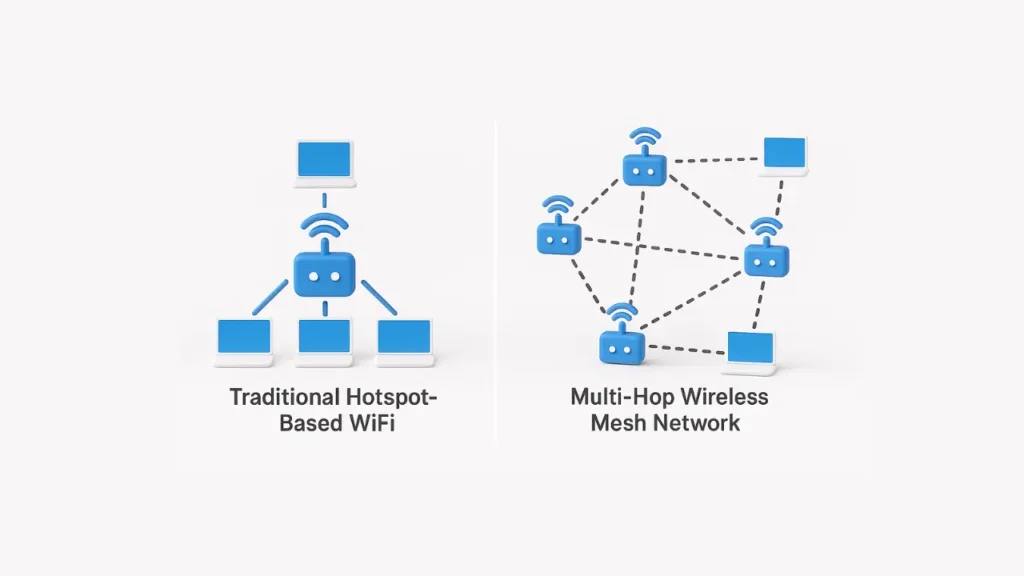
Introduction As municipalities, enterprises, and industrial facilities grow more dependent on connectivity, the limitations of traditional hotspot-based WiFi services are becoming painfully clear. High deployment costs, unreliable coverage, and scalability issues make hotspot-based models unsuitable for modern demands. Enter the multi-hop wireless mesh network — a smarter, more resilient, and future-proof solution. With features like self-healing, self-tuning, and intelligent WiFi mesh networking, these systems deliver superior performance compared to legacy setups. What Is a Traditional Hotspot-Based WiFi Network? A hotspot-based WiFi service typically connects each access point directly to the fiber backbone. This means that every new installation requires: Running fiber to the new site Securing approvals and permits Dealing with high labor and infrastructure costs For municipalities or large enterprises, this process is slow, expensive, and difficult to scale. Why Traditional WiFi Hotspots Fall Short Despite being widely used, hotspot networks have major drawbacks: Limited scalability – Adding coverage requires more fiber High deployment costs – Civil works, permits, and manpower add delays Vulnerability to outages – Fiber cuts or node failures disrupt services High operational overheads – Manual intervention is often needed to fix issues Simply put: a normal WiFi router or hotspot model isn’t enough to deliver high-performance enterprise-grade connectivity. What Is a Multi-Hop Wireless Mesh Network? A wireless mesh network is a decentralized architecture where each access point connects not only to users, but also to neighboring nodes. Instead of relying on a single fiber-fed hotspot, multi-hop mesh networks allow data to travel through multiple access points before reaching the internet or cloud. Key elements include: Multi-radio access points – Some radios dedicated for backhaul (mesh links), others for subscriber access Distributed intelligence – Each node scans its surroundings and chooses the best available route Cloud-based controllers – Automate configuration and ensure easy onboarding of new nodes Concept of multi-hop wireless mesh networks Advantages of Multi-Hop Wireless Mesh Over Hotspot-Based Networks 1. Self-Healing for Continuous Connectivity: If one node fails due to power loss or interference, the mesh automatically reroutes data through alternate paths. This self-healing ability keeps the network running without manual intervention. 2. Self-Tuning for Peak Performance: Mesh nodes constantly monitor surroundings and self-tune connections for best throughput and lowest latency. Subscribers always get the most optimal service without service provider intervention. 3. Faster & Cheaper Deployments: No need to lay fiber for every node. With WiFi mesh networking, providers can rapidly expand coverage in municipalities, campuses, and industrial sites by simply powering up new access points. 4. Scalability Across 10+ Hops: With dedicated backhaul radios, multi-hop wireless mesh networks can maintain high performance across 10 or more hops, something impossible with traditional hotspot setups. 5. Lower Operational Costs: Since the network is self-healing and self-tuning, providers don’t need to dispatch teams for every outage or performance issue. This reduces OPEX significantly. Real-World Applications of Multi-Hop Mesh Networks multi-hop wireless mesh networks: smart cities, mining, manufacturing, seaports, and large campuses. Municipalities & Smart Cities – Public WiFi, CCTV, and IoT sensors Mining Operations – Reliable connectivity across large, remote sites Manufacturing Plants – Always-on WiFi for automation, industry 4.0 & robotics Seaports & Logistics Hubs – Real-time tracking of cargo and vehicles Large Enterprises & Campuses – Seamless WiFi without dead zones Conclusion For municipalities, mining operations, seaports, and enterprises, the choice is clear: multi-hop wireless mesh networks deliver a level of scalability, resiliency, and cost efficiency that traditional hotspot-based WiFi services simply cannot match. If you’re looking for the best mesh WiFi solution — one that is intelligent, self-healing, and future-ready — multi-hop wireless mesh networking is the answer.

Mesh WiFi Network Topology vs. Traditional WiFi Network Architectures?
14 August 2025 By Aeromesh Team In General
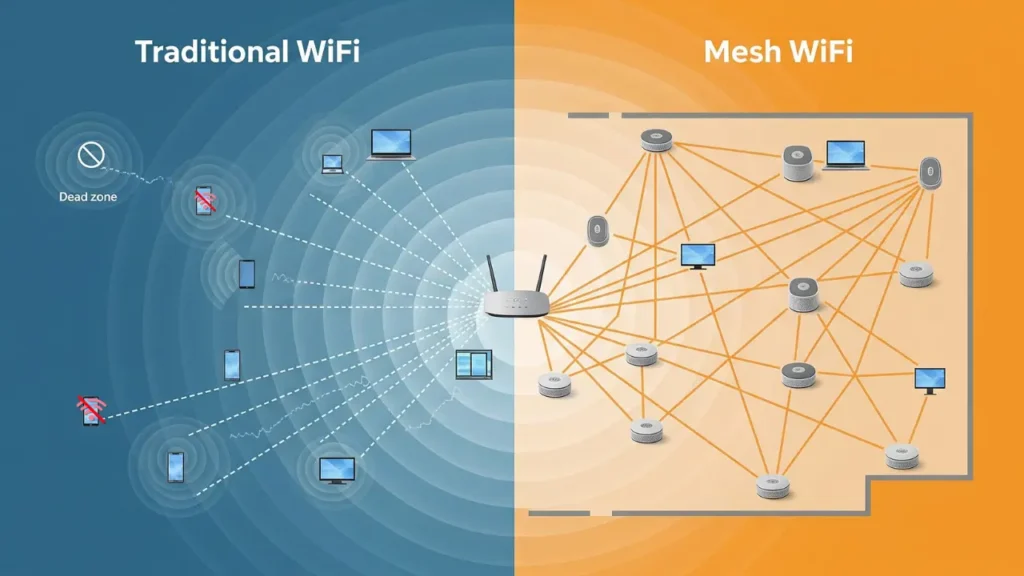
Imagine stepping into your office on a Monday morning only to find that half your team can’t access the company server because your main WiFi router has unexpectedly failed. Meanwhile, your competitor down the street is running smoothly on their Wi-Fi mesh network, which automatically rerouted around a similar issue without anyone noticing. This isn’t just a hypothetical scenario—it’s a reality that distinguishes businesses thriving with modern connectivity from those struggling with outdated systems. The choice often boils down to one key decision: choosing between traditional WiFi architectures and mesh network topology. However, many business owners may not realise they have a choice. They often assume WiFi is simply WiFi, and whatever their IT person installed years ago is still adequate. This assumption could be costing you more than you realise. Understanding Traditional WiFi Networks Let’s be frank about traditional WiFi networks. They served well when your biggest challenge was simply getting laptops online or streaming the occasional video. But today’s business environment is quite different. Traditional WiFi architectures rely on a hub-and-spoke model, connecting everything to one or two central access points. Think of it like having one main water pipe feeding your entire building—when that pipe bursts, everyone goes thirsty. As you add more devices, network performance tends to suffer. That new fleet of tablets for your sales team? They compete with existing computers for the same limited bandwidth from an overworked router. Dead zones can hinder productivity in areas where WiFi mysteriously disappears, as signals can only reach so far from a single source. When something breaks, everything can come to a halt. A single router failure means your entire operation might go offline until someone can repair or replace it. There are no backups or alternatives. Expansion can become costly and complex, as adding WiFi to new areas often requires professional installation and possibly a complete network redesign. The Mesh WiFi Revolution Now, let’s picture a different scenario. Your wireless mesh network consists of multiple interconnected nodes that function together as a team rather than relying on a single point. When one node encounters issues, the others step in to maintain seamless connectivity throughout your business. This isn’t just a theory—it’s how modern businesses gain a competitive edge through reliable connectivity. Each node in your mesh not only extends coverage but also maintains full network capabilities. Your warehouse workers stay connected whether they’re at the loading dock or in the storage area, ensuring broad coverage without dead zones. Instead of crowding around a single access point, devices automatically connect to the nearest, least congested node through automatic load balancing. Your network actually becomes more efficient as you add coverage points. The system provides self-healing reliability; when a node goes offline for maintenance or unexpectedly fails, the network reroutes traffic through alternative paths. Adding coverage to new areas is easy—just plug in additional nodes. There’s no need for rewiring or a complete network redesign, and service interruptions are minimised. Real Business Transformation Consider Sarah, who runs a growing architecture firm. Her traditional WiFi setup worked well when she had 12 employees in a single building. But as her team grew to 30 people across two floors, problems multiplied quickly. Client presentations began failing when too many people joined video calls. The conference room on the second floor became almost unusable due to poor signal strength. Her team even started working from the coffee shop across the street just to access reliable internet. This situation was becoming embarrassing during client meetings and frustrating for her staff. After switching to a wireless mesh network, everything changed overnight. Video conferences now run smoothly, regardless of how many participants join. The entire building has consistent, high-speed coverage from basement storage to second-floor conference rooms. Her team’s productivity soared because they could work effectively anywhere in the office. More importantly, Sarah stopped worrying about network reliability and could refocus on growing her business. She could confidently schedule client presentations, knowing the technology would support her efforts. comparing a traditional WiFi network with a mesh network The Financial Reality Behind the Decision Let’s talk numbers, as your CFO will definitely want to know. Traditional WiFi networks may seem cheaper at first, but that’s before you consider the costs of lost productivity, emergency IT calls, and expensive expansion projects that seem to arise frequently. A recent study found that businesses lose an average of £5,600 per minute during network outages. For most companies, even a single avoided outage can pay for an entire mesh network upgrade. But the true value lies not just in preventing disasters—it’s in enabling growth and peace of mind. Mesh networks scale with your business rather than hold it back. You can expand coverage, add locations, and support new technologies without starting from scratch every time your business evolves. Making the Right Choice So, which approach is best for your organisation? The answer depends on your current situation and future goals, but the trends are clear. Traditional WiFi might work if you have a small, stable operation with minimal growth plans, your current network meets all performance needs without issues, budget constraints make upgrades challenging right now, and you rarely face connectivity problems that impact your business. Mesh WiFi topology makes sense when reliable connectivity directly impacts your revenue and customer satisfaction, you’re planning to expand or already serve multiple locations, your team needs consistent performance throughout your facility, and you want to future-proof your infrastructure investment rather than constantly retrofitting. The Competitive Advantage You’re Missing Here’s what many business owners overlook: your network infrastructure is no longer just about internet access. It’s about gaining a competitive advantage in an increasingly connected business landscape. While your competitors wrestle with WiFi dead zones and network outages, you operate seamlessly. While they spend weekends troubleshooting connectivity issues, you focus on strategic initiatives that drive your business forward. Your wireless mesh network becomes an enabler rather than a constraint, supporting your growth instead of limiting it. Think back to the last time your network went down. Remember the stress, the lost productivity, the frustrated customers, and the emergency IT bills? Now, imagine if that simply didn’t happen anymore because your network automatically worked around problems. The Path Forward The question isn’t whether mesh WiFi is technically superior—it often is. The real question is whether the benefits justify the transition for your specific business needs and timeline. Consider this: every day you rely on unreliable traditional WiFi is a day you’re not operating at full potential. Your team, your customers, and your bottom line all suffer when connectivity becomes a bottleneck rather than an enabler. The businesses that will thrive in the coming years will view their network infrastructure as a strategic investment rather than a necessary evil. They will understand that reliable, scalable connectivity is not just about keeping the lights on—it’s about creating a foundation for growth, innovation, and competitive advantage. Ready to explore how mesh WiFi topology could transform your business connectivity? The conversation starts with understanding your unique requirements and growth plans, because the right network infrastructure should accelerate your success, not limit it.