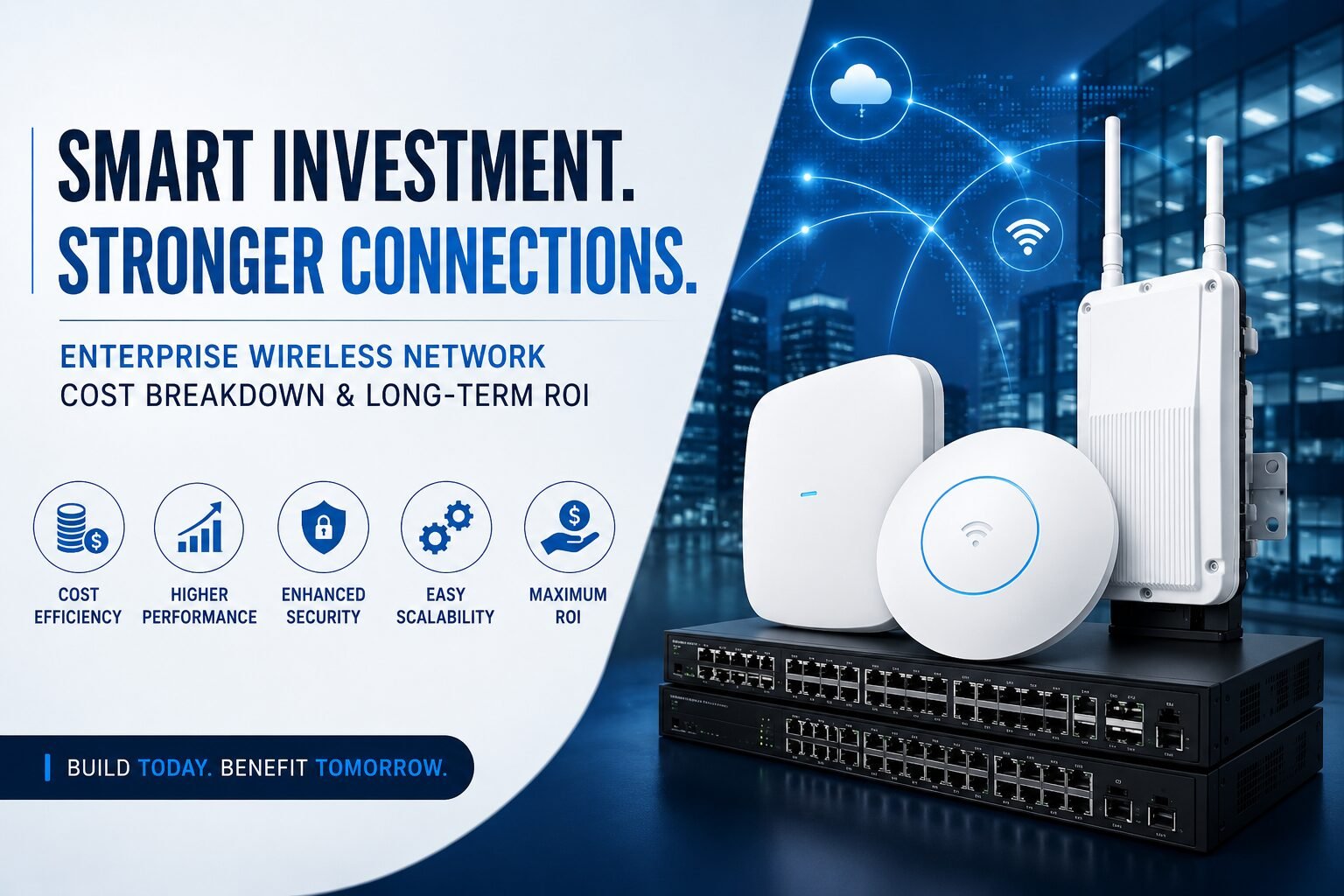
Why Cost Analysis Matters Before Deployment
When organizations plan a wireless network, the initial hardware price often receives the most attention. However, the total investment includes infrastructure, installation, network management, maintenance, and future scalability. Evaluating these costs upfront helps businesses make informed decisions and avoid unexpected expenses later.
A well-designed enterprise wireless network is a long-term investment that supports business growth, improves operational efficiency, and reduces ongoing maintenance costs.
Key Components of Enterprise Wireless Network Costs
1. Network Hardware
Hardware is the foundation of any enterprise wireless deployment. Typical components include wireless access points, point-to-point bridges, antennas, switches, mounting accessories, and power equipment.
Choosing enterprise-grade equipment may require a higher initial investment, but it delivers better reliability, longer product life, and lower replacement costs over time.
2. Network Design and Site Survey
Before deployment, organizations should conduct a professional wireless site survey to determine coverage requirements, interference levels, and equipment placement.
Proper planning reduces dead zones, minimizes signal interference, and avoids expensive redesigns after installation.
3. Installation and Configuration
Installation costs include equipment mounting, cabling, configuration, testing, and system integration.
Experienced deployment teams ensure that the network is optimized for performance and security from day one, reducing future troubleshooting expenses.
4. Security and Network Management
Enterprise wireless networks require continuous monitoring, firmware updates, user authentication, and security management.
Investing in secure network management helps prevent cyber incidents that could result in costly downtime and data loss.
5. Maintenance and Technical Support
Regular maintenance keeps the network operating efficiently throughout its lifecycle.
Typical maintenance costs include:
- Firmware upgrades
- Hardware replacement
- Performance optimization
- Preventive inspections
- Technical support
Routine maintenance is generally far less expensive than recovering from unexpected network failures.
Hidden Costs Businesses Often Overlook
Many organizations focus only on deployment costs while overlooking expenses that affect long-term ownership.
Common hidden costs include:
- Network downtime
- Productivity losses
- Emergency repairs
- Legacy hardware replacement
- Security incidents
- Future network expansion
Planning for these factors helps organizations calculate the true Total Cost of Ownership (TCO).
Understanding Long-Term ROI
The value of an enterprise wireless network extends beyond connectivity. A reliable wireless infrastructure improves daily operations while reducing ongoing operational expenses.
Long-term benefits include:
- Increased employee productivity
- Faster communication across facilities
- Reduced cabling expenses
- Lower maintenance costs
- Simplified network expansion
- Improved operational efficiency
For organizations operating multiple sites, warehouses, manufacturing plants, or campuses, these savings accumulate significantly over the network’s lifespan.
Strategies to Maximize ROI
Invest in Scalable Infrastructure
Select wireless solutions that can support future users, devices, and applications without requiring complete infrastructure replacement.
Businesses expanding across multiple facilities can benefit from secure wireless deployments designed for Industrial Applications, enabling seamless growth while maintaining reliable connectivity.
Choose Enterprise-Grade Equipment
Lower-cost consumer devices often require frequent replacement and provide limited management capabilities.
Investing in reliable WiFi Access Point / Hotspots Series solutions offers centralized management, improved security, better performance, and lower long-term operating costs.
Perform Regular Maintenance
Preventive maintenance, firmware updates, and proactive monitoring help extend equipment life while reducing unexpected repair costs and network downtime.
Monitor Network Performance
Continuous monitoring enables IT teams to identify issues before they impact business operations, improving network reliability and reducing support costs.
Measuring ROI Beyond Financial Savings
While cost reduction is important, enterprise wireless networks also deliver measurable operational value.
Organizations can evaluate ROI through:
- Improved network uptime
- Faster business processes
- Reduced operational disruptions
- Higher employee productivity
- Better customer experiences
- Easier scalability for future expansion
These operational improvements often provide greater long-term value than the initial investment alone.
Conclusion
Enterprise wireless network costs should be evaluated as a long-term business investment rather than a one-time expense. While hardware, deployment, and maintenance contribute to the overall cost, the benefits of improved productivity, reduced downtime, enhanced security, and simplified scalability generate significant long-term returns.
By investing in high-quality infrastructure, planning for future growth, and implementing proactive maintenance strategies, organizations can maximize their return on investment while building a secure and reliable wireless network that supports business success for years to come.
FAQs
The total cost includes hardware, network design, site surveys, installation, security implementation, software management, maintenance, and future expansion. Evaluating these components provides a more accurate estimate of the network's total cost of ownership.
Businesses can maximize ROI by investing in scalable enterprise-grade equipment, conducting proper network planning, performing regular maintenance, monitoring network performance, and implementing strong security practices that reduce downtime and operational costs.
A wireless site survey identifies coverage requirements, interference sources, and optimal equipment placement. This helps prevent connectivity issues, reduces installation errors, and minimizes future redesign costs.
Initial cost covers hardware and installation, while Total Cost of Ownership (TCO) includes ongoing expenses such as maintenance, software updates, technical support, energy consumption, security management, and future upgrades throughout the network's lifecycle.
Enterprise-grade wireless equipment provides higher reliability, stronger security, centralized management, longer product lifespan, and better scalability than consumer-grade devices, resulting in lower maintenance costs and a higher long-term return on investment.