
Why Network Reliability Is Critical in Industrial Operations
Industrial facilities rely on uninterrupted wireless connectivity to support automation systems, surveillance cameras, Industrial IoT (IIoT) devices, mobile workers, and real-time communication. Even a short network interruption can delay production, reduce operational efficiency, and increase maintenance costs.
Traditional wireless networks often depend on a single communication path. If that path fails due to equipment damage, interference, or environmental conditions, connected devices may lose communication. Self-healing mesh networks address this challenge by automatically finding alternative communication routes, keeping critical operations connected.
What Is a Self-Healing Mesh Network?
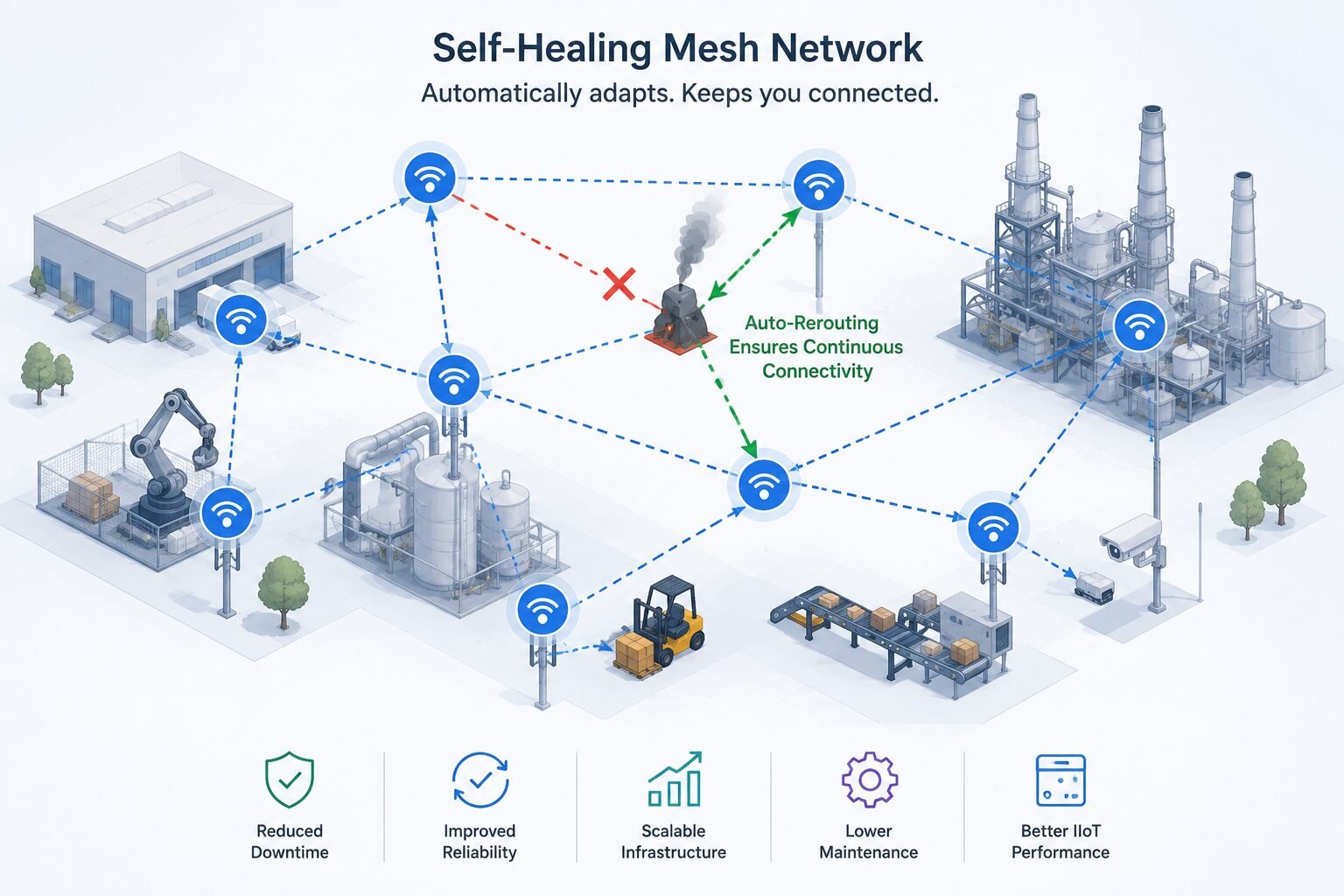
A self-healing mesh network is a wireless architecture where multiple nodes communicate with one another instead of relying on a single central connection. If one node or communication link becomes unavailable, the network automatically reroutes traffic through another available path.
This built-in redundancy enables continuous connectivity without requiring manual intervention, making mesh networks well suited for demanding industrial environments.
Common Causes of Network Failures
Industrial wireless networks face several challenges that can affect performance, including:
- Equipment failure
- Physical obstructions
- Signal interference
- Harsh environmental conditions
- Power outages
- Network congestion
A self-healing mesh network minimizes the impact of these issues by dynamically adjusting routing paths whenever network conditions change.
Benefits of Self-Healing Mesh Networks
Reduced Network Downtime
When a wireless node becomes unavailable, the mesh network automatically establishes an alternative communication path. This helps maintain continuous connectivity and reduces operational downtime.
Improved Network Reliability
Multiple communication paths create redundancy across the network. Instead of depending on a single access point, connected devices can communicate through neighboring nodes, improving overall reliability.
Greater Scalability
As industrial facilities expand, additional mesh nodes can be integrated without redesigning the entire network. This flexibility allows organizations to support more users, devices, and applications while maintaining consistent performance.
Lower Maintenance Costs
Automatic route recovery reduces the need for manual troubleshooting and emergency maintenance. IT teams can focus on proactive network management instead of responding to unexpected connectivity failures.
Better Support for Industrial IoT
Industrial IoT devices require continuous communication for monitoring, automation, and predictive maintenance. Self-healing mesh networks provide the stable connectivity needed to support these mission-critical applications.
Where Self-Healing Mesh Networks Are Used
Self-healing mesh networks are widely deployed across Industrial Applications where uninterrupted wireless communication is essential.
Common use cases include:
- Manufacturing plants
- Underground and open-pit mining
- Warehouses and distribution centers
- Oil and gas facilities
- Ports and transportation hubs
- Utility infrastructure
- Smart city projects
- Large industrial campuses
Choosing the Right Wireless Infrastructure
The performance of a mesh network depends on the quality of the wireless infrastructure. Organizations should deploy enterprise-grade WiFi Access Point / Hotspots Series solutions that offer advanced security, centralized management, and reliable wireless performance in challenging environments.
Enterprise-class wireless equipment also supports easier expansion as business requirements evolve.
Best Practices for Reliable Mesh Network Deployment
To maximize the benefits of a self-healing mesh network:
- Conduct a wireless site survey before deployment.
- Position mesh nodes for optimal coverage.
- Use enterprise-grade networking equipment.
- Secure the network with strong authentication and encryption.
- Monitor network performance continuously.
- Keep firmware updated.
- Plan for future scalability and additional connected devices.
Following these practices helps ensure consistent network performance and long-term reliability.
Conclusion
Self-healing mesh networks provide the resilience needed to support modern industrial operations. By automatically rerouting traffic around failed nodes or disrupted communication paths, they reduce downtime, improve network reliability, and maintain continuous connectivity for mission-critical applications.
As industrial environments continue to adopt automation, Industrial IoT, and real-time monitoring, investing in a self-healing mesh network helps organizations build a scalable and dependable wireless infrastructure that supports long-term operational success.
A self-healing mesh network is a wireless network in which connected nodes automatically reroute data through alternative paths if one node or link fails. This ensures continuous connectivity and minimizes network disruptions.
Self-healing mesh networks continuously monitor network paths and automatically redirect traffic when a node, link, or access point becomes unavailable. This redundancy helps prevent downtime and maintains reliable communication.
Industries such as manufacturing, mining, oil and gas, utilities, logistics, transportation, ports, and smart cities benefit from self-healing mesh networks because they rely on uninterrupted wireless connectivity for mission-critical operations.
Unlike traditional wireless networks that often depend on a single communication path, self-healing mesh networks provide multiple routing paths, greater reliability, automatic failover, easier scalability, and lower maintenance requirements.
Industrial IoT devices require continuous, low-latency communication for monitoring, automation, and predictive maintenance. Self-healing mesh networks help maintain stable connectivity, ensuring critical data is transmitted even if part of the network experiences a failure.