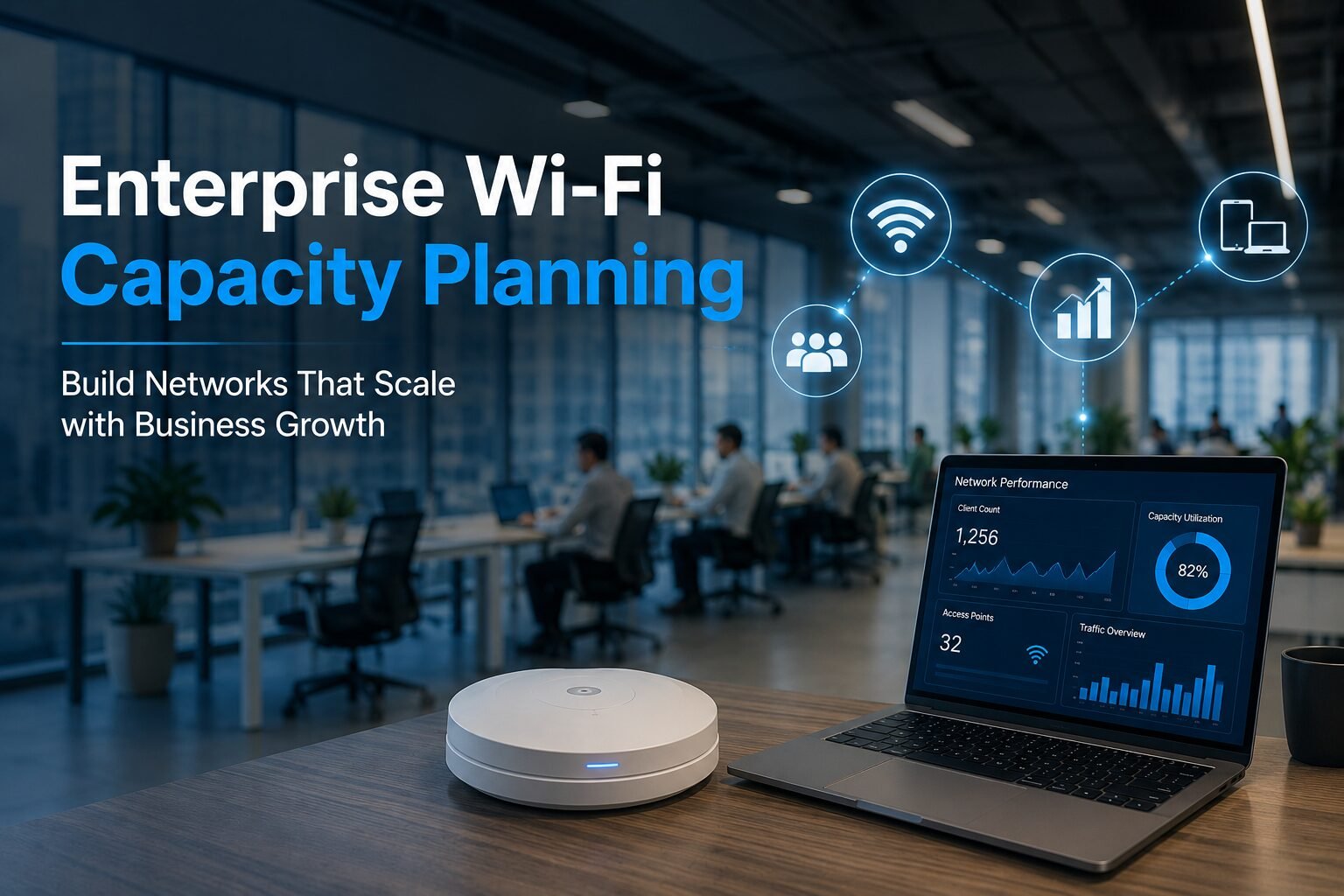
Why Capacity Planning Is Critical
As businesses grow, so does the demand on their wireless network. More employees, connected devices, cloud applications, video conferencing, and Industrial IoT (IIoT) systems all compete for network resources. Without proper capacity planning, organizations may experience slow connections, network congestion, and reduced productivity.
Enterprise Wi-Fi capacity planning ensures that wireless infrastructure is designed to handle current requirements while remaining flexible enough to support future business growth.
What Is Enterprise Wi-Fi Capacity Planning?
Enterprise Wi-Fi capacity planning is the process of determining how much wireless capacity an organization needs based on user density, device count, application requirements, and expected future expansion.
Rather than focusing only on coverage, capacity planning ensures the network can deliver consistent performance even during periods of high demand.
Key Factors That Affect Wi-Fi Capacity
Number of Connected Users
Employee growth directly increases network demand. Capacity planning should account for peak usage rather than average daily activity to maintain reliable performance.
Device Density
Modern workplaces include laptops, smartphones, tablets, IP cameras, wireless printers, sensors, and Industrial IoT devices. Each connected device consumes network resources and should be considered during the planning stage.
Bandwidth-Intensive Applications
Applications such as HD video conferencing, cloud collaboration platforms, surveillance systems, and real-time analytics require higher bandwidth and lower latency. Understanding application requirements helps allocate sufficient network capacity.
Facility Layout
Building materials, machinery, storage racks, and physical obstacles can affect wireless signal distribution. Proper planning ensures access points are positioned to provide balanced coverage and capacity across the facility.
Best Practices for Enterprise Wi-Fi Capacity Planning
Conduct a Professional Site Survey
A detailed wireless site survey identifies coverage requirements, signal interference, and optimal equipment placement. It provides the data needed to build a network that supports both current operations and future expansion.
Choose Scalable Wireless Infrastructure
Deploying enterprise-grade WiFi Access Point / Hotspots Series solutions allows organizations to support increasing numbers of users and connected devices while maintaining centralized management, strong security, and consistent network performance.
Design for Future Business Growth
Businesses should anticipate expansion when planning their wireless infrastructure. Adding new departments, production lines, offices, or connected devices should not require a complete network redesign.
Organizations deploying wireless connectivity across Industrial Applications benefit from scalable network architectures that can support automation, smart manufacturing, warehousing, and remote operations as business needs evolve.
Monitor Network Performance
Capacity planning does not end after deployment. Continuous monitoring helps IT teams identify network congestion, bandwidth bottlenecks, and performance issues before they affect business operations.
Regular performance analysis also helps determine when additional access points or infrastructure upgrades are needed.
Common Capacity Planning Mistakes
Many organizations encounter performance issues because they:
- Plan only for current user requirements.
- Ignore future device growth.
- Underestimate bandwidth-intensive applications.
- Deploy too few access points.
- Skip wireless site surveys.
- Neglect ongoing performance monitoring.
Avoiding these mistakes improves network reliability and reduces future upgrade costs.
Long-Term Benefits of Capacity Planning
A well-planned enterprise Wi-Fi network delivers measurable business value, including:
- Reliable connectivity during peak usage
- Improved employee productivity
- Better support for cloud and IoT applications
- Reduced network downtime
- Lower long-term infrastructure costs
- Easier expansion across multiple facilities
These benefits help organizations maintain operational efficiency while preparing for future technology adoption.

Conclusion
Enterprise Wi-Fi capacity planning is essential for building wireless networks that can grow alongside your business. By understanding user demand, application requirements, device density, and future expansion plans, organizations can create scalable wireless infrastructure that delivers consistent performance and long-term value.
Investing in proper planning, enterprise-grade equipment, and continuous network monitoring ensures businesses remain prepared for increasing connectivity demands while maintaining secure, reliable, and high-performance wireless operations.
Enterprise Wi-Fi capacity planning is the process of designing a wireless network that can support the required number of users, connected devices, and applications while allowing for future business growth without affecting performance.
Capacity planning helps prevent network congestion, slow performance, and connectivity issues by ensuring the wireless infrastructure has sufficient resources to handle current and future network demands.
Businesses should evaluate user density, device count, bandwidth requirements, facility layout, application usage, future expansion plans, and wireless interference when planning network capacity.
Proper capacity planning balances network traffic, reduces congestion, improves wireless coverage, supports high-bandwidth applications, and delivers a consistent user experience across the enterprise.
Industries such as manufacturing, logistics, warehousing, mining, healthcare, education, transportation, utilities, and large corporate campuses benefit from capacity planning because they rely on scalable and reliable wireless connectivity for daily operations.