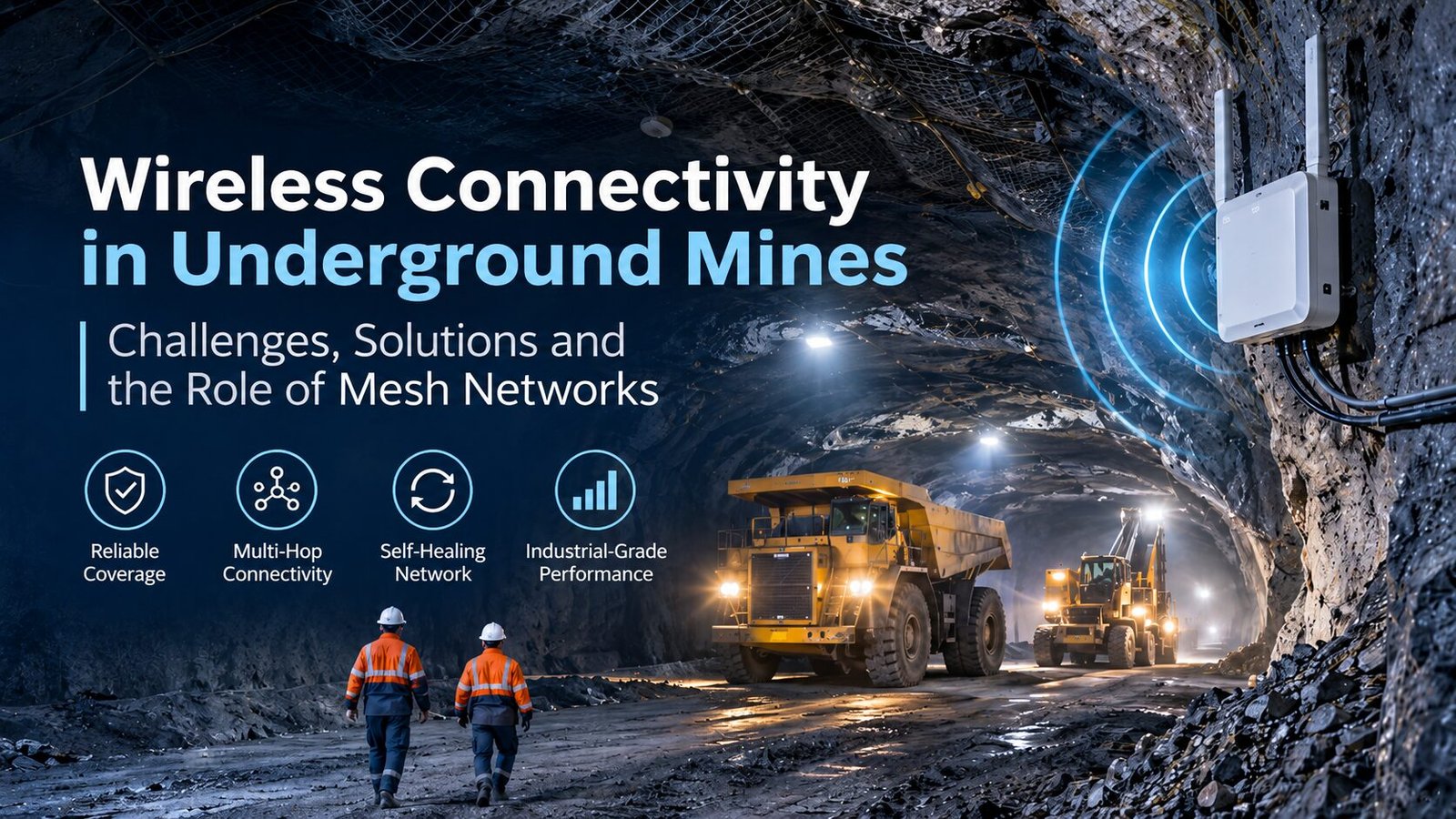
Underground mining operations depend on reliable communication between workers, machinery, control rooms, and surface facilities. However, maintaining consistent wireless connectivity underground is challenging because of tunnels, rock formations, metal equipment, moving machinery, and changing mine layouts. Mesh WiFi for mine environments offers an approach to addressing these challenges through distributed connectivity and multiple communication paths.
As mining operations become increasingly automated and data-driven, reliable wireless infrastructure is essential for equipment monitoring, worker communication, fleet management, and operational safety. This article explores the major connectivity challenges in underground mines, how wireless mesh networks address them, and what engineers should consider when selecting a mining communication solution.
Understanding Mesh WiFi for Mine Connectivity
Mesh WiFi for mine environments uses multiple wireless network nodes to establish interconnected communication paths throughout underground tunnels. Instead of relying on a single access point, mesh nodes communicate with one another and forward data towards the network gateway or connected infrastructure.
This distributed architecture allows network coverage to extend across multiple tunnel sections. When a suitable communication path becomes unavailable, a properly designed mesh network can redirect traffic through an alternative route.
Unlike conventional Wi-Fi deployments that depend heavily on individual access points connected through wired infrastructure, wireless mesh networks can use wireless backhaul to connect distributed nodes.
In underground mines, this architecture can support communication between:
- Underground workers and control rooms.
- Mining vehicles and fleet management systems.
- Sensors and industrial monitoring equipment.
- Automated machinery and remote operating systems.
- Underground cameras and safety monitoring systems.
The effectiveness of a mesh network depends on node placement, radio frequency planning, antenna configuration, tunnel geometry, and the number of available communication paths.
Key Challenges of Wireless Connectivity in Underground Mines
Underground environments create several physical and operational barriers that make conventional wireless networking difficult.
- Radio Frequency Attenuation
Rock formations, geological structures, and underground obstacles can significantly weaken wireless signals. Different rock types, moisture levels, and tunnel conditions affect radio propagation.
Metal surfaces and heavy mining equipment can also absorb, reflect, or obstruct radio frequency signals. This creates coverage gaps and inconsistent connectivity, particularly around machinery and tunnel intersections.
- Complex Tunnel Structures
Underground mines contain narrow passages, bends, junctions, shafts, and multiple working levels. Wireless signals do not always travel effectively around sharp corners or through obstructed tunnel sections.
As mining progresses, tunnel layouts change, making it difficult to maintain consistent coverage using fixed network infrastructure.
- Moving Machinery and Equipment
Dump trucks, drilling machines, loaders, and other heavy equipment constantly move throughout underground operations.
These machines can obstruct wireless signals and change the surrounding RF environment. Maintaining uninterrupted communication with moving equipment therefore requires careful network planning and adequate coverage overlap.
- Difficult Network Expansion and Maintenance
Traditional wired networking often requires extensive cable installation throughout underground tunnels. As mining operations expand, additional cabling, installation work, and maintenance can increase infrastructure complexity.
Damaged cables, difficult access points, and changing tunnel layouts can further complicate network maintenance.
- Network Reliability and Downtime
Communication interruptions can affect equipment monitoring, operational coordination, and remote-control applications.
A network architecture that depends on a single communication path can become a potential point of failure. Underground operations therefore require connectivity infrastructure designed with redundancy and alternative communication paths.
How Wireless Mesh Networks Address Underground Connectivity Challenges
Wireless mesh networks provide a distributed approach to underground communication. Multiple interconnected nodes create a network that can extend coverage across different tunnel sections without requiring a separate wired connection to every node.
Multi-Hop Communication
Multi-hop communication allows data to travel through multiple wireless nodes before reaching its destination. Instead of requiring a direct connection to a central access point, devices can communicate through intermediate nodes.
For example, a mining vehicle operating deep inside a tunnel can send data through nearby mesh nodes. Each node forwards the information towards the network gateway.
This approach helps extend network coverage into areas where direct communication with the surface or central infrastructure is not practical.
Self-Healing Network Architecture
A self-healing mesh network can identify changes in network connectivity and use available alternative paths when a communication link becomes unavailable.
For example, if a mining vehicle or temporary obstruction affects one wireless link, the network may route traffic through another connected node, provided a suitable alternative path exists.
This helps improve network resilience and reduces dependence on individual communication links.
TDMA Within Multi-Hop Networks
Time Division Multiple Access (TDMA) is a communication technique that allocates specific time slots to different devices or nodes for transmitting data.
When implemented within a multi-hop wireless network, TDMA can help coordinate transmissions and manage access to the shared wireless medium.
This is particularly useful in industrial environments where multiple devices communicate simultaneously and predictable network access is important.
However, TDMA performance depends on network design, traffic requirements, synchronization, and the underlying radio technology.
Flexible Network Expansion
Wireless mesh infrastructure can be expanded by introducing additional nodes as mining operations move into new sections.
This can reduce the need for extensive new cabling for every network expansion. Engineers must still ensure adequate radio coverage, backhaul capacity, and suitable node placement.
Mesh WiFi vs Leaky Feeder Systems in Underground Mines
Leaky feeder systems have traditionally been used for underground communication. They use specially designed coaxial cables that radiate radio frequency signals along their length, providing communication coverage through connected underground sections.
Wireless mesh networks use interconnected wireless nodes to establish communication paths without requiring a continuous radiating cable throughout the entire network.
Both technologies have advantages and limitations.
Leaky feeder systems offer an established communication approach, particularly for voice and radio applications. However, installation and maintenance can become challenging as tunnels expand or cables become damaged.
Wireless mesh networks offer greater flexibility in network expansion and can support data-intensive applications, including video surveillance, equipment monitoring, and industrial automation, depending on their design and capacity.
The choice depends on operational requirements, coverage expectations, existing infrastructure, reliability targets, and the applications being supported. In some mining environments, combining different communication technologies may provide the most suitable approach.
Best Practices for Deploying Wireless Networks in Underground Mines
A reliable underground wireless network requires more than installing access points or mesh nodes. Network design must account for the physical environment and operational requirements.
Engineers should consider the following factors:
- Conduct an RF site survey: Evaluate tunnel geometry, geological conditions, metal obstructions, and existing infrastructure before deployment.
- Plan node placement carefully: Position nodes to maintain suitable signal strength and overlapping coverage, particularly around junctions and tunnel bends.
- Evaluate backhaul capacity: Ensure wireless links can support the expected traffic across multiple hops.
- Design for redundancy: Provide alternative communication paths wherever practical to reduce the impact of individual link failures.
- Consider mobility requirements: Test connectivity with moving vehicles and equipment rather than relying only on stationary coverage measurements.
- Plan for future expansion: Select infrastructure that can accommodate new tunnels, additional machinery, and increasing data requirements.
- Test under operating conditions: Validate performance during actual mining activities, including machinery movement and changing environmental conditions.
These practices help IT and OT teams develop a network that supports both current operations and future mining requirements.
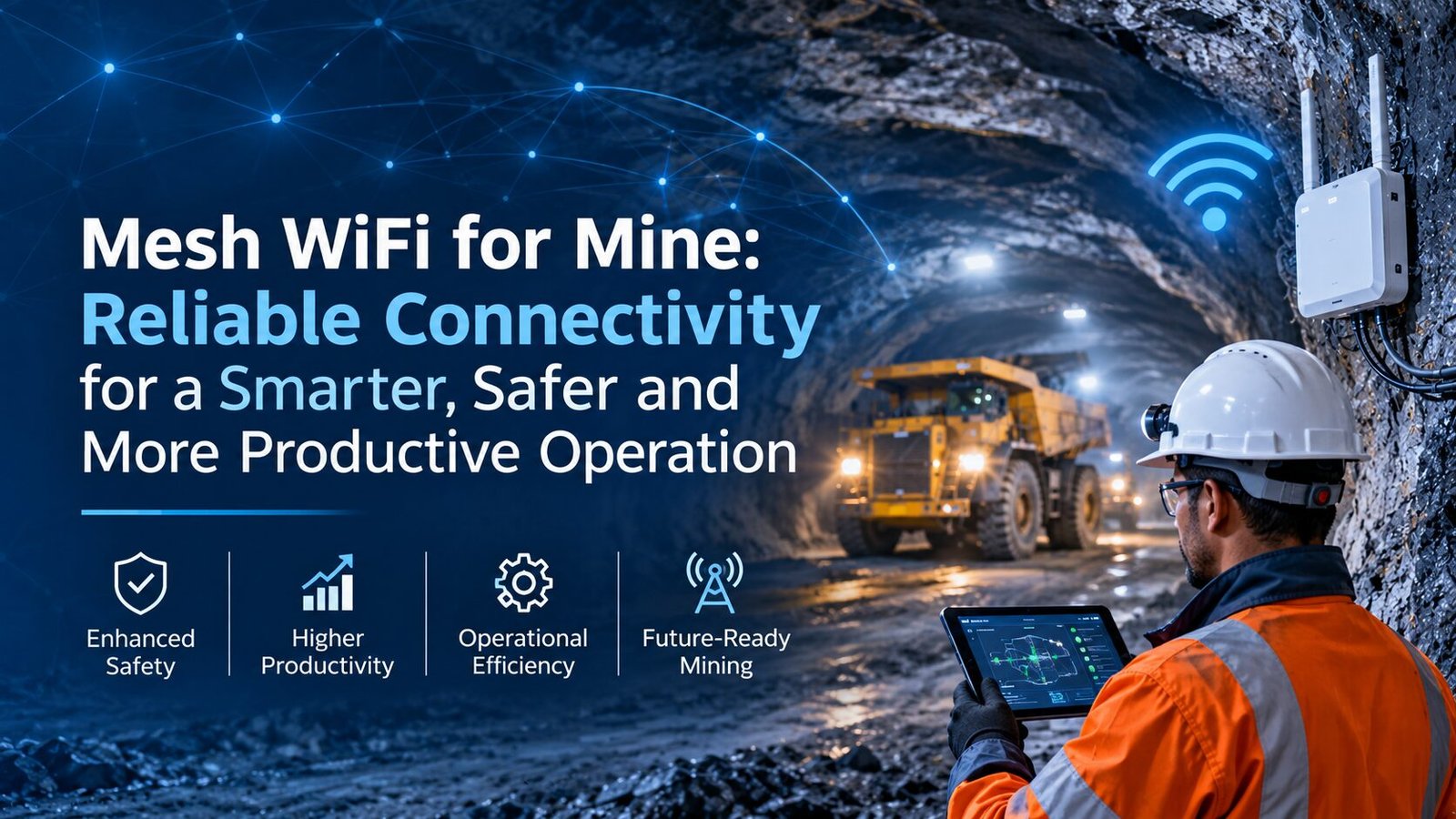
Conclusion: Choosing the Right Mesh WiFi for Mine Connectivity
Reliable underground communication is essential for modern mining operations. However, rock formations, metal equipment, changing tunnel layouts, and moving machinery make wireless connectivity difficult to maintain.
Mesh WiFi for mine environments offers a flexible networking approach through multi-hop communication, alternative data paths, and distributed network infrastructure. Features such as self-healing capabilities and TDMA-based transmission management can further support reliable industrial communication when properly implemented.
For mining operators, selecting the right solution requires evaluating RF conditions, network capacity, mobility, redundancy, and future expansion requirements.
Aeromesh Systems designs wireless mesh Wi-Fi solutions for industrial environments, with capabilities such as multi-hop communication, TDMA, and self-healing network architecture. These technologies can help address the connectivity requirements of demanding underground mining operations.
Frequently Asked Questions
The best Wi-Fi for mining depends on tunnel conditions, coverage requirements, equipment mobility, and data needs. Industrial wireless mesh networks can provide flexible coverage through interconnected nodes and multiple communication paths.
Yes. Wireless mesh networks can operate underground using strategically positioned nodes. Their performance depends on radio frequency conditions, tunnel geometry, equipment obstructions, antenna placement, and network design.
Multi-hop communication allows data to travel through intermediate wireless nodes instead of requiring a direct connection to a central access point. This helps extend coverage across long and complex underground tunnels.
Mesh Wi-Fi uses interconnected wireless nodes to transfer data, while leaky feeder systems radiate radio signals through specially designed coaxial cables. Both support underground communication but differ in infrastructure, flexibility, and application suitability.
Yes. Properly designed industrial mesh networks can support equipment monitoring, telemetry, video surveillance, fleet communication, and automation applications, subject to latency, bandwidth, reliability, and safety requirements.