
Modern manufacturing plants increasingly use digital twins to monitor equipment, understand production processes, and identify potential operational problems before they cause downtime. However, a digital twin is only as useful as the data feeding it. Delayed, incomplete, or inconsistent equipment data can reduce the accuracy of the digital representation and limit its value for operational decisions.
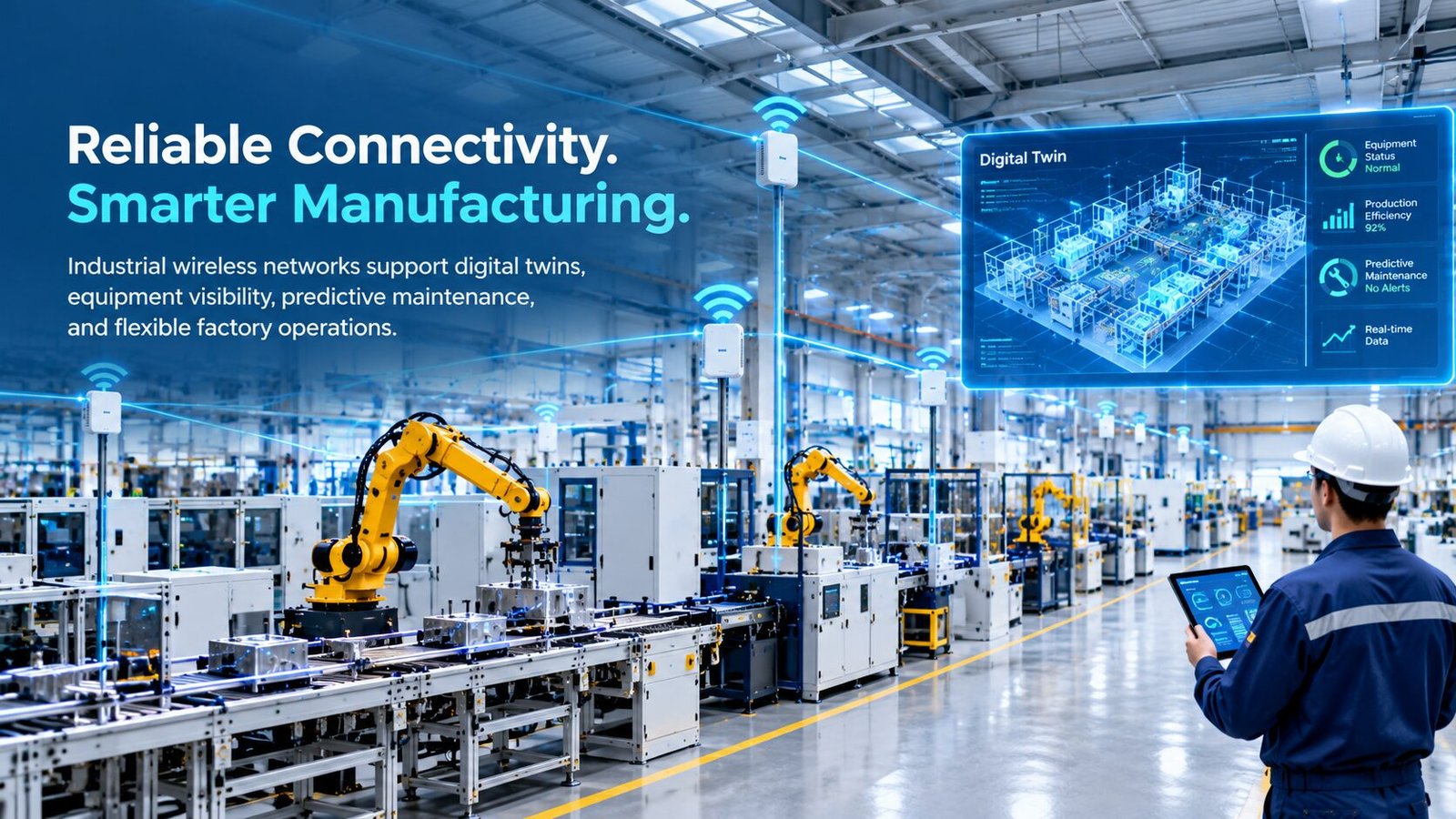
Industrial wifi solutions for manufacturing plants help connect machines, sensors, controllers, mobile equipment, and monitoring systems that contribute to digital twin applications. When designed for industrial conditions, wireless networks can support continuous data exchange across production floors, warehouses, and other operational areas without requiring a wired connection to every moving or hard-to-reach asset.
This article explains how wireless connectivity supports digital twins, the challenges manufacturers must address, and how a high performance wireless mesh network can help establish reliable communication for connected industrial operations.
What Is a Digital Twin in Manufacturing?
A digital twin is a digital representation of a physical asset, process, or system that uses data from the real world to reflect its condition and behaviour. In manufacturing, digital twins can represent individual machines, production lines, material-handling systems, or entire facilities.
Unlike a static 3D model, a connected digital twin can receive operational data from sensors, industrial controllers, and monitoring platforms. This information helps engineers compare expected performance with actual operating conditions.
For example, a digital twin of a production line may use motor temperature, vibration, operating speed, and production output to identify performance deviations. Engineers can use these insights to investigate inefficiencies, schedule maintenance, and improve production planning.
Wireless connectivity supports this process by transporting data between field devices, network infrastructure, edge systems, and digital twin platforms. The network must deliver appropriate coverage, capacity, and reliability for the application’s data requirements.
Why Industrial WiFi Solutions for Manufacturing Plants Matter
Manufacturing environments contain a mixture of fixed machines, moving equipment, metal structures, electrical interference sources, and changing production layouts. Extending wired connectivity to every sensor or mobile asset can be costly or impractical, particularly when equipment moves or production areas are frequently reconfigured.
Industrial wifi solutions for manufacturing plants provide a way to connect devices without installing a separate cable to every endpoint. They can support wireless sensors, inspection devices, mobile terminals, industrial gateways, and other compatible equipment used in digital twin systems.
Wireless networking is particularly useful where manufacturers need to expand connectivity across large facilities or connect assets in areas where cable routing is difficult. However, Wi-Fi does not automatically replace industrial Ethernet or deterministic control networks. Safety-critical and time-sensitive control loops may still require wired or specifically engineered real-time communication.
The objective is to select a network architecture that matches the digital twin’s data requirements while maintaining the reliability of existing operational technology (OT).
Key Connectivity Challenges in Digital Twin Applications
Digital twin applications depend on consistent communication between physical assets and digital systems. Several networking challenges can affect the quality and usefulness of this data.
Coverage gaps can occur behind machinery, between production areas, or inside facilities with dense metal structures. These gaps may prevent sensors and gateways from sending complete data to monitoring platforms.
Network congestion can develop when cameras, machine sensors, mobile devices, and other connected equipment share limited wireless capacity. As the number of connected devices increases, network planning becomes more important.
Latency and data loss can affect applications that depend on timely equipment information. A delay may not matter for historical production reports, but it can be significant for condition monitoring or alerts that require a prompt response.
Changing plant layouts create another challenge. Moving a production line or introducing autonomous material-handling equipment may require network coverage to be redesigned. A flexible wireless architecture can simplify these changes, provided the network is properly planned and validated.
How a High Performance Wireless Mesh Network Supports Digital Twins
A high performance wireless mesh network can connect distributed devices through wireless nodes that communicate with one another. Depending on the architecture, data can travel through multiple nodes to reach a gateway or connected network infrastructure.
This approach can help manufacturers extend coverage across large production areas without installing a separate wired backhaul connection at every wireless node.
Multi-hop communication across production areas
A multi hop wireless mesh network allows data to travel through intermediate nodes when a direct connection to the destination is unavailable or impractical. For example, a sensor gateway in a distant production zone may send data through several mesh nodes before it reaches the plant network.
This architecture can help extend connectivity into remote production areas, storage zones, and sections separated by physical obstacles. However, each additional hop introduces potential delay and consumes shared wireless capacity when links use the same radio resources. Network design must therefore account for throughput, hop count, interference, and application requirements.
Redundant paths and network resilience
Some mesh architectures support multiple paths between network nodes. If a link becomes unavailable, the network may redirect traffic through an alternative path, depending on its routing and recovery capabilities.
This can help maintain data flow when equipment moves, a radio link degrades, or a node becomes unavailable. Self-healing capabilities can further support recovery by allowing the network to respond automatically to certain link failures.
For digital twin applications, the practical benefit is more consistent access to equipment data. Actual resilience depends on network topology, configuration, power availability, and the independence of alternative paths.
Benefits for Manufacturing and Industrial Operations
Well-designed wireless connectivity can improve the reach and flexibility of digital twin systems. One key benefit is greater visibility into equipment performance. Connecting more sensors and assets allows manufacturers to collect information about operating conditions, production output, and equipment health.
Wireless connectivity can also support condition monitoring and predictive maintenance. When vibration, temperature, or other sensor readings reach the relevant analytics platform reliably, engineers can identify unusual patterns and investigate developing faults. The effectiveness of these applications depends on sensor quality, data frequency, analytics, and the network’s performance.
Another benefit is flexible production expansion. Wireless infrastructure can reduce the need to install new data cables whenever compatible equipment is relocated or additional monitoring points are introduced. This is particularly useful in facilities where layouts and material flows change regularly.
Finally, a suitable wireless network can support better coordination between IT and OT systems. By connecting operational data sources with approved gateways and industrial applications, manufacturers can improve the availability of information used for maintenance, production planning, and performance analysis.
These benefits do not come from wireless connectivity alone. They depend on integrating the network with suitable sensors, industrial systems, data platforms, and cybersecurity controls.
Practical Use Cases in Smart Manufacturing
Digital twins can support several manufacturing applications when reliable wireless data collection is available.
In predictive maintenance, wireless sensors can transmit motor vibration and temperature readings to monitoring systems. Engineers can use these measurements to investigate abnormal operating conditions and plan maintenance before a failure disrupts production.
In production-line monitoring, connected devices can report machine status, cycle times, and output data. A digital representation of the line can help teams identify bottlenecks and compare actual performance with production targets.
In warehouse and material handling, wireless connectivity can support mobile terminals, connected vehicles, and equipment monitoring. A digital twin of warehouse operations can use available data to improve asset visibility and understand material movement.
In facility-wide monitoring, mesh connectivity may help link devices in separate operational zones where conventional cabling is difficult. This can be useful when the network must cover a large plant with changing physical conditions.
Each use case has different requirements. High-frequency vibration monitoring, for example, may need more bandwidth and carefully controlled latency than periodic equipment-status reporting.
Best Practices for Deploying Industrial Wireless Networks
Manufacturers should evaluate the requirements of their digital twin applications before selecting a wireless architecture. The following practices help ensure that connectivity supports operational needs.
- Assess coverage and interference: Conduct a wireless site survey to identify dead zones, metal obstructions, interference sources, and areas with high device density.
- Plan capacity and latency: Estimate the number of connected devices, data rates, reporting frequency, and acceptable delays. Account for the impact of additional mesh hops on available throughput.
- Select the right network architecture: Use mesh networking where multi-hop connectivity and flexible coverage are beneficial. Retain wired connections where predictable performance or specialised industrial protocols require them.
- Integrate cybersecurity controls: Apply network segmentation, authentication, encryption, access controls, and monitoring to protect industrial systems and data.
- Test under real operating conditions: Validate roaming, throughput, failover, latency, and recovery while machinery is running and the plant is operating at representative capacity.
Manufacturers should also define how data travels from sensors to the digital twin platform, including whether processing occurs at the edge or in a central system. Edge computing can reduce the need to transmit every raw measurement across the network, particularly when local systems can filter data or generate alerts.
Conclusion
Digital twins help manufacturers understand equipment behaviour, monitor production, and make better-informed operational decisions. Their usefulness depends on timely, accurate data from physical assets.
Industrial wifi solutions for manufacturing plants can connect distributed sensors, mobile equipment, and monitoring systems while supporting flexible expansion. A high performance wireless mesh network, including a multi hop wireless mesh network where appropriate, can extend connectivity across complex production environments.
Manufacturers should evaluate coverage, capacity, latency, resilience, and cybersecurity before deployment. With the right network architecture, wireless connectivity can provide a practical foundation for digital twin applications and more connected manufacturing operations.
Frequently Asked Questions
Wireless connectivity transports data from physical assets, sensors, and industrial gateways to digital twin platforms. This helps manufacturers monitor equipment conditions, analyse performance, and maintain an updated digital representation of operations.
Industrial wifi solutions for manufacturing plants connect distributed equipment without requiring a separate cable to every device. They support flexible deployment, equipment monitoring, and connectivity expansion across production floors and warehouses.
A multi hop wireless mesh network forwards data through intermediate wireless nodes, extending connectivity into areas where direct connections are difficult. Performance depends on hop count, interference, radio capacity, and network design.
Yes. Wireless mesh networks can transport sensor readings such as temperature and vibration to monitoring systems. Predictive maintenance performance also depends on sensor accuracy, data frequency, analytics, and reliable end-to-end communication.
No. Wi-Fi can support monitoring, telemetry, and many data-collection applications, but safety-critical control loops may require wired Ethernet or specialised real-time networking. Selection should reflect the application's latency, reliability, and security requirements.