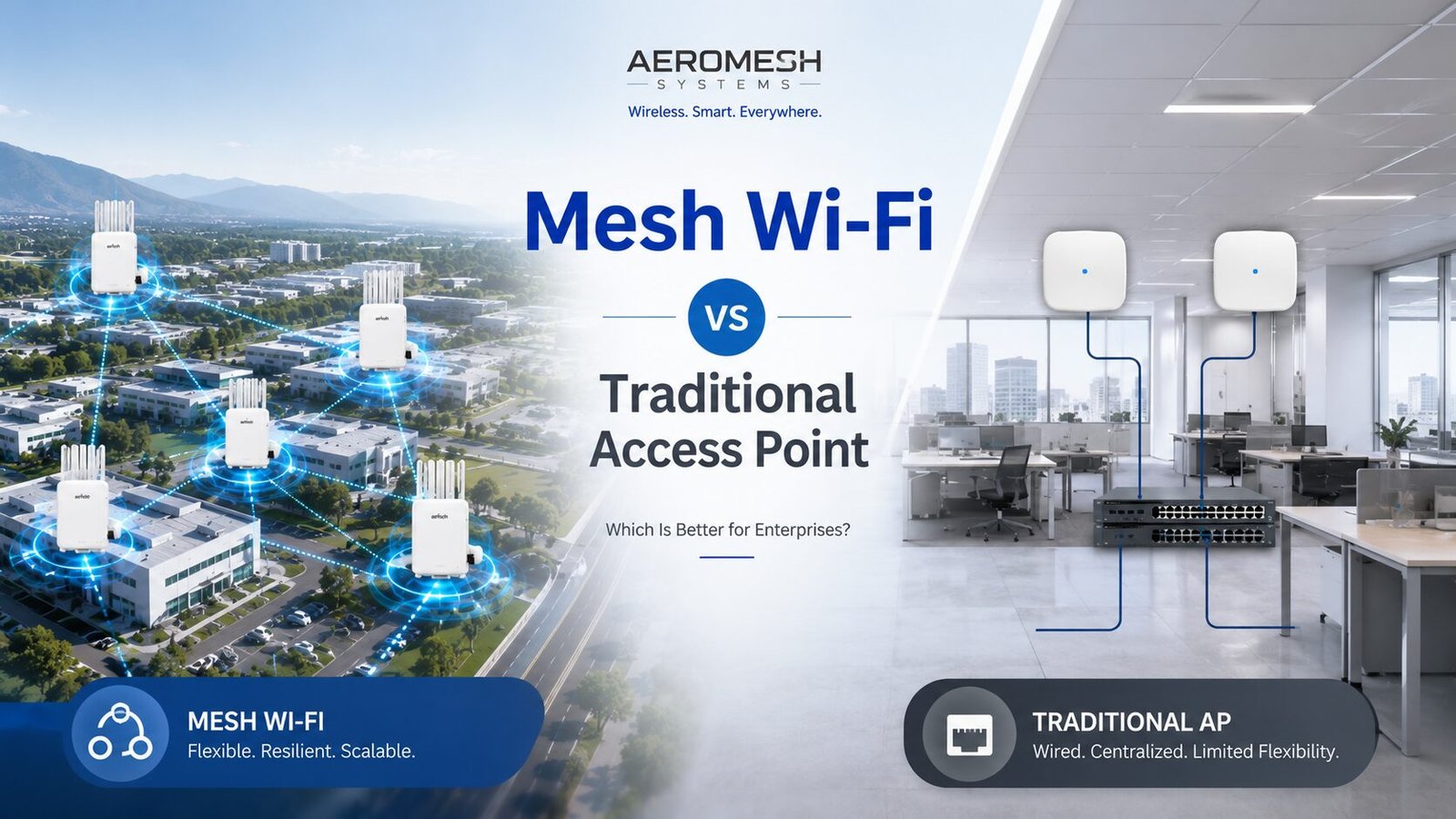
Understanding Enterprise Wireless Architecture
Enterprise wireless networks are expected to deliver secure, high-speed, and uninterrupted connectivity across offices, warehouses, manufacturing plants, campuses, and outdoor facilities. Selecting the right network architecture is a key decision because it directly affects coverage, scalability, maintenance, and long-term operational efficiency.
Two of the most common approaches are Mesh Wi-Fi and traditional access point (AP) architecture. While both provide wireless connectivity, they differ significantly in how they handle communication, expansion, and network resilience.
What Is a Traditional Access Point Architecture?
A traditional wireless network consists of multiple access points connected to a central wired network through Ethernet cabling and switches. Each access point broadcasts wireless coverage within its designated area.
This architecture works well in offices and buildings with an established cabling infrastructure. However, expanding the network often requires additional cables, switches, and installation work.
Advantages
- Stable wired backhaul
- Predictable network performance
- Suitable for structured office environments
- Simplified centralized management
Limitations
- Higher installation costs for new locations
- Limited flexibility in remote or outdoor areas
- Expansion often requires additional cabling
What Is Mesh Wi-Fi Architecture?
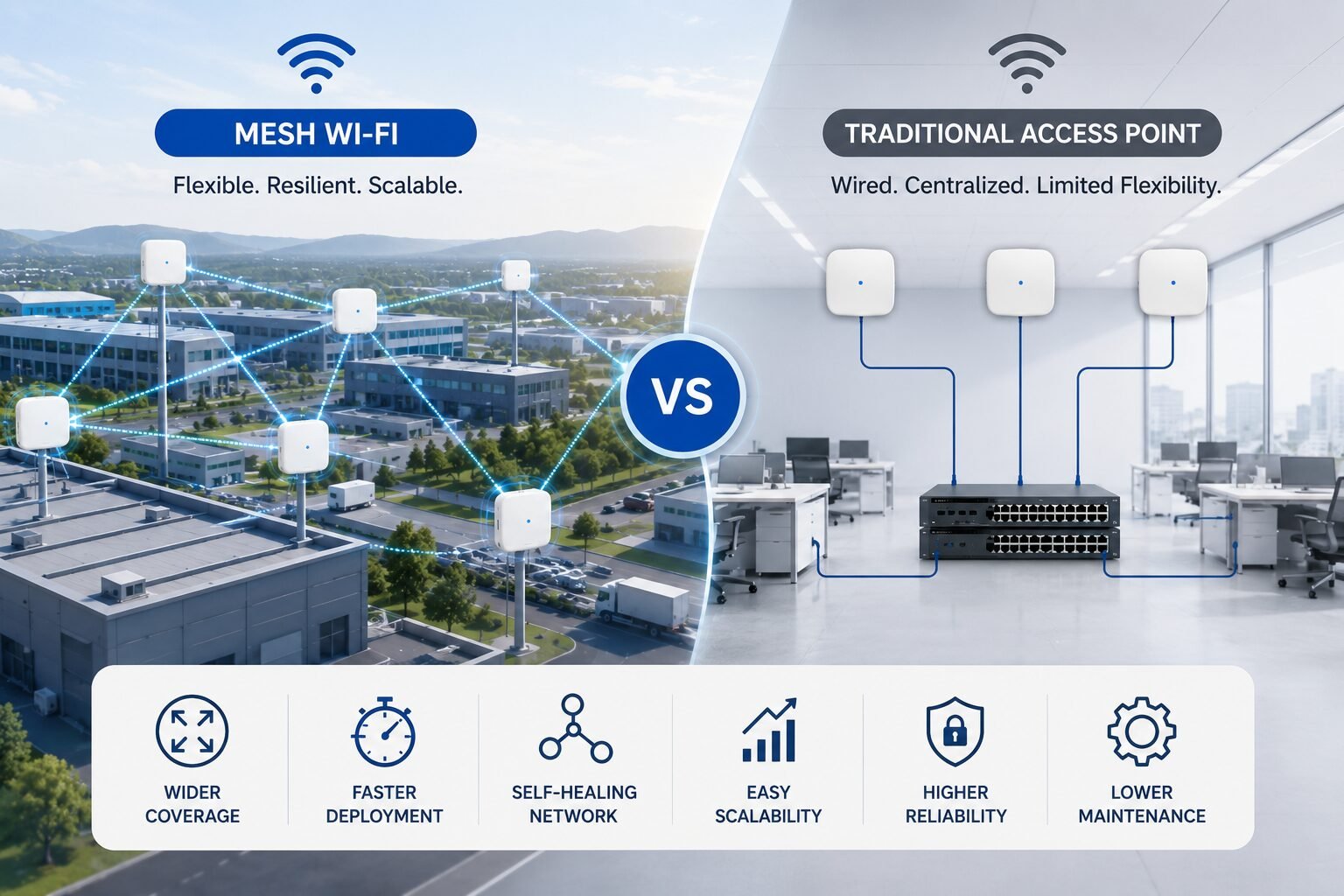
Mesh Wi-Fi uses interconnected wireless nodes that communicate with one another to create a unified network. Instead of relying entirely on wired connections, mesh nodes can forward data through neighboring nodes, extending coverage across large or difficult-to-wire environments.
If one communication path becomes unavailable, the network automatically reroutes traffic through another available node, improving overall reliability.
Mesh Wi-Fi vs Traditional Access Point Architecture
| Feature | Mesh Wi-Fi | Traditional Access Point |
| Coverage | Easily extends across large areas | Limited by wired infrastructure |
| Deployment | Faster in difficult-to-wire locations | Requires Ethernet cabling |
| Scalability | Add new mesh nodes with minimal disruption | Expansion often requires new cabling |
| Network Resilience | Automatic path rerouting | Dependent on wired connections |
| Maintenance | Simplified expansion and management | More infrastructure changes during upgrades |
Which Architecture Is Better for Enterprises?
The answer depends on the deployment environment and operational requirements.
Traditional access point architecture is often suitable for office buildings with existing structured cabling and predictable coverage requirements.
Mesh Wi-Fi, however, offers greater flexibility for organizations operating across large campuses, warehouses, industrial facilities, mining sites, ports, and outdoor environments where installing cables can be expensive or impractical.
Businesses deploying wireless infrastructure across Industrial Applications often benefit from mesh networking because it provides broader coverage, simplified expansion, and improved network resilience in demanding environments.
Key Considerations Before Choosing
Before selecting a wireless architecture, evaluate the following:
- Facility size and layout
- Existing wired infrastructure
- Number of connected users and devices
- Future expansion plans
- Environmental conditions
- Security requirements
- Budget and long-term maintenance costs
Choosing the right architecture should align with both current operational needs and future business growth.
Selecting Enterprise-Grade Wireless Equipment
Regardless of the chosen architecture, reliable hardware plays a critical role in network performance.
Deploying enterprise-grade WiFi Access Point / Hotspots Series solutions provides advanced security, centralized management, reliable coverage, and scalable performance for growing enterprise environments. High-quality wireless infrastructure also reduces maintenance requirements and supports long-term network reliability.
Best Practices for Enterprise Wireless Deployment
To achieve the best results:
- Conduct a professional Wi-Fi site survey before deployment.
- Design the network for future expansion.
- Use enterprise-grade wireless hardware.
- Implement network segmentation and strong security.
- Monitor network performance continuously.
- Update firmware and software regularly.
- Review network capacity as business requirements evolve.
Following these practices helps maximize network performance regardless of the chosen architecture.
Conclusion
Both Mesh Wi-Fi and traditional access point architecture have important roles in enterprise networking. Traditional access points provide reliable performance in structured environments with established cabling, while Mesh Wi-Fi delivers greater flexibility, wider coverage, and automatic path redundancy for large or complex deployments.
Organizations should evaluate their operational requirements, facility layout, scalability needs, and long-term growth plans before making a decision. Investing in the right wireless architecture and enterprise-grade infrastructure ensures secure, reliable connectivity that supports business operations today and adapts to future demands.
Mesh Wi-Fi uses interconnected wireless nodes that communicate with each other to extend coverage and automatically reroute traffic if a connection fails. Traditional access point architecture relies on wired Ethernet connections between access points and the central network.
For large campuses, warehouses, manufacturing plants, mining sites, and outdoor facilities, Mesh Wi-Fi is often the better choice because it offers flexible deployment, wider coverage, and built-in network resilience. Traditional access points are well suited for office environments with established cabling.
Yes. Mesh Wi-Fi allows businesses to expand coverage by adding additional mesh nodes with minimal infrastructure changes. Traditional access point networks usually require extra cabling and network hardware when expanding.
Yes. One of the key advantages of Mesh Wi-Fi is its self-healing capability. If a node or communication path fails, the network automatically redirects traffic through another available route, helping maintain uninterrupted connectivity.
Organizations should evaluate facility size, user density, application requirements, existing network infrastructure, security needs, future growth plans, maintenance costs, and environmental conditions before selecting the most suitable enterprise wireless architecture