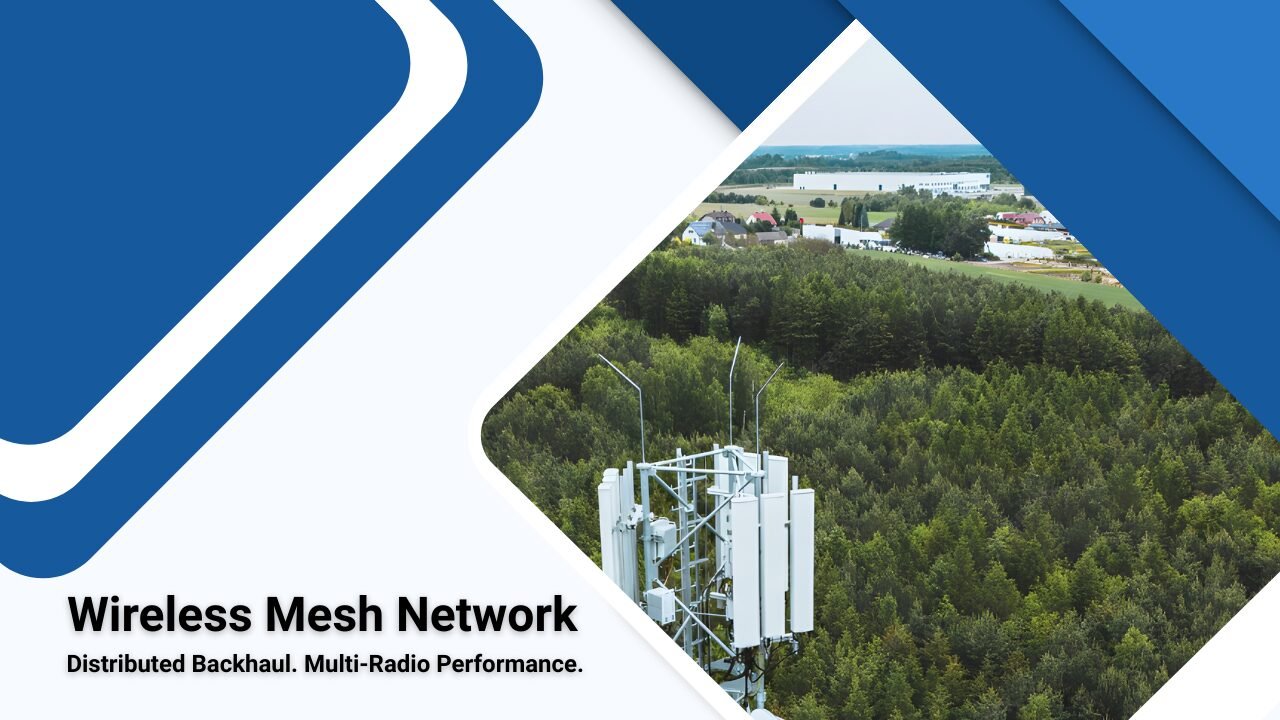
Remote sites rarely wait for perfect infrastructure. Mining zones expand. Highways stretch beyond city limits. Renewable plants are built where land is available, not where fiber exists. Yet every one of these environments depends on reliable, high-capacity connectivity.
The challenge is simple – how do you connect remote sites without fiber?
The answer, increasingly, is a properly designed wireless mesh network built specifically for backhaul performance. Modern wireless backhaul is not a temporary workaround. When implemented correctly with distributed backhaul radios and multi-radio architecture, it becomes a resilient, scalable alternative to fiber.
This article focuses on how wireless mesh backhaul actually works in the field and how to implement it correctly.
Why Traditional Backhaul Models Fail in Remote Environments
Point-to-point radio links have been used for years to connect remote locations. While effective in simple deployments, they introduce structural limitations:
- Single path dependency
- Limited redundancy
- Complex expansion
- Vulnerability to link obstruction
In dynamic industrial or transportation environments, these limitations quickly surface. One broken link can isolate an entire segment.
This is where a wireless mesh network fundamentally changes the architecture.
The Real Strength of a Wireless Mesh Network
A wireless mesh network is not just multiple radios connected together. Its strength lies in distributed intelligence and multi-path routing.
In a true mesh backhaul design:
- Each node communicates with multiple neighboring nodes
- Traffic dynamically reroutes around failures
- No single node acts as a permanent bottleneck
- Expansion does not require redesigning the core
The key differentiator in modern systems is the distributed backhaul radio architecture.
Distributed Backhaul Radio Architecture Explained
Traditional systems often use a single radio for both client access and backhaul. This creates congestion and performance degradation.
Modern industrial-grade mesh systems use:
Multi-Radio Structure
Each node typically includes:
- Dedicated backhaul radios
- Separate client access radios
- Independent frequency management
This separation ensures that backhaul traffic does not compete with access traffic. It improves throughput stability and reduces latency spikes.
Distributed Backhaul Intelligence
Instead of relying on a central controller to make routing decisions, distributed backhaul nodes make real-time decisions based on:
- Link quality
- Signal strength
- Congestion levels
- Interference
If one path degrades, traffic automatically shifts to the next optimal route without human intervention.
This is critical in remote environments where on-site IT teams may not be available.
How Multi-Radio Mesh Improves Performance
Let us break this down practically.
In a single-radio chain topology:
Node A connects to B
B connects to C
C connects to D
If B fails, everything downstream collapses.
In a multi-radio wireless mesh network:
- Node A connects to B and C
- Node B connects to A, C, and D
- Node C connects to A, B, and D
Each node uses dedicated radios for backhaul, enabling simultaneous links.
This architecture provides:
- Higher aggregate throughput
- Reduced latency variation
- Automatic failover
- Smoother video transmission
- Better QoS handling
For high-bandwidth applications like surveillance and industrial monitoring, this makes a measurable difference.
Implementation Strategy for Wireless Mesh Backhaul
Designing a wireless mesh network for remote backhaul requires structured planning. Here is a practical implementation approach.
-
Site and Terrain Analysis
Before selecting equipment, evaluate:
- Elevation differences
- Obstructions
- Interference sources
- Weather patterns
- Power availability
Use RF planning tools to simulate link quality and redundancy.
Skipping this step often results in unstable performance later.
-
Define Backhaul Capacity Requirements
Calculate:
- Number of cameras and resolution
- IoT sensor density
- Control system data
- Future scalability
For example, 20 HD cameras at 6 Mbps each already require 120 Mbps sustained backhaul, excluding overhead.
Overdesign slightly to avoid saturation during peak usage.
- Design for Redundancy, Not Just Coverage
Coverage alone is not enough. The real advantage of a wireless mesh network comes from path diversity.
Best practice:
- Ensure each node connects to at least two neighbors
- Avoid linear daisy-chain layouts
- Use height strategically for clear line-of-sight
This creates a self-healing topology rather than a fragile chain.
-
Separate Backhaul and Access Traffic
If your mesh nodes also provide Wi-Fi access, use a multi-radio structure:
- Dedicated 5 GHz or licensed band for backhaul
- Separate radio for client devices
- Independent channel planning
This is where many deployments fail. Mixing access and backhaul traffic on a single radio reduces performance dramatically.
When evaluating the best mesh wifi solutions for industrial backhaul, prioritize systems that clearly separate these functions.
Consumer mesh products are not designed for distributed backhaul in harsh environments. Industrial mesh platforms are purpose-built for long-range stability and traffic segregation.
-
Integrate with Hybrid Architecture When Needed
In many cases, the optimal design combines:
- Fiber at core aggregation points
- Wireless mesh for remote segments
This reduces trenching while maintaining high-speed uplink performance.
If you already have content on hybrid network architectures, this is a strong place for internal linking within your website.
Real-World Use Cases
Mining and Construction Sites
These sites change constantly. Equipment relocates. Boundaries expand.
Wireless mesh allows:
- Rapid deployment
- Scalable expansion
- Reliable CCTV streaming
- Worker communication systemsNodes can be mounted on portable masts and repositioned as operations evolve.
Renewable Energy Farms
Solar and wind installations cover large areas.
Wireless mesh backhaul connects:
- Inverter stations
- Weather sensors
- SCADA systems
- Security infrastructure
If one node fails, monitoring continues through alternate routes.
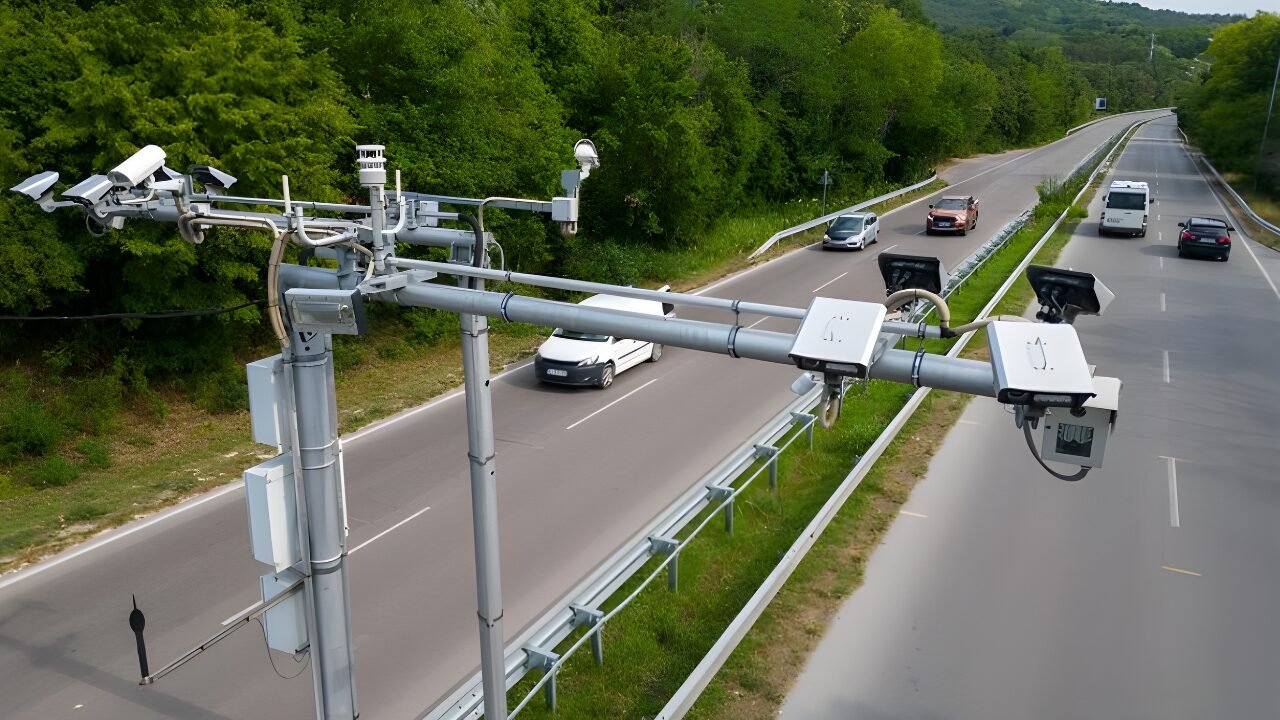
Transportation Corridors
Highways require continuous connectivity for:
- Traffic cameras
- Smart signage
- Incident detection systems
- Connected vehicle communication
Deploying fiber along hundreds of kilometers is expensive. A distributed wireless mesh network offers resilience with faster rollout.
This is also a relevant point for internal linking to your transportation infrastructure content.
Public Safety Networks
Remote surveillance networks depend on uptime.
Multi-radio mesh ensures:
- Stable video feeds
- Reduced packet loss
- Automatic failover during link degradation
- Continued operation during partial outages
In disaster scenarios where fiber is damaged, wireless mesh continues operating if designed with sufficient redundancy.
Cost and Deployment Advantages
Wireless backhaul typically offers:
- Lower initial infrastructure cost
- Faster deployment timelines
- Minimal civil construction
- Easier expansion
Organizations frequently reduce rollout time from months to weeks.
However, cost savings should not come at the expense of architecture quality. Poorly designed mesh networks create bottlenecks that are expensive to fix later.
Conclusion
Wireless backhaul is no longer a secondary option. With a properly implemented wireless mesh network using distributed backhaul radios and multi-radio structure, remote sites can achieve reliable, scalable connectivity without fiber.
The real performance advantage comes from:
- Path redundancy
- Traffic separation
- Distributed routing intelligence
- Scalable node expansion
If you are planning remote connectivity for industrial, transportation, or energy infrastructure, focus on architecture first. Equipment selection should support distributed backhaul, not just basic Wi-Fi coverage.
A well-designed mesh backhaul network is not simply wireless connectivity. It is resilient infrastructure built for long-term performance.
For deeper technical planning frameworks and deployment strategies, explore our related resources on industrial mesh design and hybrid network architectures.
FAQs
Yes, when implemented with multi-radio architecture and redundant node placement. Distributed backhaul ensures automatic failover and stable performance.
They separate backhaul traffic from client access traffic, preventing congestion and improving throughput consistency.
Industrial mesh systems are designed for long-range outdoor performance, harsh environments, and dedicated backhaul capacity. Home mesh Wi-Fi systems are optimized for indoor coverage and light client traffic.