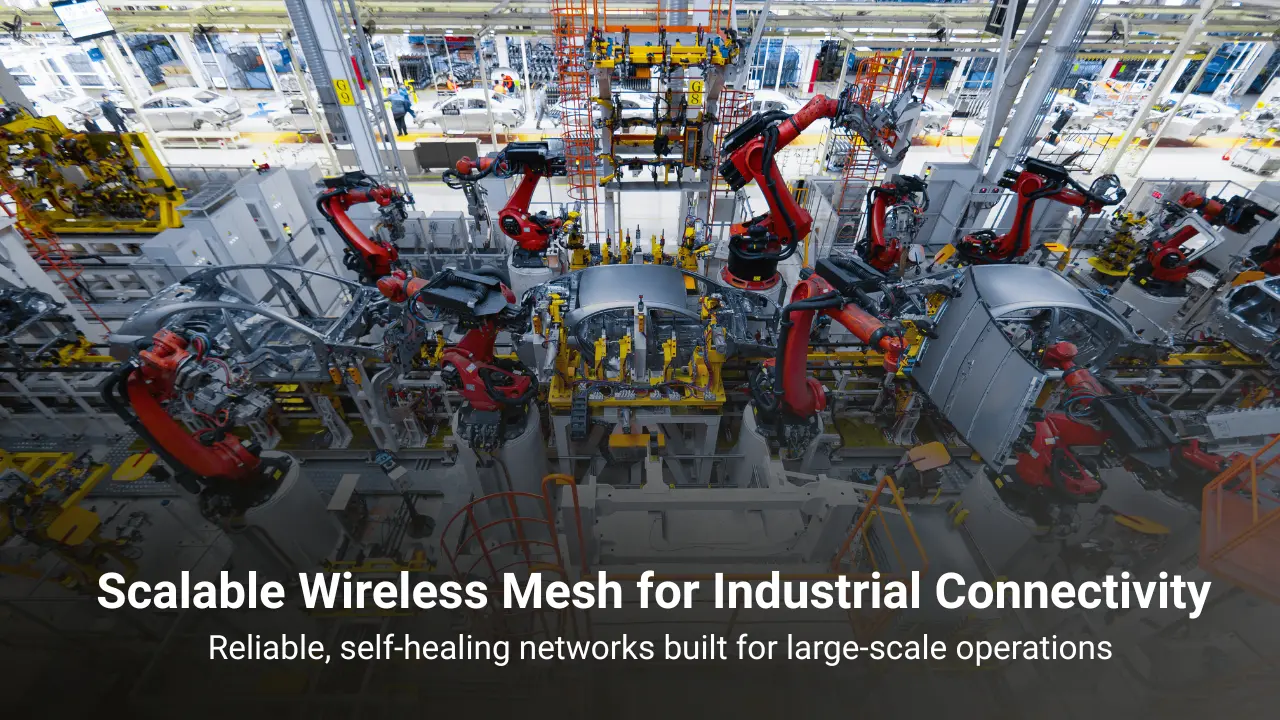
Introduction – The Next Era of Industrial Wireless Connectivity
Industrial operations are becoming increasingly digital, automated, and data-driven. From smart factories and connected warehouses to large campuses and outdoor industrial environments, reliable wireless connectivity is no longer optional – it is mission-critical.
Traditional wireless networks struggle to keep up with modern industrial demands such as mobility, scalability, low latency, and uninterrupted uptime. This is where scalable mesh networks are emerging as a game-changing solution. By enabling self-healing, multi-path communication and distributed intelligence, mesh networking is redefining how industries deploy and manage wireless infrastructure.
In this blog, we explore why scalable mesh networks represent the future of wireless connectivity and how they are transforming industrial WiFi solutions for manufacturing plants, IoT, and automation.
What Are Scalable Wireless Mesh Networks?
A wireless mesh network is a decentralized network architecture where each node connects to multiple other nodes, forming a resilient web of communication paths. Unlike traditional hub-and-spoke models, mesh networks do not rely on a single point of failure.
Key Characteristics of Scalable Mesh Networks
- Multi-hop communication with intelligent routing
- Self-healing and self-optimizing behavior
- Seamless scalability without network redesign
- Distributed traffic handling and load balancing
This architecture allows organizations to expand coverage and capacity while maintaining consistent performance, making it ideal for complex industrial environments.
Why Traditional Industrial WiFi Falls Short
Limitations of Conventional Wireless Networks
- Single point of failure at the controller or gateway
- Performance degradation as client density increases
- Limited range and coverage in large facilities
- Manual reconfiguration during expansion
In manufacturing plants, logistics hubs, and energy facilities, these limitations result in downtime, data loss, and reduced operational efficiency.
How Mesh Networks Are Redefining Industrial WiFi Solutions for Manufacturing Plants
Manufacturing environments are highly dynamic, with moving machinery, autonomous vehicles, and real-time monitoring systems.
Benefits of Mesh Networking in Manufacturing
- Consistent coverage across large factory floors
- Low latency connectivity for time-sensitive applications
- High availability even during node or link failures
- Flexible deployment without heavy cabling
Scalable mesh networks ensure uninterrupted connectivity for PLCs, robots, HMIs, and mobile workforce devices, enabling true Industry 4.0 transformation.
Enabling Industrial WiFi for IoT and Automation
IoT and automation systems depend on reliable, always-on connectivity to collect, process, and act on data in real time.
Why Mesh Networks Are Ideal for Industrial IoT
- Supports thousands of connected sensors and devices
- Enables real-time data flow across distributed systems
- Maintains performance as device density increases
- Adapts automatically to changing network conditions
From predictive maintenance and asset tracking to automated quality inspection, industrial WiFi for IoT and automation thrives on the resilience and scalability of mesh networking.
Scalability Without Compromise – A Key Advantage
Seamless Network Expansion
One of the biggest advantages of scalable mesh networks is the ability to grow without disruption. Adding a new node instantly extends coverage and capacity, without re-engineering the network.
Performance at Scale
Unlike traditional systems, well-designed mesh networks avoid throughput collapse by intelligently routing traffic and separating access and backhaul paths. This makes them suitable for mission-critical industrial applications where performance consistency matters.
Is a Mesh Network the Best Mesh Wi-Fi System for Industrial Use?
When evaluating the best mesh Wi-Fi system for industrial deployments, consumer-grade mesh solutions often fall short. Industrial-grade mesh networks offer:
- Dedicated radios for access and backhaul
- Industrial enclosures and environmental hardening
- Deterministic routing and QoS controls
- Centralized visibility with distributed intelligence
These features ensure predictable performance and long-term reliability in harsh industrial environments.
Industries Being Transformed by Scalable Mesh Networks
Manufacturing and Smart Factories
- Real-time machine monitoring
- Autonomous material handling
- Wireless production lines
Logistics and Warehousing
- Fleet tracking and automation
- Large-area coverage with mobility support
Energy, Utilities, and Mining
- Outdoor and remote connectivity
- Resilient networks in challenging terrain
Smart Cities and Transportation
- Traffic systems and surveillance
- Public safety communications
The Future of Wireless Connectivity Is Mesh-Driven
As industries move toward greater automation, digitization, and real-time intelligence, wireless infrastructure must evolve accordingly. Scalable mesh networks provide the flexibility, resilience, and performance required to support future-ready industrial operations.
They eliminate traditional bottlenecks, reduce deployment complexity, and create a foundation for innovation across manufacturing, logistics, utilities, and beyond.
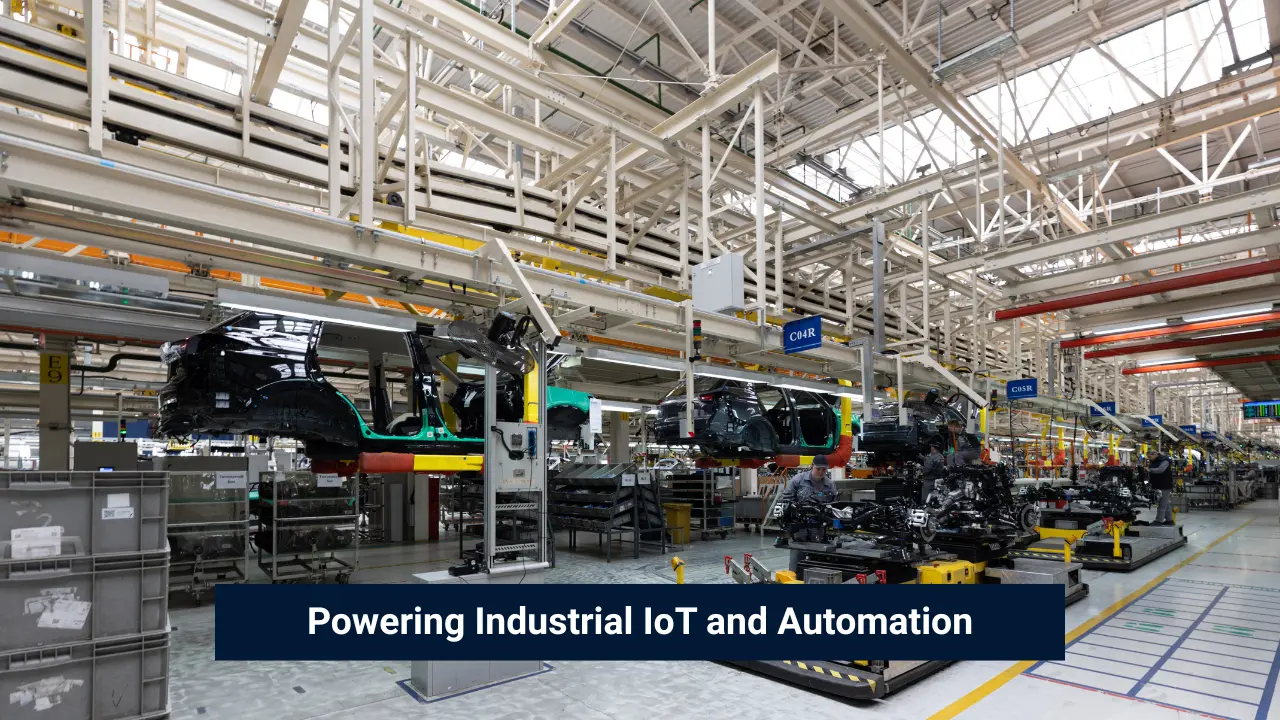
Conclusion – Building Future-Ready Industrial Networks
Scalable wireless mesh networks are no longer an emerging technology – they are becoming the backbone of modern industrial connectivity. By enabling reliable, flexible, and high-performance communication, they redefine what is possible for industrial WiFi solutions for manufacturing plants and industrial WiFi for IoT and automation.
Organizations investing in mesh networking today are positioning themselves for long-term scalability, operational efficiency, and technological leadership in an increasingly connected world.
FAQ’s
Mesh networks offer self-healing, multi-path routing and scalability, making them far more resilient and reliable in industrial environments compared to traditional WiFi architectures.
Yes. Scalable mesh networks are ideal for large manufacturing plants because they provide seamless coverage, low latency, and high availability across expansive areas.
Absolutely. Mesh networks are well-suited for industrial WiFi for IoT and automation, supporting high device density and real-time data communication.
Industrial mesh networks can scale from a few nodes to thousands without major redesign, making them future-ready for growing operations.
Industrial-grade mesh networks, with dedicated radios and intelligent routing, are among the best mesh Wi-Fi systems for demanding industrial applications.