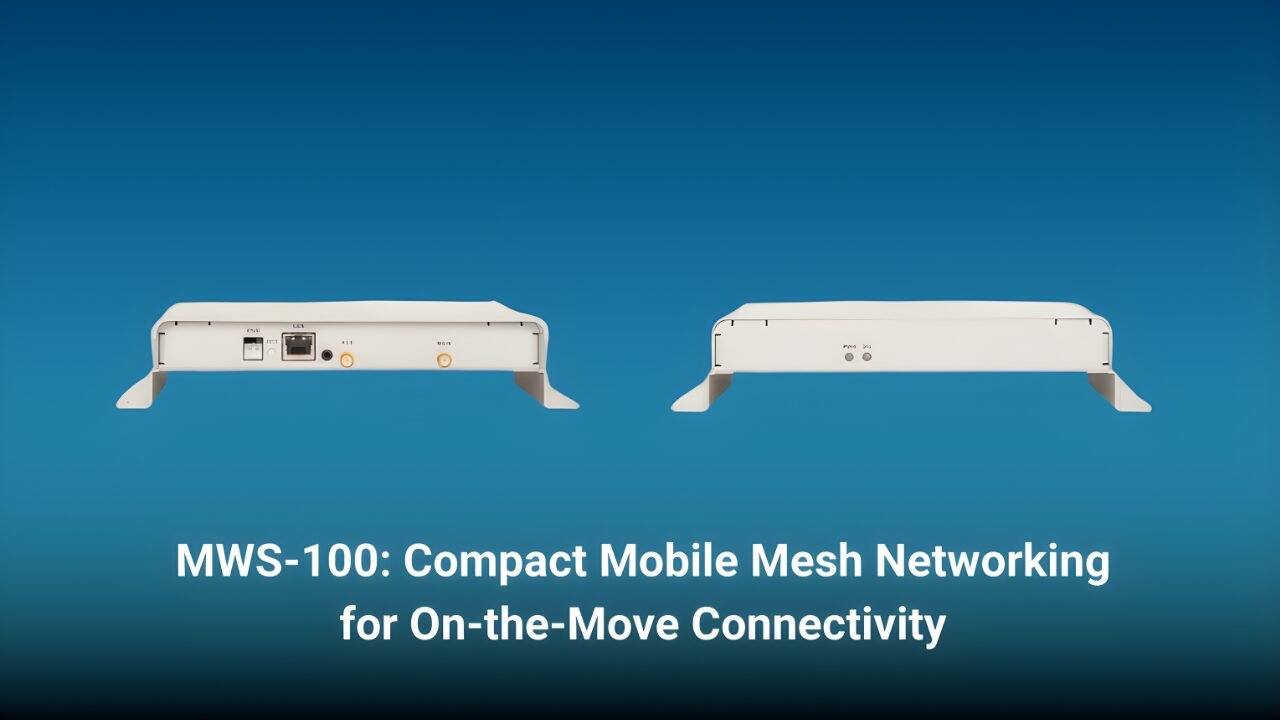
Introduction: Solving Connectivity Gaps with Wireless Mesh Network Technology
In today’s dynamic enterprise environments – from sprawling industrial sites to smart city corridors – consistent, robust connectivity is no longer a luxury, but a fundamental operational necessity. Traditional point-to-point wireless systems often struggle with coverage gaps, especially where mobility and changing topology come into play. This is where a wireless mesh network becomes transformative, providing self-organizing and resilient connectivity across a distributed footprint. Compact mobile units like the MWS-100 extend this capability further, enabling resilient, on-the-move connectivity without sacrificing performance or reliability.
What Is a Wireless Mesh Network and Why Does It Matter?
A wireless mesh network is a decentralized network architecture composed of multiple interconnected nodes that communicate with each other to route data intelligently. Each node forwards data for the network, which enhances coverage, resilience, and flexibility compared to traditional wireless setups. Unlike single-point Wi-Fi or cellular hotspots, mesh systems adaptively reroute traffic when nodes change position or experience interference, making them ideal for industrial and enterprise scenarios.
In practical terms, this means a mobile mesh unit can sustain communication even when individual devices move across zones – a crucial benefit for industries with vehicular fleets, dynamic equipment, or field teams.
MWS-100 Architecture: Compact Yet Capable Mesh Networking
At its core, the MWS-100 is designed as a compact mesh wifi router-class device optimized for mobile deployments. In mesh terminology, it acts as both a client access node and a routing point, supporting multi-hop connectivity back to gateways or core networks.
Key Technical Elements in Simple Terms
- Mesh Nodes: Each MWS-100 participates in the mesh as a peer – relaying data to nearby nodes and extending the network organically across the coverage area.
- Multi-Hop Routing: Data can traverse several nodes before reaching a wired backhaul or central gateway, significantly increasing coverage without additional wired infrastructure.
- Self-Healing Topology: If a node fails or moves, neighboring nodes reconfigure routes automatically, retaining network integrity.
- Adaptive Channel Selection: Intelligent radio management minimizes RF interference and dynamically selects optimal channels for communication.
This architectural combination provides a redundant, resilient, and scalable mesh infrastructure suitable for diverse industrial environments.
Where MWS-100 Excels: Industrial Use Cases
Below are some real-world scenarios where compact mobile mesh networking delivers clear value:
Industrial Logistics and Yard Operations
In large logistics yards or warehouses, vehicles and automated guided vehicles (AGVs) often move far from fixed AP coverage. Traditional Wi-Fi can fail as machines move out of range.
With an MWS-100 mesh node onboard each vehicle or crane, the network footprint moves with assets. Wireless mesh ensures:
- Continuous telemetry and control data flow
- Real-time tracking and route updates
- Unbroken connectivity without manual handoffs
Coverage footprints expand organically as more mobile nodes participate.
Railway Corridors and Transit Routes
Rail networks demand robust communications for both safety systems and passenger experience:
- On-the-move data flows: Monitoring systems aboard trains can transmit telemetry back to control centers as trains traverse large distances.
- Mesh coverage across remote tracks: MWS-100 units installed on maintenance vehicles or trackside equipment create overlapping coverage zones, eliminating the need for constant wired infrastructure.
In regions where wired fiber is expensive or impractical, mobile mesh bridges operational gaps reliably.
Smart Construction Sites
Construction environments are highly dynamic – equipment shifts location, terrain changes, and cabling is impractical.
Deploying compact mesh units around the site:
- Keeps machine telemetry and safety sensors connected
- Enables real-time logging of project metrics
- Provides reliable voice, data, and video connectivity across shifting zones
This is especially relevant in India’s fast-growing infrastructure projects.
Performance Considerations: Latency, Redundancy, and Scalability
When evaluating mobile mesh mesh wifi router deployments, consider these critical aspects:
Latency and Real-Time Data
Latency refers to the time it takes for data to travel from source to destination. In multi-hop mesh scenarios, each additional hop can introduce delay. Compact mobile nodes like the MWS-100 manage this by:
- Using higher processing power for routing decisions
- Optimizing radio channel usage
- Prioritizing real-time traffic through QoS mechanisms
Lower latency improves performance for applications such as surveillance video feeds, telemetry control loops, and voice-enabled communications.
Redundancy and Reliability
Mesh networks inherently provide redundancy, meaning if one path fails, another automatically takes over. This is crucial in industrial environments where RF obstacles, interference, or physical disruptions can occur.
In addition, adaptive self-healing topology ensures the broader wireless mesh network remains operational even when individual nodes are offline.
Scalability for Growing Networks
Scaling traditional wireless architectures often means adding more wired connections or redesigning the network. In contrast, mesh architectures scale more fluidly:
- Adding more mesh units expands coverage without cabinet rewiring
- Mobile nodes extend the network footprint as needed
- Mesh technology supports thousands of nodes, suitable for sprawling sites and urban deployments
This makes mesh a future-ready backbone for IoT, automation, and digital twin initiatives.
Technical Integration: Interfaces and Management
While specifics vary by implementation, compact mesh routers like the MWS-100 typically include:
- Standard Wi-Fi interfaces for client access
- Ethernet or cellular backhaul options
- SNMP, CLI, and HTTP/S API interfaces for centralized management and monitoring
- Remote firmware updates for lifecycle support
These features unify distributed deployments under a cohesive network management strategy.
Practical Deployment Tips
When planning a mobile mesh deployment:
- Survey RF conditions: Identify high-interference zones to adjust node placement or frequency usage.
- Segment traffic: Separate control telemetry from bulk data streams for better performance.
- Manage hops: Keep average hops low (e.g., under 5) for latency-sensitive applications while still leveraging mesh reach.
These planning steps ensure the wireless mesh network performs at peak efficiency.
Conclusion: Enabling Resilient Connectivity with Mobile Mesh
In environments where traditional connectivity falters, a wireless mesh network like that enabled by compact mobile solutions such as the MWS-100 provides a resilient, scalable, and intelligent alternative. It combines self-organizing architecture, redundancy, and expanded reach without the complexity of extensive wired infrastructures. For enterprises and industrial operators seeking dependable, on-the-move connectivity – whether across logistics yards, transit corridors, or construction sites – mobile mesh networking offers a future-ready foundation for operational excellence.
FAQ
A wireless mesh network connects multiple devices in a decentralized topology to improve coverage, resilience, and redundancy without relying solely on wired infrastructure.
Mesh routers both serve clients and forward traffic across nodes, whereas traditional APs typically depend on a central controller or wired backhaul.
Yes - with optimized routing, QoS mechanisms, and latency-aware design, compact mobile mesh units can support real-time applications effectively.
Absolutely - mesh scales organically, minimizes wiring costs, and adapts to varied terrain, making it ideal for India’s diverse industrial landscapes.
Mesh networks use self-healing algorithms that reroute traffic automatically if a node fails or moves, ensuring continuity of connectivity.