Introduction: Why Connectivity Is the Backbone of Modern Education
Education today extends far beyond classrooms and blackboards. Universities and institutions are transforming into fully connected digital ecosystems where students attend virtual lectures, access cloud-based resources, collaborate in real time, and move freely across campus while staying connected.
Traditional network infrastructures struggle to keep up with this demand. Dead zones, inconsistent speeds, and network congestion directly impact learning outcomes. This is where mesh Wi-Fi for education plays a critical role.
With scalable, resilient, and high-performance connectivity, mesh Wi-Fi enables truly connected campuses and future-ready digital classrooms.
The Rise of Digital Classrooms and Smart Campuses
Digital classrooms rely heavily on uninterrupted connectivity. From video-based lectures and online assessments to AR/VR-based learning tools, modern education requires networks that perform consistently under pressure.
A connected campus includes:
- Lecture halls with hundreds of simultaneous users
- Libraries and labs with bandwidth-intensive applications
- Outdoor learning spaces and hostels
- Administrative offices and research facilities
To support this, institutions need campus WiFi solutions for higher education that deliver seamless roaming, high capacity, and centralized management.
What Is Mesh Wi-Fi and Why It Fits Education Environments
Mesh Wi-Fi uses multiple interconnected access points that communicate with each other to form a unified network. Instead of relying on a single router, the network dynamically routes traffic through the most efficient path.
Key advantages of mesh Wi-Fi for campuses:
- No single point of failure
- Seamless roaming for students and staff
- Easy expansion without redesigning the network
- Better performance in complex layouts
This makes mesh architecture ideal for large and distributed educational environments.
Campus WiFi Solutions for Higher Education: Beyond Basic Coverage
Higher education institutions face unique networking challenges. Thousands of devices connect simultaneously, often during peak hours like lectures or exams.
Why traditional Wi-Fi falls short:
- Limited scalability
- Performance degradation under load
- High maintenance complexity
How mesh Wi-Fi solves this:
- Intelligent traffic routing across nodes
- Load balancing to prevent congestion
- Centralized control and monitoring
Advanced campus WiFi solutions for higher education ensure consistent connectivity across classrooms, dormitories, and outdoor spaces without constant manual intervention.
High Density WiFi Solutions for Lecture Halls and Auditoriums
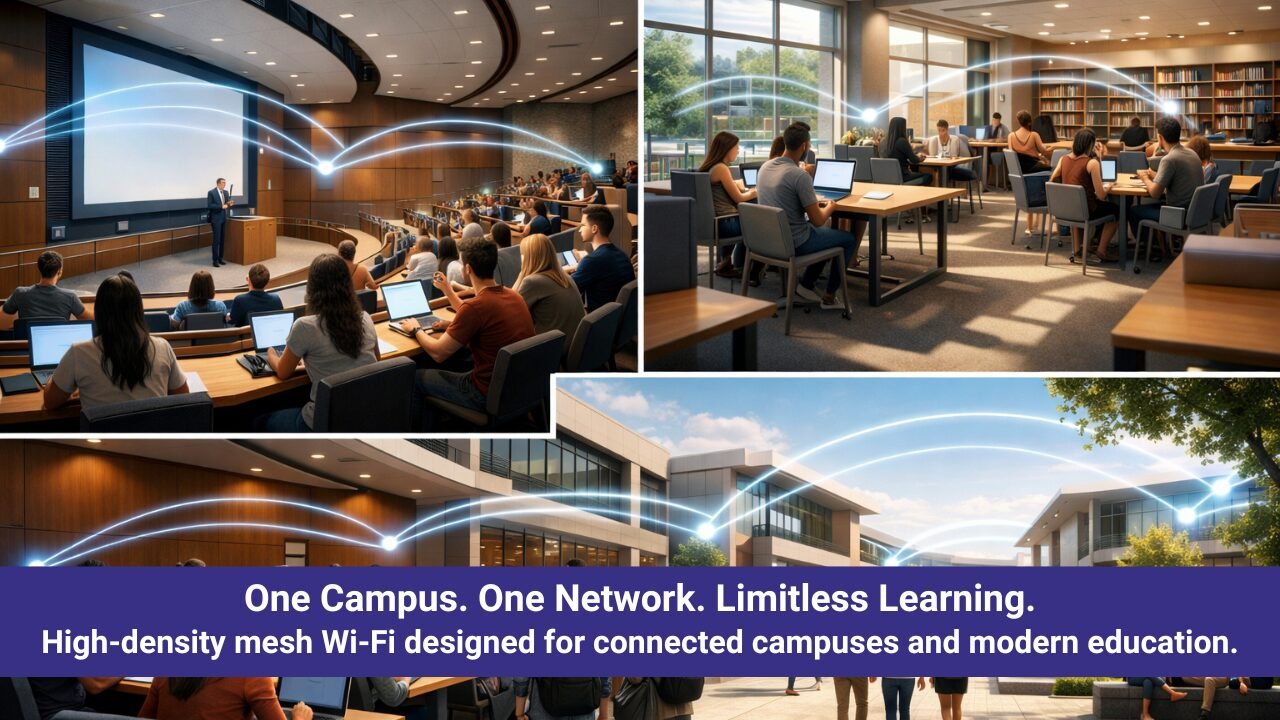
Lecture halls are one of the most demanding environments for wireless networks. Hundreds of students connect at the same time, streaming content, accessing LMS platforms, and participating in live polls.
Challenges in lecture halls:
- High device density
- Interference from overlapping signals
- Latency-sensitive applications
Mesh Wi-Fi advantages in high-density areas:
- Dedicated backhaul for stable performance
- Multiple radios to handle concurrent connections
- Low-latency data forwarding
With high density WiFi solutions for lecture halls, institutions can deliver smooth, interruption-free digital learning experiences even at peak usage.
Seamless Connectivity Across Indoor and Outdoor Campuses
Learning does not stop at classroom doors. Students collaborate in cafeterias, courtyards, hostels, and open spaces. A well-designed mesh network ensures the same level of performance everywhere.
Mesh Wi-Fi supports:
- Continuous connectivity while roaming
- Outdoor coverage without signal drops
- Secure access for students, faculty, and guests
This enables a truly connected campus where learning happens anywhere, anytime.
Security, Reliability, and Centralized Management
Educational networks must balance openness with strong security controls.
Modern mesh Wi-Fi platforms offer:
- Role-based access for students, staff, and visitors
- Secure authentication and encryption
- Centralized dashboards for monitoring and troubleshooting
Institutions can quickly identify issues, manage bandwidth policies, and ensure compliance without disrupting learning activities.
Choosing the Best Mesh Wi-Fi System for Education
Not all mesh solutions are designed for large-scale education networks. Institutions should look for:
Key considerations:
- Scalability for future growth
- Proven performance in high-density environments
- Dedicated backhaul and multi-radio architecture
- Centralized cloud or on-premise management
The best mesh Wi-Fi system is one that aligns with the institution’s size, usage patterns, and long-term digital strategy.
Enterprise-grade mesh solutions, such as those quietly deployed by providers like Aeromesh Systems, are purpose-built to support large campuses with predictable performance and minimal downtime.
Conclusion: Empowering Education Through Connected Campuses
Digital classrooms and connected campuses are no longer optional. They are essential for delivering inclusive, engaging, and future-ready education.
By adopting mesh Wi-Fi, institutions can:
- Eliminate dead zones
- Support high-density learning environments
- Enable seamless digital experiences across campus
With the right mesh Wi-Fi for education, universities and schools can focus on what matters most – empowering students and educators through reliable connectivity.
FAQs
Mesh Wi-Fi uses multiple interconnected nodes to create a single, seamless network. It improves coverage, reliability, and performance across large campuses.
Higher education campuses require scalability, high-density support, and seamless roaming, which traditional Wi-Fi systems cannot reliably deliver.
Yes. Mesh networks with dedicated backhaul and multi-radio designs handle large numbers of concurrent users with low latency and stable performance.
Mesh nodes can be deployed outdoors to extend coverage while maintaining seamless connectivity and centralized management.
The best mesh Wi-Fi system depends on campus size, device density, performance requirements, and long-term scalability goals.