Introduction
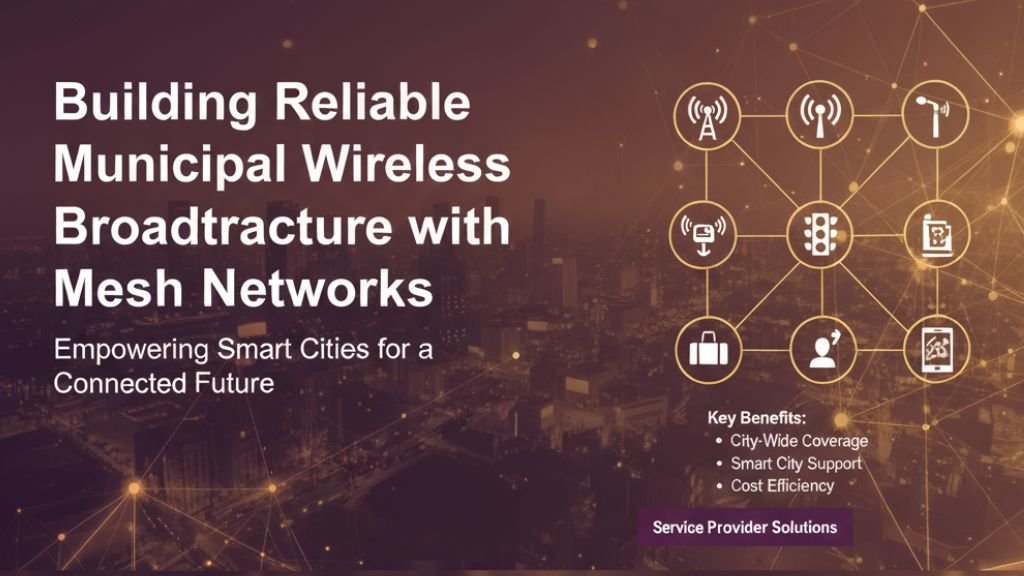
As cities grow and evolve, the demand for faster, more reliable, and more accessible connectivity becomes critical. Modern municipalities are no longer just responsible for delivering water and electricity—they must also provide seamless digital access to empower communities, drive innovation, and support smart city initiatives. One of the most effective ways to achieve this is by investing in municipal wireless broadband infrastructure powered by advanced mesh networks.
Why Municipalities Need Wireless Broadband
Digital services are now essential for education, healthcare, governance, and economic development. Residents expect easy access to high-speed internet in schools, public spaces, and homes. Meanwhile, municipalities are under pressure to support automated meter reading (AMR), smart grid systems, and IoT-enabled city services. Traditional wired networks are costly and complex to scale, making them less practical for large urban or rural deployments.
Wireless mesh networks provide a flexible, cost-efficient alternative, enabling cities to roll out resilient broadband infrastructure quickly and effectively.
<
Key Benefits of Mesh Networks for Municipal Infrastructure
1. City-Wide Coverage
Mesh networks connect multiple nodes across the city, creating overlapping zones that ensure reliable coverage for residents, businesses, and municipal operations. Unlike conventional networks, they can scale easily to cover neighborhoods, towns, or even entire cities.
2. High Reliability and Resilience
Mesh networks are self-healing. If one node fails, traffic is automatically rerouted through others, ensuring uninterrupted connectivity for critical services like public safety, smart traffic systems, and utility monitoring.
3. Support for Smart City Applications
From smart lighting to AMR and IoT devices, municipal services rely on consistent connectivity. Mesh solutions provide the bandwidth and scalability required to handle diverse applications simultaneously.
4. Cost Efficiency
By reducing the need for extensive cabling or trenching, mesh networks significantly cut deployment and maintenance costs. This makes it easier for municipalities to deliver affordable or even free internet services to their communities.
Real-World Applications
- Public WiFi Initiatives: Offering free or low-cost broadband in public spaces.
- Smart Utilities: Supporting AMR for accurate billing and reduced manual effort.
- Disaster Management: Maintaining communication systems during emergencies.
Aeromesh Systems: Enabling Smarter Cities
At Aeromesh Systems Municipal Utilities & AMR Solutions, we provide multi-band, self-healing mesh networks that make municipal deployments easier and more reliable. Our technology enables seamless integration of smart meters, IoT devices, and city-wide broadband to create resilient infrastructure.
For ISPs and municipalities working together, our Service Provider Solutions ensure scalable and cost-effective deployments that benefit both residents and local governments.
Final Thoughts
As cities transform into smart hubs of connectivity, municipal wireless broadband infrastructure will be the foundation for growth, innovation, and efficiency. By leveraging mesh networks, municipalities can deliver reliable connectivity to every corner of the community while supporting a future-ready digital ecosystem. Investing in municipal wireless broadband infrastructure is not just about technology—it’s about empowering citizens and shaping the smart cities of tomorrow.
FAQ’s
Municipal wireless broadband infrastructure refers to citywide or community-wide internet networks deployed by municipalities. These networks often use mesh technology to provide reliable, scalable, and affordable connectivity for residents, businesses, and smart city applications.
For residents, it provides affordable internet access and better connectivity in public spaces. For governments, it supports smart utilities, automated meter reading (AMR), IoT services, and emergency response systems, making city operations more efficient and reliable.