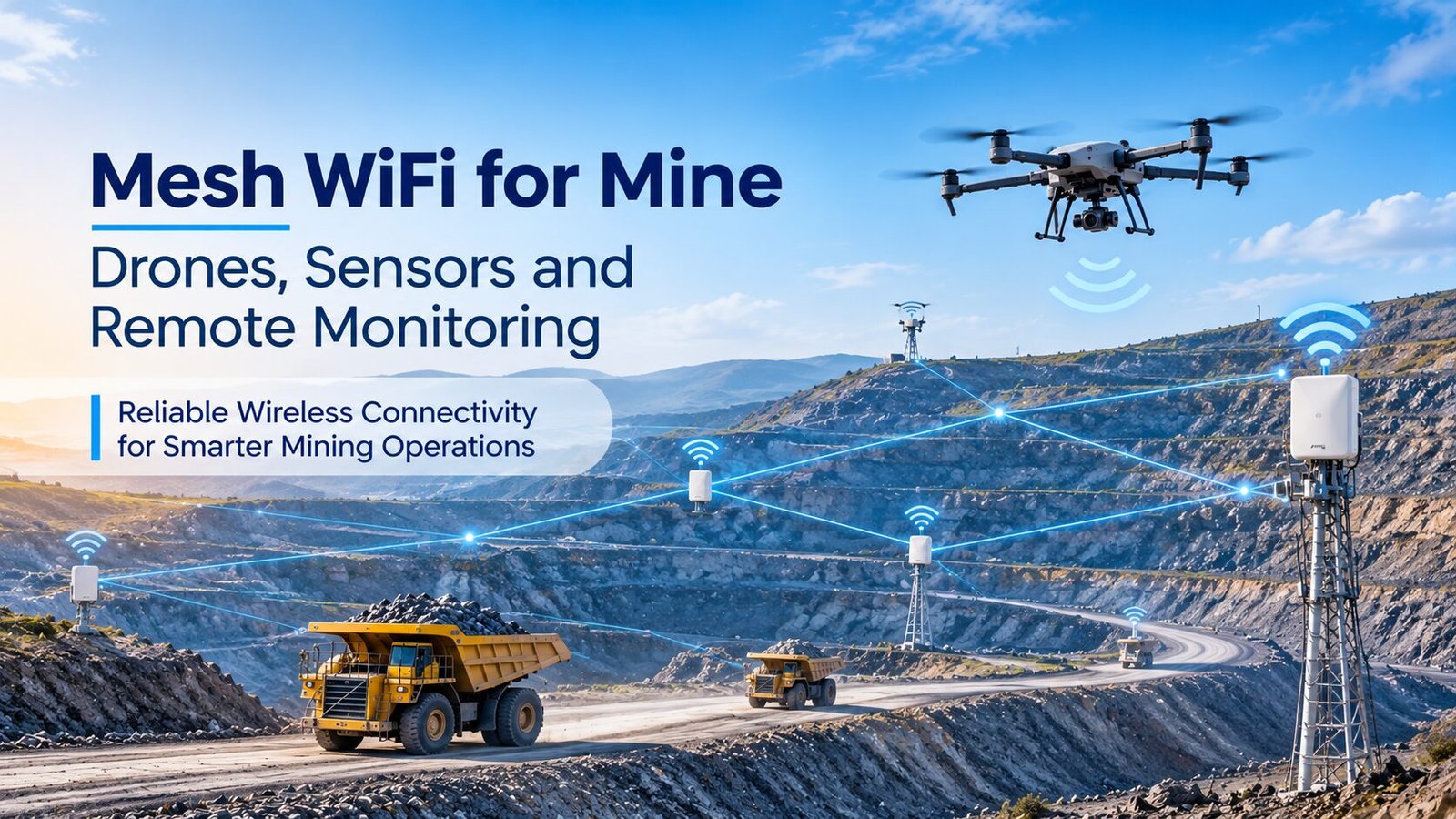
Mining operations are becoming increasingly dependent on real-time information to improve safety, monitor equipment, and manage operations across large and complex sites. Drones inspect difficult-to-access areas, sensors collect equipment and environmental data, and remote monitoring systems help teams make informed decisions. However, these technologies depend on reliable wireless communication.
This is where mesh WiFi for mine environments becomes relevant. A well-designed wireless network can connect different operational areas, support data exchange between devices, and provide connectivity across locations where traditional wired infrastructure may be difficult to extend. This article explains how wireless mesh networking supports mining drones, sensor systems, and remote monitoring, along with the key considerations for deployment.
What Is Mesh WiFi for Mine Operations?
Mesh WiFi for mine operations refers to a wireless networking approach in which multiple network nodes work together to provide connectivity across different areas of a mining site.
Instead of depending entirely on a single access point, mesh networks can establish communication paths between multiple wireless nodes. Depending on the network design, data can travel through intermediate nodes to reach the connected network infrastructure.
This approach is particularly useful in mining environments where operations extend across large geographical areas, changing work locations, and multiple operational zones.
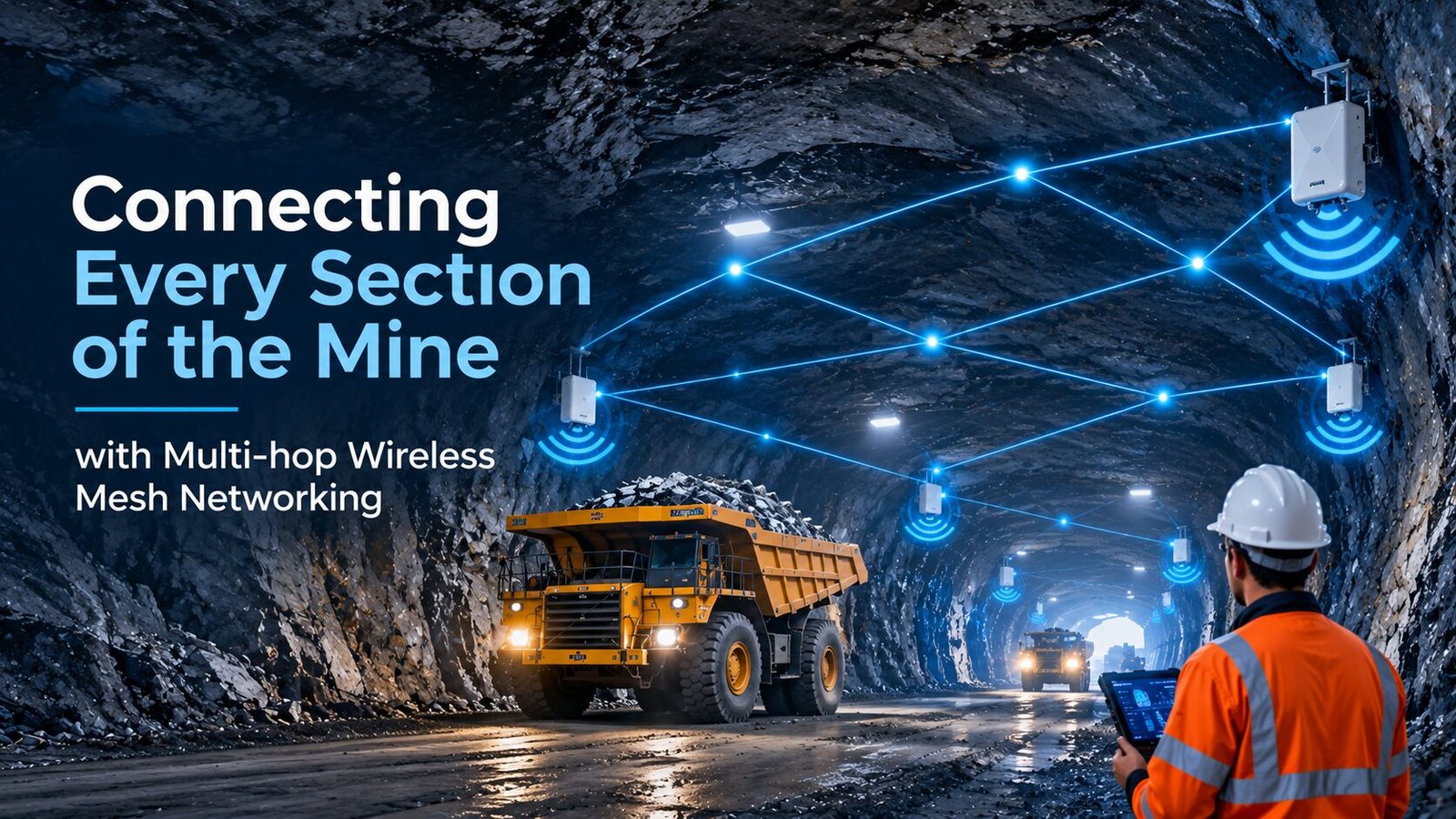
A multi hop wireless mesh network can extend connectivity beyond the immediate coverage of an individual node. It allows network infrastructure to support communication across multiple connected locations without requiring a separate wired connection at every point.
For mining operators, this creates opportunities to connect monitoring devices, operational equipment, and communication systems through a common wireless infrastructure.
Why Mining Operations Need Reliable Wireless Connectivity
Mining sites present several connectivity challenges. Open-pit mines cover extensive areas, while underground operations involve long tunnels, changing work zones, and limited opportunities for conventional infrastructure expansion.
These conditions can affect the reliability and availability of data communication.
Drones require dependable communication links for control, telemetry, and data transfer. Sensors need to transmit information about equipment conditions, environmental parameters, and operational activities. Remote monitoring systems depend on consistent data availability to provide useful operational insights.
Some common challenges include:
Large operational areas: Mining activities may extend across multiple working zones, making it difficult to provide consistent network coverage using conventional access points alone.
Changing equipment locations: Dumpers, inspection vehicles, and other mobile equipment move between operational areas. Their connectivity requirements change as they move.
Infrastructure expansion: Extending wired connectivity to every monitoring point or operational location can require additional installation work and maintenance.
Data availability: Monitoring applications need reliable communication to transfer information between field devices, network infrastructure, and central monitoring systems.
A wireless network designed around mining requirements can help address these challenges while supporting the gradual expansion of connected operations.
How Mesh WiFi for Mine Supports Drones, Sensors and Remote Monitoring
Different mining technologies have different communication requirements. A wireless network must account for these requirements rather than treating every connected device in the same way.
1. Supporting Mining Drones
Mining drones are increasingly used for aerial inspections, surveying, stockpile measurement, and monitoring areas that may be difficult or unsafe for personnel to access.
These applications generate valuable operational data, including images, video, and location information.
Reliable wireless infrastructure can support communication between drone operation areas, ground control facilities, and connected network systems. However, the drone’s control and telemetry link must also be designed around its supported radio technology, operating range, and flight conditions.
A well-planned mesh Wi-Fi network can provide supporting connectivity across ground infrastructure and designated operational zones, helping integrate drone-generated information into wider monitoring workflows.
2. Connecting Mining Sensors
Sensors are essential for collecting information from mining equipment and surrounding environments. They can monitor temperature, vibration, pressure, equipment status, and environmental conditions.
Wireless connectivity allows data from supported sensor gateways and monitoring devices to reach central systems without requiring individual wired connections at every location.
A multi hop wireless mesh network can help extend network connectivity across multiple monitoring points. This can be useful when sensors are distributed across different operational sections.
The network design must account for sensor communication protocols, gateway compatibility, data requirements, and coverage conditions.
3. Enabling Remote Equipment Monitoring
Remote monitoring helps mining teams understand equipment conditions and identify operational issues.
Connected monitoring systems can collect information from vehicles, machinery, and fixed infrastructure. This information can help maintenance teams assess equipment performance and plan inspections.
Wireless mesh networking can provide communication between network-connected equipment, field gateways, and monitoring infrastructure.
For mobile equipment, solutions supporting fast roaming can help maintain connectivity as vehicles move between wireless coverage areas, subject to compatible network configurations and radio conditions.
Key Benefits of a Multi Hop Wireless Mesh Network in Mining
A multi hop wireless mesh network offers several advantages when designed around mining site requirements.
Extended network coverage: Multiple interconnected wireless nodes can help provide connectivity across operational areas that are difficult to cover with a single access point.
Flexible network expansion: Additional nodes can be introduced as operational requirements change, subject to network capacity and coverage planning.
Improved network resilience: Self-healing capabilities can help a network identify alternative communication paths when a supported network link becomes unavailable.
Support for mobile operations: Wireless connectivity and fast roaming capabilities can support communication for compatible mobile equipment moving between coverage areas.
Reduced dependence on extensive cabling: Wireless infrastructure can reduce the need to extend physical network cables to every connected location.
These benefits make mesh networking a useful option for mining operators looking to develop connected and digitally monitored operations.
Best Practices for Deploying Wireless Connectivity in Mining
A successful mining wireless deployment begins with understanding the actual communication requirements of the site.
First, conduct a site assessment to identify operational zones, equipment movement patterns, monitoring locations, and existing network infrastructure. Underground and surface operations may require different network designs.
Second, identify the communication requirements of each connected device. Drone control, video transmission, sensor telemetry, and equipment monitoring may have different bandwidth, latency, and availability requirements.
Third, plan wireless node placement according to coverage, link quality, interference, and network capacity. A multi hop architecture should be designed to maintain suitable communication paths without creating unnecessary network congestion.
Fourth, consider mobility. Mining vehicles and inspection equipment may move between different coverage zones. The network should support appropriate roaming behaviour wherever mobile connectivity is required.
Finally, validate the deployment under actual operating conditions. Testing should cover data throughput, latency, roaming performance, link availability, and the behaviour of the network when individual links become unavailable.
Conclusion
Connected mining operations depend on reliable communication between field devices, equipment, and monitoring systems. Drones, sensors, and remote monitoring applications can provide valuable operational information, but their effectiveness depends on the availability of suitable network infrastructure.
Mesh WiFi for mine environments offers a flexible approach to connecting distributed operational areas through interconnected wireless nodes. With multi hop networking, self-healing capabilities, and support for mobile connectivity, wireless mesh infrastructure can help mining operators build a stronger foundation for digital operations.
Aeromesh can support these connectivity requirements through industrial wireless mesh Wi-Fi solutions designed for demanding operational environments. The right network architecture can help connect mining equipment, monitoring systems, and operational areas while allowing infrastructure to evolve with changing site requirements.
Frequently Asked Questions
Mesh WiFi in mining uses interconnected wireless nodes to provide network coverage across different operational areas. It can support communication between compatible equipment, sensors, gateways, and monitoring systems.
A multi hop wireless mesh network transfers data through multiple interconnected wireless nodes. This allows information to travel across different network locations without requiring a direct connection to a central access point.
Yes. Wireless mesh infrastructure can provide supporting ground connectivity for drone operations, data transfer, and monitoring systems. Drone control and telemetry still require compatible communication links and appropriate coverage planning.
Wireless connectivity allows supported equipment monitoring devices and gateways to transmit operational data to central systems. This helps maintenance and operations teams access information and assess equipment conditions.
Self-healing technology helps a wireless mesh network respond to certain link failures by identifying alternative communication paths. This can improve network resilience and help maintain connectivity across connected operational areas.