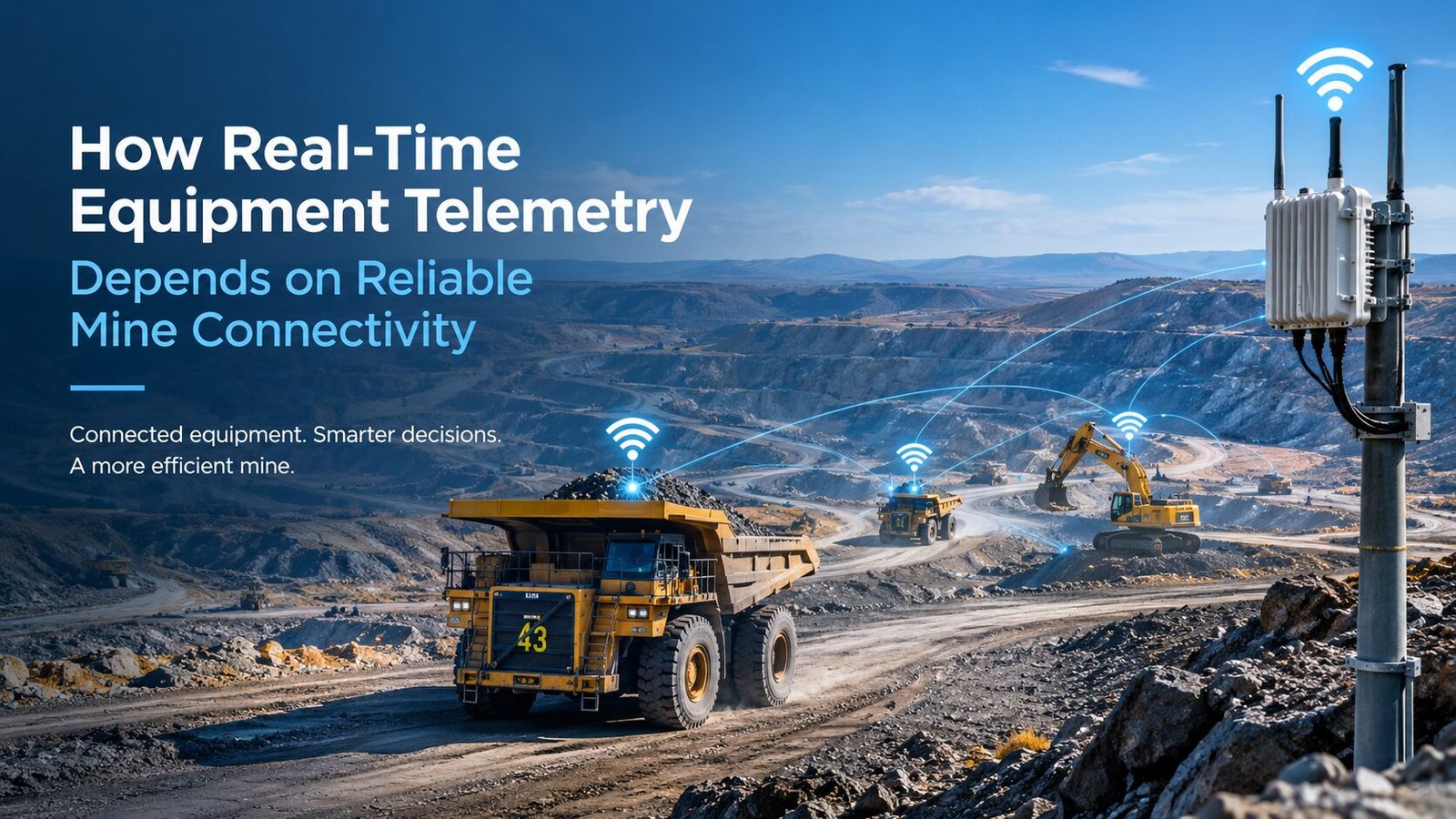
Mining operations increasingly depend on real-time equipment telemetry to monitor machinery, track operating conditions, and support timely maintenance decisions. From haul trucks and drilling equipment to excavators and conveyor systems, connected machines generate data that helps operators understand equipment performance and identify potential problems before they escalate.
However, collecting telemetry is only part of the challenge. The data must also travel reliably from moving equipment to monitoring systems, even when machinery operates across large open pits, changing haul roads, and areas with limited infrastructure.
Reliable real-time equipment telemetry depends on a wireless network that can maintain connectivity as equipment moves and operating conditions change. This article explains the relationship between mine connectivity and telemetry, the networking challenges mining teams face, and how wireless mesh Wi-Fi can support connected mining operations.
What Is Real-Time Equipment Telemetry in Mining?
Real-time equipment telemetry is the collection and transmission of operational data from machinery to monitoring platforms with sufficiently low delay to support timely observation and action.
Mining equipment can generate information about engine temperature, fuel consumption, vibration, location, operating hours, hydraulic pressure, and equipment utilization. Sensors and onboard systems collect this information and transmit it to fleet management platforms, control rooms, or maintenance applications.
For example, vibration data from a drilling machine may indicate an abnormal operating condition. If the information reaches the monitoring system promptly, maintenance personnel can investigate and assess whether intervention is required.
Telemetry does not automatically prevent equipment failure. Its value depends on data quality, monitoring logic, and the ability of personnel to respond appropriately.
Reliable connectivity is essential because telemetry data is useful only when it reaches the systems that need it within the required time.
Why Real-Time Equipment Telemetry Depends on Reliable Mine Connectivity
Mining environments present networking challenges that differ from those in fixed industrial facilities. Equipment travels across large operating areas, infrastructure changes as mining progresses, and machinery may move between locations with different wireless coverage.
When connectivity becomes intermittent, telemetry updates can be delayed, interrupted, or lost, depending on how the onboard equipment and applications handle network disruptions.
Moving equipment and changing coverage
Haul trucks, drilling machines, and excavators move throughout the mine. A wireless access point that provides adequate coverage in one location may not provide the same signal quality along a changing haul road or in another part of the pit.
As equipment moves between coverage areas, the network must support suitable roaming and handoffs. Poorly managed transitions can interrupt data transmission and affect applications that depend on frequent updates.
Network gaps and interrupted data flow
Large mining sites may contain areas where terrain, benches, machinery, or infrastructure placement limits wireless coverage. A single access point may not provide sufficient coverage across the entire operating area.
If equipment enters a coverage gap, its telemetry may stop reaching the monitoring platform until connectivity returns. Whether the data is recovered later depends on local buffering, retransmission, and application design.
Congestion and shared bandwidth
A mine network may carry telemetry alongside video surveillance, voice communications, location tracking, and other operational applications. As the number of connected devices increases, shared bandwidth and interference can affect network performance.
Applications requiring frequent updates need sufficient capacity, stable latency, and an appropriate quality-of-service strategy.
How Wireless Mesh Wi-Fi Supports Mining Telemetry
Wireless mesh Wi-Fi can help extend connectivity across mining areas by allowing network nodes to forward data through multiple wireless links. Instead of requiring every connected device to communicate directly with a central access point, the network can use intermediate nodes to reach the wider infrastructure.
This approach can be useful when equipment and operational areas are spread across a large site. However, the actual performance depends on node placement, radio conditions, interference, traffic load, and the network architecture.
Multi-hop connectivity
In a multi-hop wireless mesh network, data travels through intermediate nodes to reach its destination. This can extend coverage beyond the range of a single wireless link.
For example, a dumper operating farther from the main network may communicate through a nearby mesh node. Additional nodes can relay traffic toward the site network, provided that suitable wireless paths are available.
Engineers must account for the impact of multiple hops on throughput and latency. Shared-radio designs can experience significant capacity reductions as traffic is forwarded through additional hops. Dedicated access and backhaul resources can help manage this constraint.
MIMO for wireless link performance
Multiple-input multiple-output (MIMO) technology uses multiple transmit and receive antennas to improve wireless communication under suitable radio conditions. Depending on the implementation, it can increase throughput, improve link robustness, or make better use of available spectrum.
In mining environments, MIMO can support wireless links carrying telemetry and other operational data. Its effectiveness depends on antenna configuration, signal quality, multipath conditions, and interference.
TDMA for coordinated communication
Time-division multiple access (TDMA) allocates communication opportunities in defined time slots. In supported network designs, this coordination can help manage transmissions between participating nodes and reduce contention.
For mining telemetry, predictable access to the wireless medium can be useful when multiple devices share network resources. Actual latency and performance still depend on scheduling, traffic priorities, radio conditions, and overall network load.
Self-healing and self-tuning capabilities
A self-healing mesh network can redirect traffic when an alternative usable path exists and a link or node becomes unavailable. This can help reduce the impact of individual network disruptions.
Self-tuning capabilities can adjust selected network parameters in response to changing conditions. These features can support network stability, but they do not eliminate every outage. Redundant paths, suitable coverage, and proper configuration remain essential.
Operational Benefits of Reliable Connectivity for Mining Equipment
A well-engineered mine wireless network can improve the availability and timeliness of operational data.
Faster identification of abnormal conditions: When telemetry arrives consistently, monitoring systems can identify unusual temperature, vibration, or pressure readings sooner. Maintenance teams can investigate these signals and prioritize inspections.
Improved fleet visibility: Reliable connectivity supports more consistent reporting of equipment status, location, operating hours, and utilization. This information helps fleet managers understand how equipment is being used across the site.
Better support for remote monitoring: Engineers and supervisors can review equipment information without always needing to be physically present near the machinery. The value depends on application availability and the quality of the underlying data.
More flexible network expansion: Wireless mesh infrastructure can be extended or reconfigured as mining areas change. This can reduce the need to install fixed wired connections at every new coverage location, although power, backhaul, mounting, and site infrastructure may still be required.
Choosing the Best WiFi for Mining Telemetry
The best WiFi for mining is not determined by coverage range or peak data rate alone. Mining teams should evaluate the network against their telemetry requirements, operating conditions, and future expansion plans.
Key considerations include:
- Coverage and mobility: Validate coverage across haul roads, loading areas, drilling zones, and other operational locations, including roaming between access points.
- Latency and capacity: Measure end-to-end delay, throughput, packet loss, and performance under realistic device loads.
- Network resilience: Assess redundant paths, node failure recovery, interference management, and the availability of alternative routes.
- Backhaul architecture: Evaluate how traffic moves through the network and whether dedicated backhaul resources are needed to maintain capacity across multiple hops.
- Integration and security: Confirm compatibility with onboard systems, telemetry platforms, authentication, encryption, and existing IT/OT policies.
A site survey and pilot deployment can help validate these requirements before a wider rollout. Engineers should test the network with representative equipment, actual telemetry traffic, and realistic operating conditions rather than relying solely on theoretical coverage estimates.
How Aeromesh Systems Can Support Connected Mining Operations
Aeromesh Systems designs and manufactures wireless mesh Wi-Fi networking equipment for industrial and infrastructure environments. Its approach to industrial connectivity can support mining applications where coverage must extend across changing operating areas and connected equipment needs access to operational data.
Multi-hop networking can help extend wireless coverage, while MIMO and TDMA capabilities can support wireless link performance and coordinated communication in suitable network configurations. Self-healing and self-tuning capabilities can further help manage changing network conditions.
For mining teams evaluating connectivity for fleet telemetry, the appropriate design depends on the site layout, equipment mobility, required data rates, latency limits, and backhaul availability.
The objective is to build a network that can support consistent data delivery as mining operations evolve, while providing a practical path for expansion and integration with monitoring systems.
Conclusion
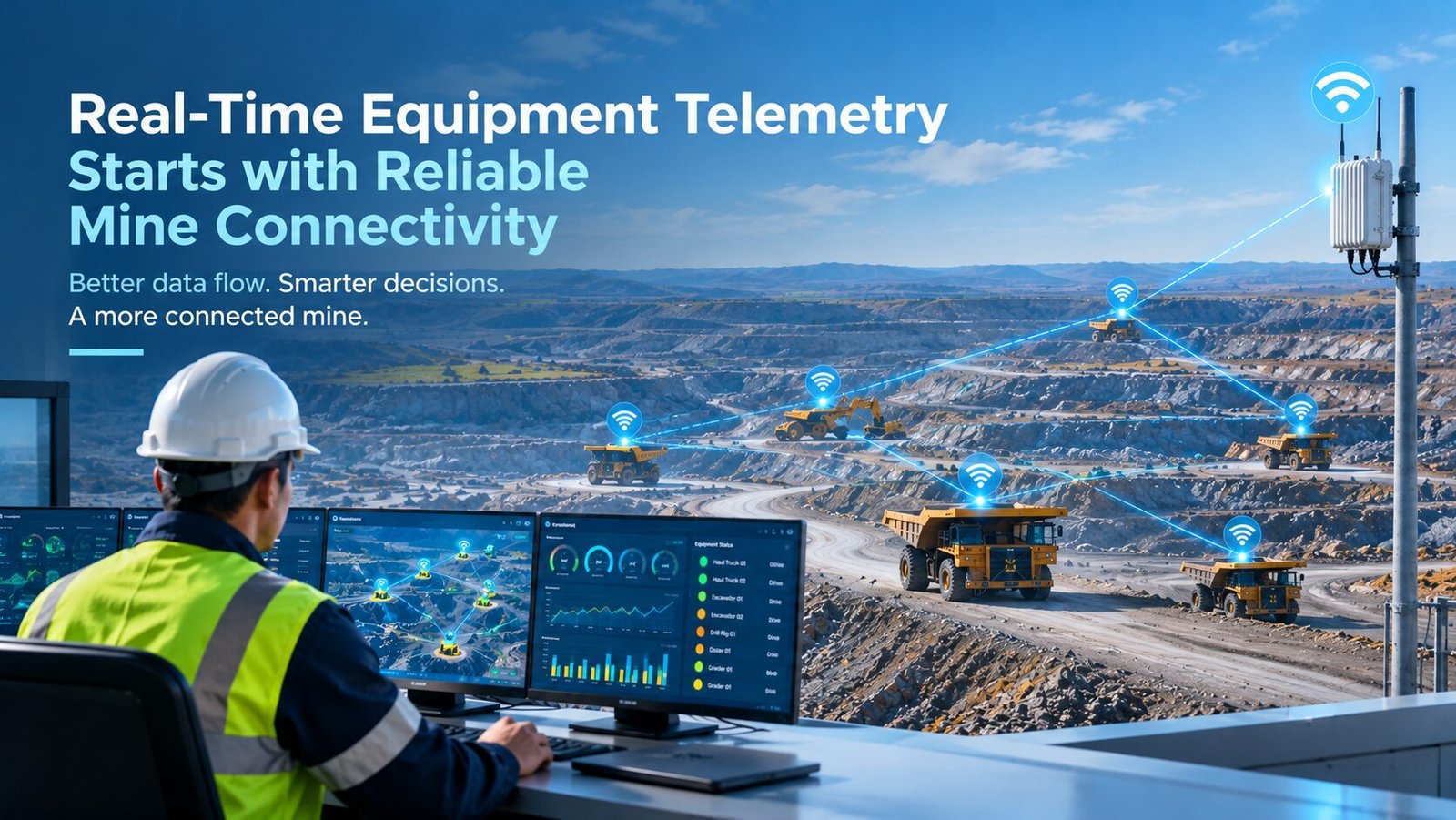
Real-time equipment telemetry depends on more than sensors and monitoring software. It requires reliable mine connectivity that can support moving equipment, changing coverage requirements, and continuous data transmission.
Wireless mesh Wi-Fi, multi-hop connectivity, MIMO, TDMA, and self-healing capabilities can help address these challenges when supported by sound network engineering and site-specific validation.
For mining operators, the priority should be to evaluate connectivity against actual telemetry requirements and operational conditions. A well-planned network helps make equipment data more accessible, supporting better-informed maintenance and fleet management decisions.
Frequently Asked Questions
Reliable connectivity helps equipment send operational data to monitoring platforms with fewer interruptions. This allows teams to review equipment conditions and respond to relevant alerts more promptly.
WiFi for mining connects onboard devices and sensors to monitoring systems, supporting the transmission of information such as equipment status, location, vibration, temperature, and utilization.
A wireless mesh network can extend coverage through multiple wireless links. The achievable area and performance depend on terrain, node placement, interference, radio capacity, and backhaul design.
Multi-hop networking forwards data through intermediate nodes to extend connectivity. TDMA coordinates transmissions using time slots, which can help manage shared wireless resources in supported network designs.
Mining teams should evaluate coverage, mobility, roaming, latency, throughput, resilience, backhaul capacity, cybersecurity, and integration with existing telemetry systems. Site testing is essential before deployment.