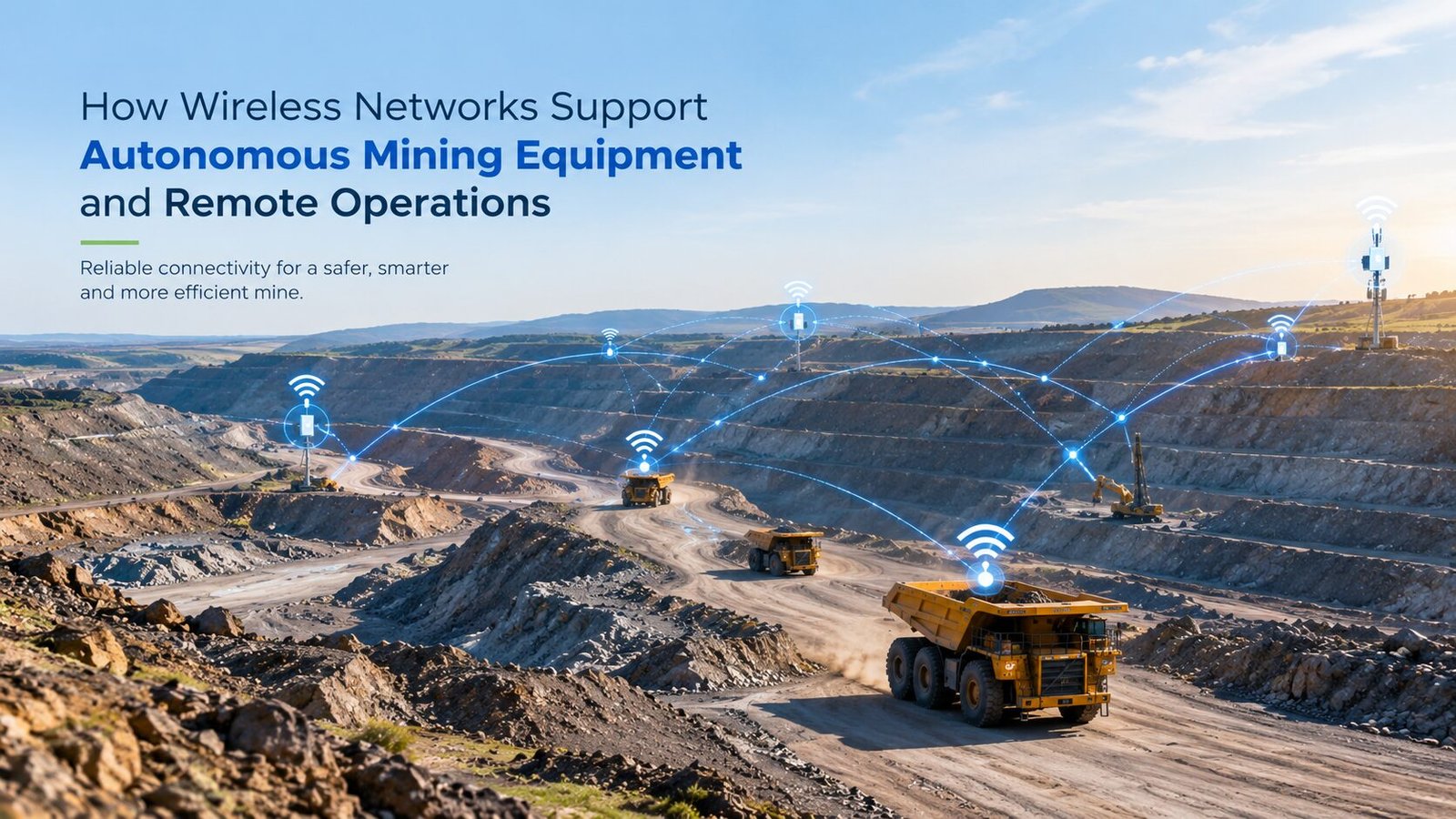
Mining operations are becoming increasingly dependent on autonomous vehicles, remote monitoring, fleet management, and real-time industrial data. As equipment moves across large pits, haul roads, stockyards, and other operational areas, maintaining reliable connectivity becomes a critical part of the infrastructure. A mesh WiFi for mine architecture can provide continuous wireless coverage where fixed network infrastructure alone may not be practical.
Autonomous mining equipment depends on wireless communication to exchange telemetry, positioning information, machine data, video, alerts, and control-related information. Any disruption can affect visibility and operational continuity. This makes network design an important consideration for mines adopting automation and remote operations.
Why Connectivity Matters for Autonomous Mining Equipment
Autonomous and remotely operated equipment continuously generates and exchanges data. Depending on the application, this can include equipment status, location, diagnostics, sensor information, video streams, and operational alerts.
Unlike conventional office networks, mining networks must support moving assets over large and changing areas. Haul roads can extend across considerable distances, while benches, pits, machinery, and other structures can influence radio propagation.
A reliable wireless infrastructure therefore needs to provide more than basic internet access. It must maintain communication as equipment moves between coverage areas and support applications that depend on consistent connectivity and low latency.
How Mesh WiFi for Mine Operations Extends Coverage
A wireless mesh network uses multiple interconnected nodes to distribute connectivity across an operational area. Instead of relying entirely on a single access point or a continuous wired connection to every location, mesh nodes can relay traffic through multiple wireless paths.
For mining environments, this architecture can be useful when equipment operates beyond the practical reach of a single wireless access point.
A high performance wireless mesh network can support:
- Multi-hop communication across large operational areas
- Wireless connectivity for moving vehicles and machinery
- Alternative communication paths when a node becomes unavailable
- Flexible expansion as mining areas change
- Connectivity for industrial IoT and telemetry applications
The network architecture should also account for the performance impact of multiple wireless hops. Using appropriate radio separation for client access and backhaul traffic can help maintain network capacity as data travels through the mesh.
Supporting Remote Operations and Fleet Visibility
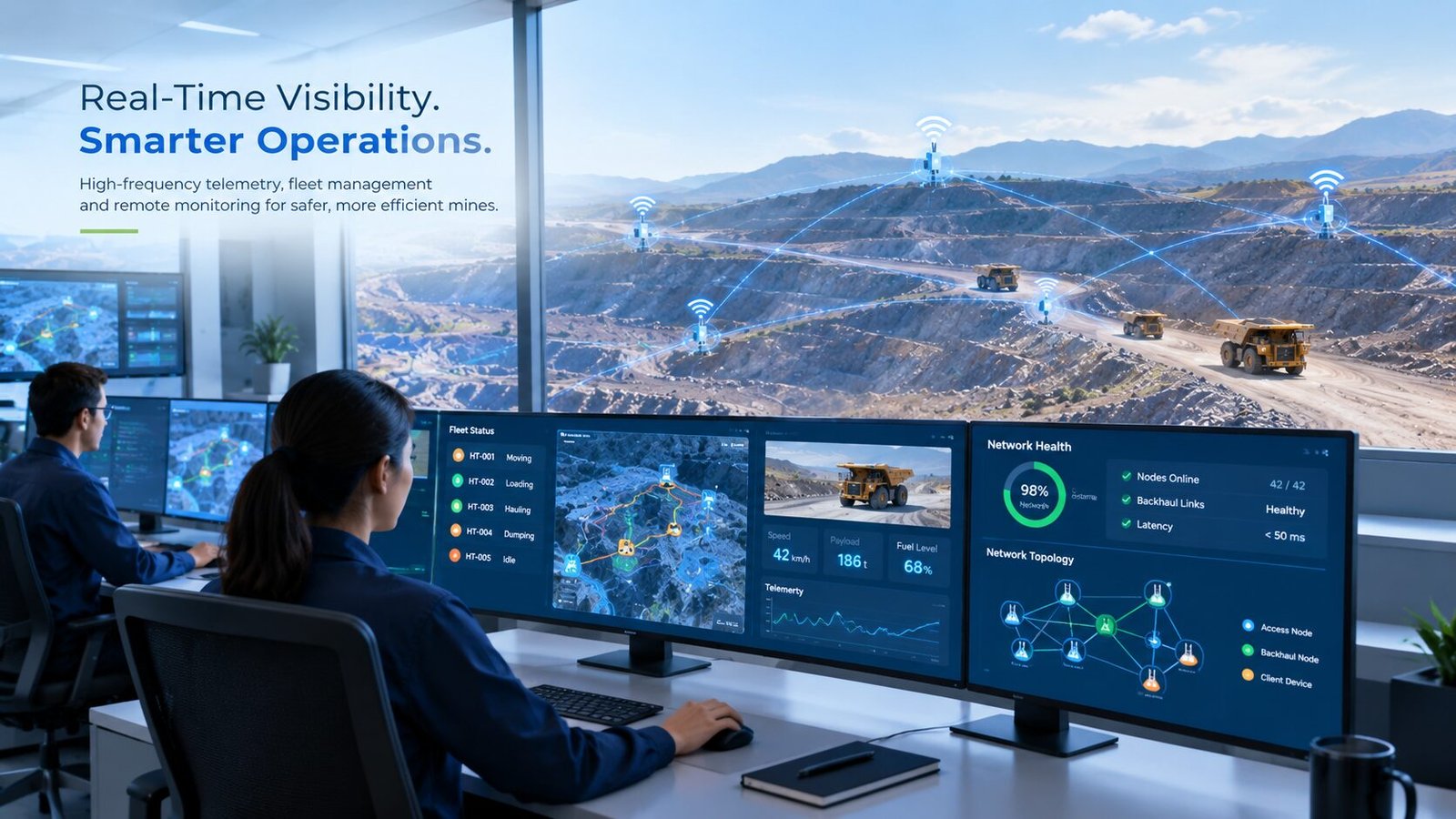
Remote operations depend on a reliable flow of information between equipment in the field and systems used by operators or control teams.
For example, a fleet management platform may need regular equipment telemetry to monitor vehicle location, operating conditions, utilization, or alerts. Video-based applications may require considerably more bandwidth, while control-related applications can be more sensitive to latency and interruptions.
Wireless solutions for mining therefore need to be designed around the actual application requirements rather than coverage alone.
A well-designed network can provide connectivity between mobile equipment and fixed infrastructure while allowing operational data to reach centralized or edge-based systems. This creates a communication layer that supports automation without requiring every moving asset to depend on a direct wired connection.
Self-Healing Networks for Changing Mining Environments
Mining environments change continuously. Equipment moves, working areas expand, haul routes change, and temporary operational zones can appear.
This makes network resilience particularly important. In a mesh architecture, nodes can communicate through alternative paths. If one path becomes unavailable, traffic can potentially be redirected through another available route, depending on the network design.
Self-healing capabilities can reduce the dependency on a single wireless link and help maintain connectivity as conditions change.
However, self-healing alone does not guarantee application performance. Network planners should consider node placement, radio interference, available backhaul capacity, hop count, traffic requirements, and redundancy during deployment.
Key Considerations When Deploying Mining Wireless Networks
A mining wireless network should be designed around the physical environment and the applications it needs to support.
Important considerations include:
Coverage and terrain: Open pits, benches, stockpiles, buildings, and other structures can affect wireless propagation.
Mobility: The network should support equipment moving between coverage areas without creating unnecessary communication interruptions.
Backhaul capacity: Each mesh hop can introduce additional traffic and capacity constraints, making radio architecture and link planning important.
Application requirements: Telemetry, video, fleet management, automation, and voice communications can have different bandwidth and latency requirements.
Network resilience: Redundant paths and appropriate node placement can help reduce the impact of individual link or node failures.
Future expansion: Mining operations change over time, so the network should allow additional nodes and coverage areas to be introduced without redesigning the entire infrastructure.
Where Mesh Networks Fit in Autonomous Mining
Mesh networking is particularly relevant where mobile equipment operates across areas that are difficult or expensive to connect entirely through fiber.
Typical applications can include autonomous haulage, remote equipment monitoring, fleet management, high-frequency telemetry, industrial IoT, machine diagnostics, and operational video.
The objective is not simply to provide WiFi across a mine. The objective is to create a wireless communication layer capable of supporting the data flows required by increasingly connected mining operations.
Conclusion
Autonomous mining equipment and remote operations require dependable communication across large and constantly changing operational areas. A properly engineered mesh WiFi for mine architecture can extend wireless coverage, support mobile equipment, provide multiple communication paths, and connect applications such as telemetry, fleet management, and industrial IoT.
For mining operators, the most effective approach is to design the wireless network around application requirements, mobility, terrain, backhaul capacity, and resilience. As automation increases, reliable wireless infrastructure will become an increasingly important part of the connected mine.
Frequently Asked Questions
Mesh WiFi for mine operations uses interconnected wireless nodes to extend connectivity across large mining areas, allowing equipment and industrial applications to communicate through multiple network paths.
Autonomous equipment relies on wireless communication for telemetry, positioning, diagnostics, alerts, video, and other operational data. Reliable connectivity helps maintain communication as equipment moves across the mine.
Yes. A high performance wireless mesh network can support mining telemetry when it is properly engineered for bandwidth, latency, mobility, interference, hop count, and application requirements.
Wireless solutions for mining can connect mobile equipment with fleet management, monitoring, automation, and edge systems, allowing operational data to move between field assets and remote teams.
Key factors include terrain, coverage, equipment mobility, radio interference, backhaul capacity, network redundancy, application requirements, and the ability to expand coverage as mining operations change.