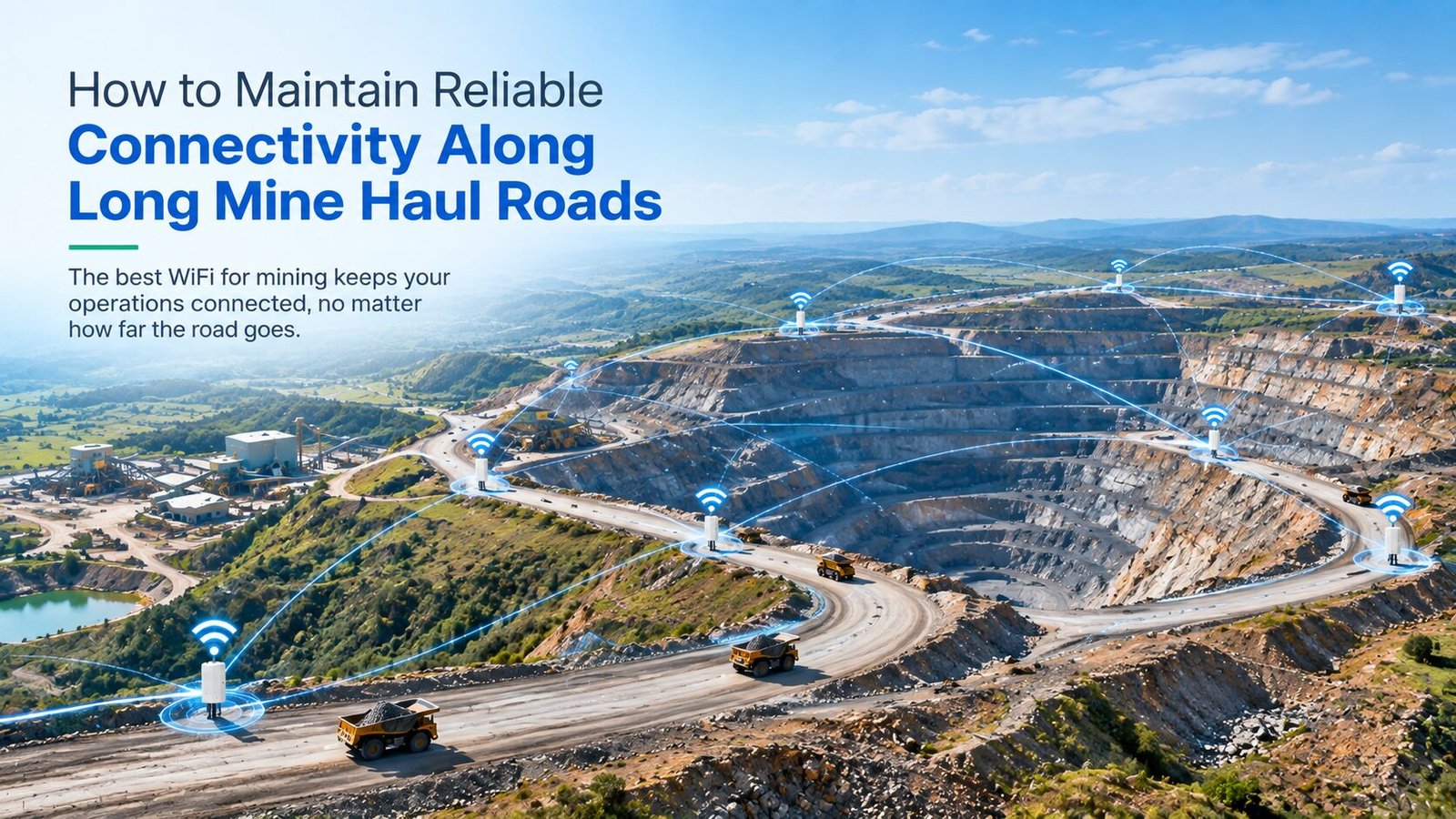
Long mine haul roads create a difficult wireless networking environment. Haul trucks move continuously between loading points, crushers, stockpiles, workshops, and dumping areas, while road layouts and operating zones can change as mining progresses. For mine operators looking for the best wifi for mining, the challenge is not simply providing Wi-Fi coverage. The network must maintain reliable connectivity while vehicles move through large, changing areas.
Reliable connectivity supports fleet communication, equipment telemetry, dispatch systems, video, worker communication, and other industrial applications. This article explains the main challenges of haul-road connectivity and the network design practices that can help maintain consistent wireless coverage across large mining sites.
Why Long Haul Roads Are Difficult to Cover
A long haul road can extend across several kilometres and may pass through changing terrain, curves, elevation differences, and areas with limited infrastructure. A conventional access-point deployment may provide strong coverage in fixed areas but struggle when connectivity needs to extend continuously along a moving route.
The network also needs to support mobile equipment. A dump truck or haul truck can move from one coverage zone to another while applications remain active. If the connection drops during this transition, telemetry, video, voice communication, or control-related data may be interrupted.
Mining environments add another challenge: the network itself may need to move or expand as the mine develops. New benches, roads, loading areas, and operational zones can change the original coverage requirements.
Key Connectivity Challenges Along Mine Haul Roads
Several factors can affect wireless performance along long haul routes.
Distance and terrain: Wireless signals can weaken over long distances, particularly where terrain, elevation, rock faces, or other obstacles interfere with the radio path.
Changing mine geometry: Open-pit mines evolve continuously. A network designed around today’s haul-road layout may require changes as roads are extended, relocated, or redirected.
Mobile clients: Trucks and other equipment constantly move between wireless coverage areas. Stable roaming and handoffs become important when applications cannot tolerate frequent disconnections.
Multi-hop performance: In a wireless mesh network, traffic may travel through multiple wireless nodes before reaching the network core. Each additional hop can affect available throughput and latency if the architecture is not properly engineered.
Harsh operating conditions: Dust, vibration, temperature variations, and physical exposure can influence equipment selection and installation requirements.
These challenges mean that wireless solutions for mining need to be designed around the actual operational environment rather than simply the theoretical coverage area of individual access points.
How a High Performance Wireless Mesh Network Helps
A High performance wireless mesh network can extend connectivity across areas where installing wired infrastructure at every location is difficult or impractical.
In a mesh architecture, wireless nodes can relay traffic between one another. This allows connectivity to be extended along a haul road without requiring every network node to have a direct wired connection to the central network.
However, mesh should not be treated as simply adding more wireless nodes. Network architecture has a direct effect on performance. Where possible, dedicated radios for client access and backhaul can help separate user traffic from the wireless links carrying traffic between network nodes.
Backhaul capacity is particularly important. As traffic travels across multiple hops, available throughput can decline. Applications such as high-frequency equipment telemetry, operational video, and other data-intensive workloads therefore require careful radio planning, channel allocation, and capacity calculations.
A properly engineered mesh network can also provide alternate communication paths. If one wireless path becomes unavailable, traffic may be able to use another route, improving network resilience.
Designing Connectivity for Moving Mining Equipment
Haul-road connectivity needs to account for movement, not just static coverage.
Mobile equipment should be able to transition between coverage areas without causing unnecessary interruptions. This makes roaming performance, radio configuration, client behaviour, and network planning important considerations.
For example, a haul truck carrying an onboard wireless client may travel from one mesh node’s coverage area to another. If the transition is poorly managed, the truck’s telemetry connection may experience packet loss or a temporary interruption.
The network should therefore be evaluated using real movement patterns rather than only stationary signal measurements. Engineers should consider:
- Typical truck routes and travel speeds
- Road intersections and turning areas
- Loading and dumping points
- Coverage overlap between wireless nodes
- Expected client density
- Required application throughput and latency
- Backhaul capacity across each hop
This approach helps ensure that wireless coverage supports actual mining operations rather than simply producing acceptable signal levels on a coverage map.
Best Practices for Reliable Mine Haul-Road Connectivity
A reliable deployment begins with understanding how the mine operates. Network planning should consider current requirements as well as expected changes to the mine layout.
Wireless nodes should be positioned to provide appropriate coverage overlap while maintaining sufficient backhaul quality. Excessive reliance on long wireless links can create weak points in the network, particularly when terrain changes or additional traffic is introduced.
Capacity planning is equally important. A network that works well with a small number of clients may experience congestion as more trucks, sensors, cameras, and industrial devices are connected.
Redundancy should also be considered for critical areas. Where operational requirements justify it, alternate paths can help maintain connectivity if a node or wireless link becomes unavailable.
Finally, network monitoring should be continuous. Engineers can use performance information such as link quality, throughput, latency, packet loss, client associations, and node health to identify degradation before it becomes an operational problem.
Where Reliable Mining Connectivity Supports Operations
Reliable haul-road connectivity can support a range of mining applications.
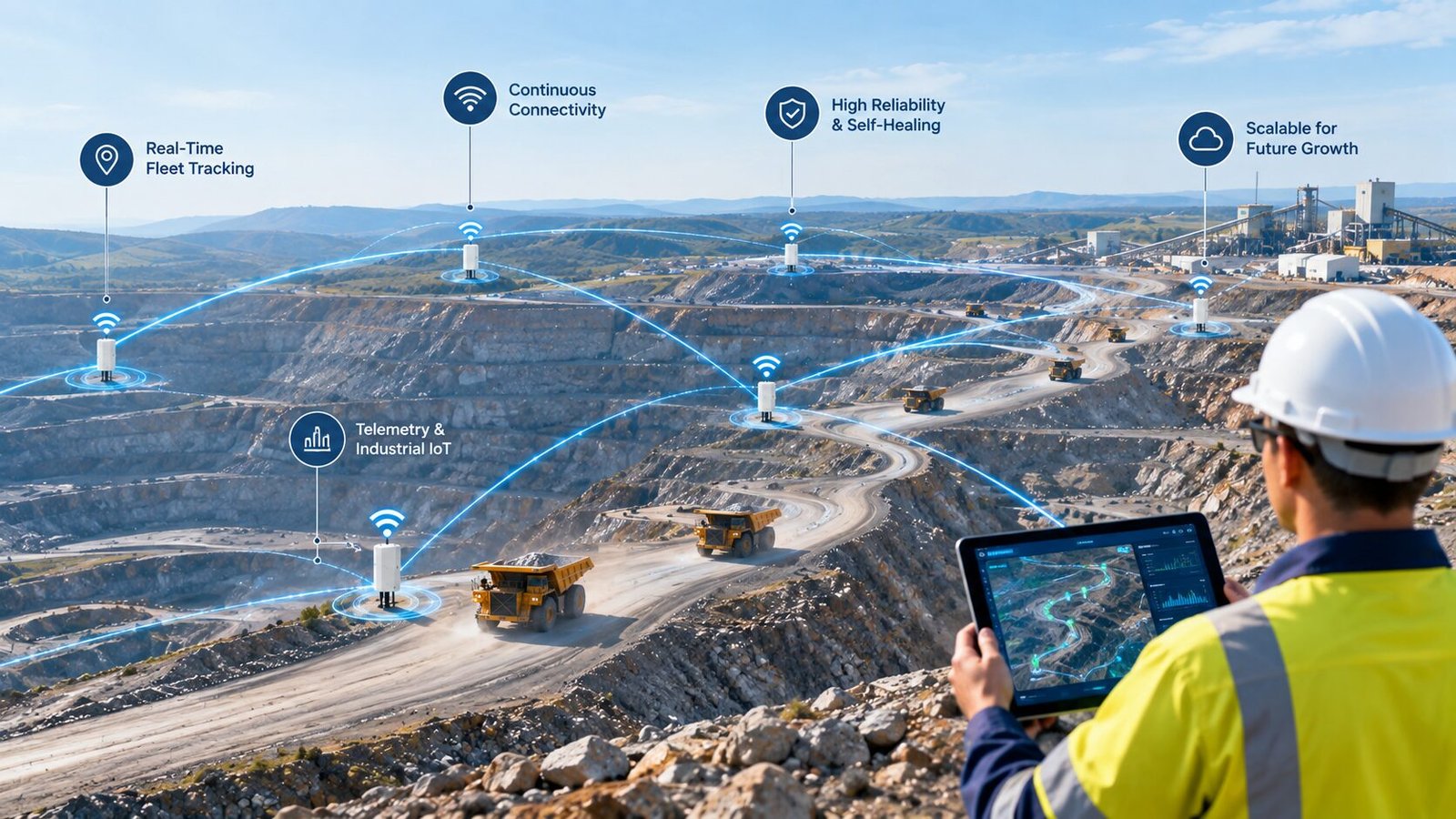
Fleet management systems can use continuous wireless connectivity to exchange vehicle information and operational data. Equipment telemetry can provide timely information about machine performance, location, and operating conditions.
Real-time communication can also help personnel coordinate activities across large mining areas. Video and other bandwidth-intensive applications may require higher-capacity wireless links and careful traffic planning.
As mines introduce more automation and industrial IoT applications, network requirements can become more demanding. A scalable wireless architecture can provide a connectivity foundation that can evolve alongside these applications.
Building a Network That Can Evolve With the Mine
Mining networks should not be designed as if the physical environment will remain unchanged. Haul roads move, working areas expand, and equipment fleets change.
This makes scalability an important part of network design. A wireless architecture should allow additional nodes or coverage areas to be introduced without requiring a complete redesign of the existing network.
Self-healing capabilities can also be useful in large deployments. If a wireless path becomes unavailable, an appropriately designed mesh architecture can potentially reroute traffic through another available path.
For mine operators, the objective is not simply maximum coverage. The objective is dependable connectivity that can support current operations while adapting to the mine’s future requirements.
Conclusion
Maintaining connectivity along long mine haul roads requires more than placing wireless access points at regular intervals. Terrain, vehicle movement, changing mine geometry, multi-hop performance, roaming, capacity, and network resilience all need to be considered.
For operations evaluating the best wifi for mining, a properly engineered wireless mesh architecture can provide a scalable approach to extending connectivity across large and changing mine environments. The right design combines appropriate node placement, sufficient backhaul capacity, reliable roaming, redundancy, and continuous network monitoring.
The result is a wireless infrastructure that can better support fleet communication, telemetry, industrial IoT, video, and other applications as mining operations continue to evolve.
Frequently Asked Questions
The best WiFi for mining haul roads depends on terrain, coverage distance, client mobility, throughput requirements, and mine layout. A properly engineered wireless mesh network can extend connectivity across changing haul-road environments.
Mesh Wi-Fi allows wireless nodes to relay traffic across large areas, reducing the need to connect every coverage point directly through wired infrastructure. It can also provide alternate communication paths when properly designed.
Mining equipment can maintain connectivity through overlapping wireless coverage and properly engineered roaming between network nodes. Radio configuration, client behaviour, network capacity, and coverage planning all affect handoff performance.
Terrain, distance, elevation changes, obstacles, radio interference, node placement, antenna configuration, and environmental conditions can all affect wireless coverage along mine haul roads.
Yes. Properly designed wireless solutions for mining can support industrial IoT applications such as equipment telemetry, fleet management, location data, monitoring, video, and operational communication, provided the network is engineered for the required traffic.