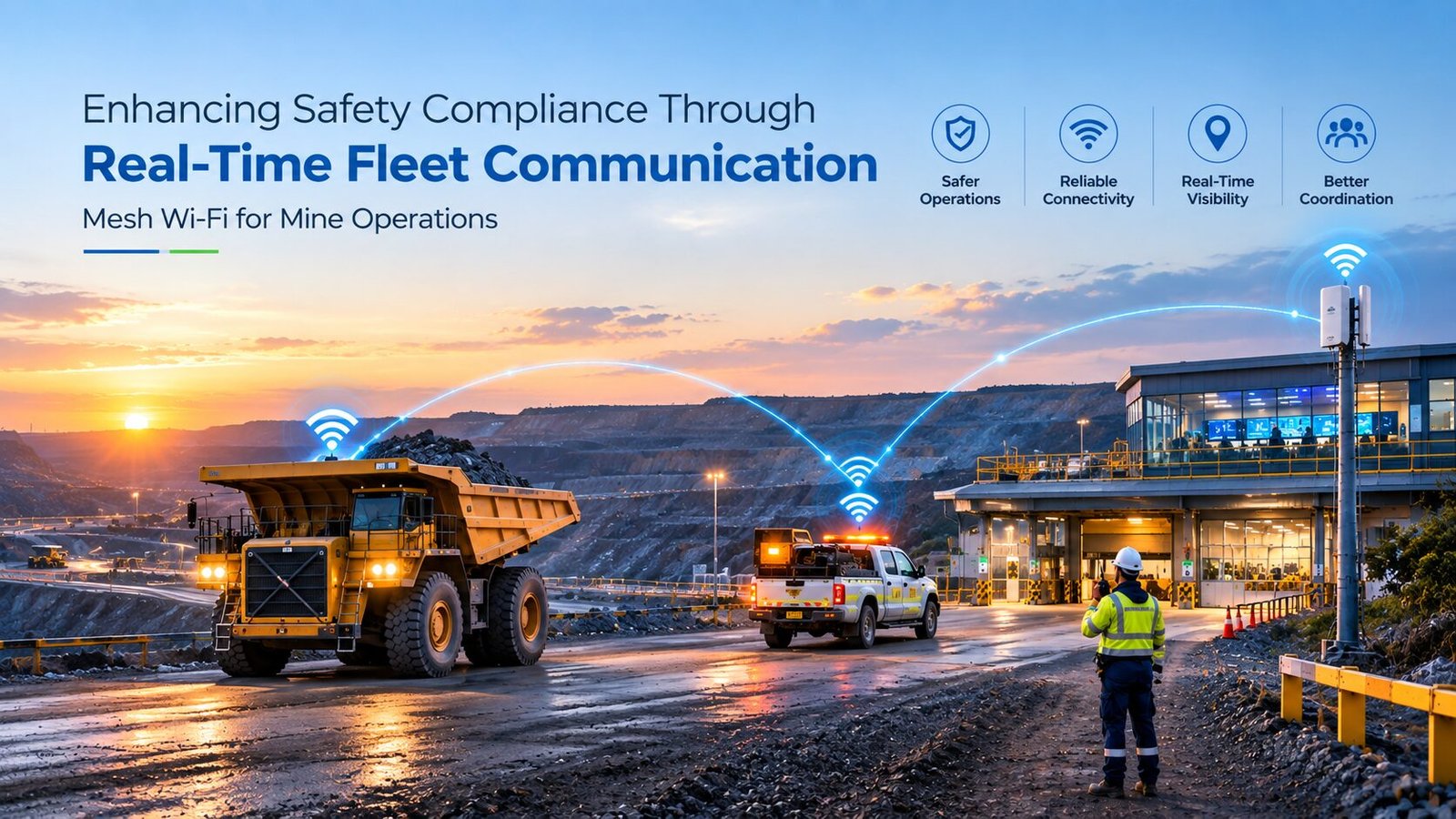
A haul truck approaching a blind turn, a maintenance vehicle entering a restricted zone, or a delayed emergency alert can create serious safety challenges in mining. Reliable communication between fleet vehicles, control rooms, and field teams is essential for coordinating operations and responding to hazards. Traditional wireless networks may struggle to maintain connectivity across changing mine layouts, large open pits, and moving equipment. Mesh Wi-Fi for mine operations provides an approach to extending wireless coverage and maintaining communication across distributed industrial environments.
Real-time fleet communication is not simply about providing internet access to vehicles. It supports timely safety notifications, equipment coordination, location-aware workflows, and communication between workers and supervisors. This article explains how industrial wireless mesh networks support fleet communication, the challenges that affect safety-related connectivity, and the deployment practices that help mining and industrial teams build more reliable communication infrastructure.
What Is Mesh Wi-Fi for Mine Operations?
Mesh Wi-Fi for mine operations uses multiple wireless nodes to create a connected network across mining areas. Instead of relying on a single access point or a fixed wireless link, mesh nodes can relay data between one another, allowing connected equipment to communicate across a larger area.
In a mining fleet, wireless client radios installed on dumpers, haul trucks, service vehicles, or other mobile equipment connect to the network. Fixed or strategically positioned mesh nodes provide access and backhaul connectivity, while a central management system can monitor network performance.
A high performance wireless mesh network can support several communication paths between vehicles and control infrastructure. If a particular wireless path becomes unavailable, network designs with alternate routes can help maintain connectivity. The actual level of resilience depends on node placement, radio configuration, interference, and available backhaul capacity.
Why Real-Time Fleet Communication Matters for Safety Compliance
Safety compliance in mining involves following established procedures for vehicle movement, equipment operation, hazard management, and emergency response. Communication infrastructure supports these procedures by helping personnel receive information when it is needed.
For example, a mine may have a designated speed limit near a loading area or a temporary restriction around maintenance work. Fleet communication systems can deliver operational notifications to vehicle operators and supervisors, while monitoring systems can record relevant events.
The network does not replace safety procedures or independently establish compliance. Instead, it provides the connectivity needed for communication, monitoring, and coordination.
Common safety-related communication requirements include:
- Delivering alerts from control systems to vehicle operators.
- Supporting voice communication between field teams and control rooms.
- Sharing equipment status and location information.
- Maintaining connectivity during movement across haul roads and work zones.
Key Connectivity Challenges in Mining Fleets
Mining environments introduce several challenges that can affect communication reliability. Large pits, changing terrain, dust, equipment movement, and interference from industrial machinery can make wireless coverage difficult to maintain.
A traditional network that depends on a small number of fixed access points may have coverage gaps when vehicles move beyond their range. Fiber connections can provide strong fixed infrastructure, but extending fiber to every changing work area may require additional civil work and maintenance.
Another challenge is network congestion. A busy fleet may generate telemetry, operational data, video, and voice traffic simultaneously. When these applications share limited wireless capacity, latency and packet loss can affect time-sensitive communication.
The network must also accommodate changes in mine geometry. Haul roads, loading zones, and active work areas can shift as extraction progresses. A fixed network design may require frequent adjustments to remain effective.
How a High Performance Wireless Mesh Network Supports Fleet Communication
A high performance wireless mesh network provides a distributed connectivity layer for mobile and fixed industrial equipment. Its value comes from the way wireless nodes, backhaul links, and management systems work together.
In a mine, fixed mesh nodes can relay traffic from mobile equipment toward a control room or network gateway. When the design includes alternate paths, data can potentially use another route if a link becomes unavailable.
For example, a dumper carrying a wireless client radio moves along a haul road while sending equipment telemetry. As it moves, the radio connects through available mesh infrastructure. A network with overlapping coverage and suitable roaming support can reduce communication interruptions as the vehicle transitions between nodes.
Multi-radio designs can further improve network performance by separating client access from backhaul traffic. Dedicated ingress and egress backhaul radios can help reduce contention between vehicle communication and the traffic used to connect mesh nodes. This is particularly useful in multi-hop environments where each relay introduces additional traffic demands.
However, wireless mesh does not eliminate the need for engineering. Every hop consumes wireless capacity, and poor radio planning can reduce throughput. Network teams should validate latency, throughput, coverage, and failover performance under realistic operating conditions.
Real-Time Fleet Communication Use Cases
Vehicle-to-Control-Room Communication
Fleet operators and control-room personnel can exchange information about equipment movement, operational restrictions, and developing hazards. A reliable network supports voice, data, and other approved communication applications.
Equipment Telemetry and Alerts
Sensors on mobile machinery may report engine status, temperature, vibration, fuel levels, or other operating conditions. Wireless connectivity enables this data to reach monitoring platforms, where authorized personnel can review alerts and take action.
For example, an abnormal vibration reading from a haul truck can be transmitted to a maintenance monitoring system. The network supports the delivery of that information, while the monitoring platform and maintenance procedures determine the appropriate response.
Restricted-Zone and Traffic Coordination
Mining fleets often operate around loading areas, crushers, workshops, and other controlled zones. Network-connected systems can distribute notifications about temporary restrictions, equipment movements, or changes in operating conditions.
These applications can support existing traffic management and safety processes when integrated with appropriate sensors, software, and operating procedures.
Best Practices for Deploying Mesh Wi-Fi for Mine Operations
Successful deployment begins with a site assessment. Engineers should map haul roads, operating zones, control rooms, fixed infrastructure, and areas where reliable connectivity is required.
The design should consider:
- Coverage and mobility: Assess signal quality along actual vehicle routes, including turns, loading points, and changing work areas.
- Capacity planning: Estimate the number of connected vehicles and the traffic generated by telemetry, voice, video, and control applications.
- Radio and backhaul design: Select suitable frequencies, channel widths, antenna configurations, and backhaul paths for the terrain and traffic load.
- Roaming and failover: Test handoffs between mesh nodes and verify how the network responds to link failures.
- Monitoring and maintenance: Track signal quality, latency, packet loss, throughput, and node availability to identify problems before they affect operations.
Safety-critical applications should have defined fallback procedures. Wireless communication should be treated as a supporting infrastructure layer, not the sole safeguard against vehicle collisions, equipment failures, or other hazards.
How Aeromesh Systems Supports Industrial Wireless Connectivity
Aeromesh Systems designs and manufactures wireless mesh Wi-Fi solutions for industrial environments. Its product portfolio includes wireless mesh nodes and industrial wireless equipment that can support connectivity across distributed operations.
For mining fleet communication, a solution such as the PTMP-6000 can be evaluated as part of a point-to-multipoint network architecture, while mobile wireless nodes can provide connectivity for equipment operating across changing work areas. The appropriate design depends on the required coverage, traffic, equipment, and site conditions.
A practical evaluation should consider the complete network, including fixed nodes, mobile radios, backhaul, management, and integration with the fleet communication platform.
Conclusion
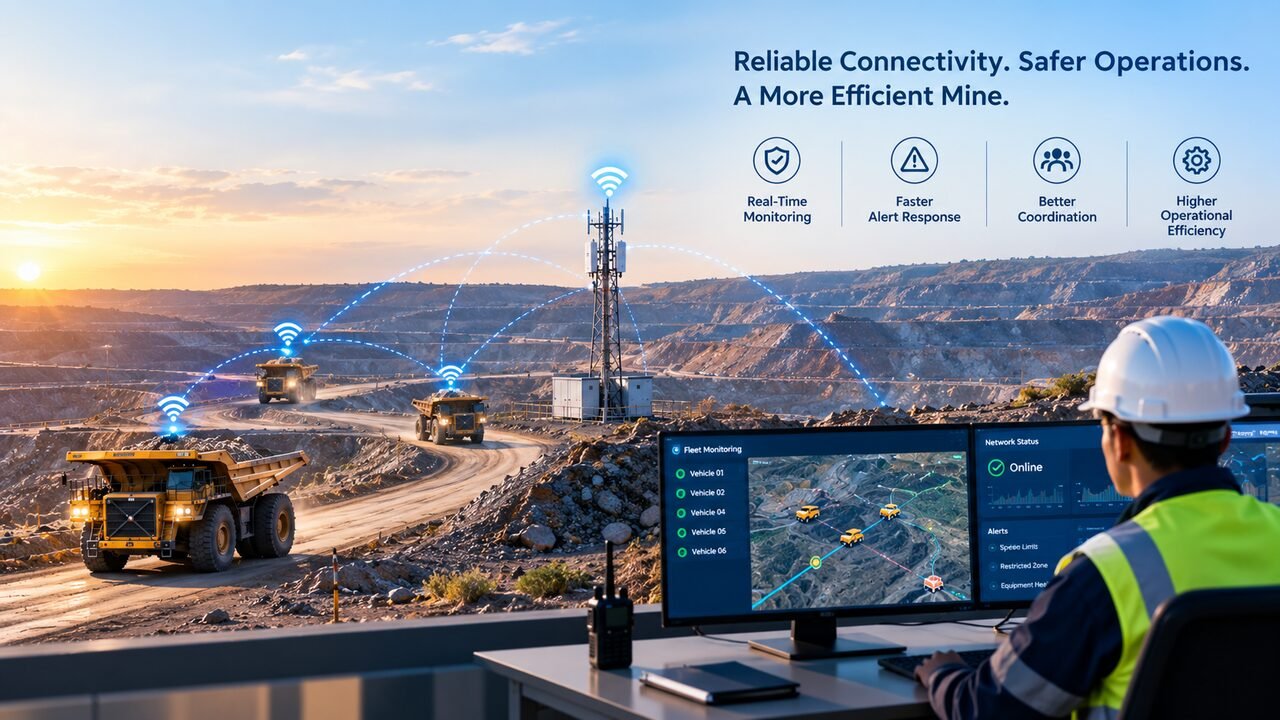
Real-time fleet communication supports mining safety procedures by helping vehicles, field teams, and control rooms exchange information across large operating areas. Mesh Wi-Fi for mine operations can extend connectivity through distributed wireless nodes, while suitable backhaul design, roaming, and network monitoring help address the challenges of mobile industrial fleets.
For mining engineers and IT teams, the priority is to build a network that meets measurable communication requirements and supports established safety processes. A properly engineered wireless mesh network can provide the connectivity foundation for fleet monitoring, operational alerts, and coordinated industrial communication.
Frequently Asked Questions
Mesh Wi-Fi for mine operations connects multiple wireless nodes to provide coverage across mining areas. It supports vehicle communication, telemetry, and control-room connectivity through distributed wireless infrastructure.
A wireless mesh network can extend connectivity across haul roads and work zones through multiple nodes. Alternate paths, when properly designed, may help maintain communication if a wireless link becomes unavailable.
A high performance wireless mesh network is designed to provide reliable coverage, adequate throughput, and low latency for industrial applications. Its performance depends on radio planning, backhaul capacity, interference, and network configuration.
Mesh Wi-Fi can provide connectivity for safety-related communication, including alerts, telemetry, and coordination. Critical safety functions still require appropriate safeguards, independent controls, and defined fallback procedures.
Engineers should evaluate coverage, fleet mobility, network capacity, interference, roaming, backhaul, and maintenance requirements. Testing the network along actual vehicle routes helps validate its suitability for operations.