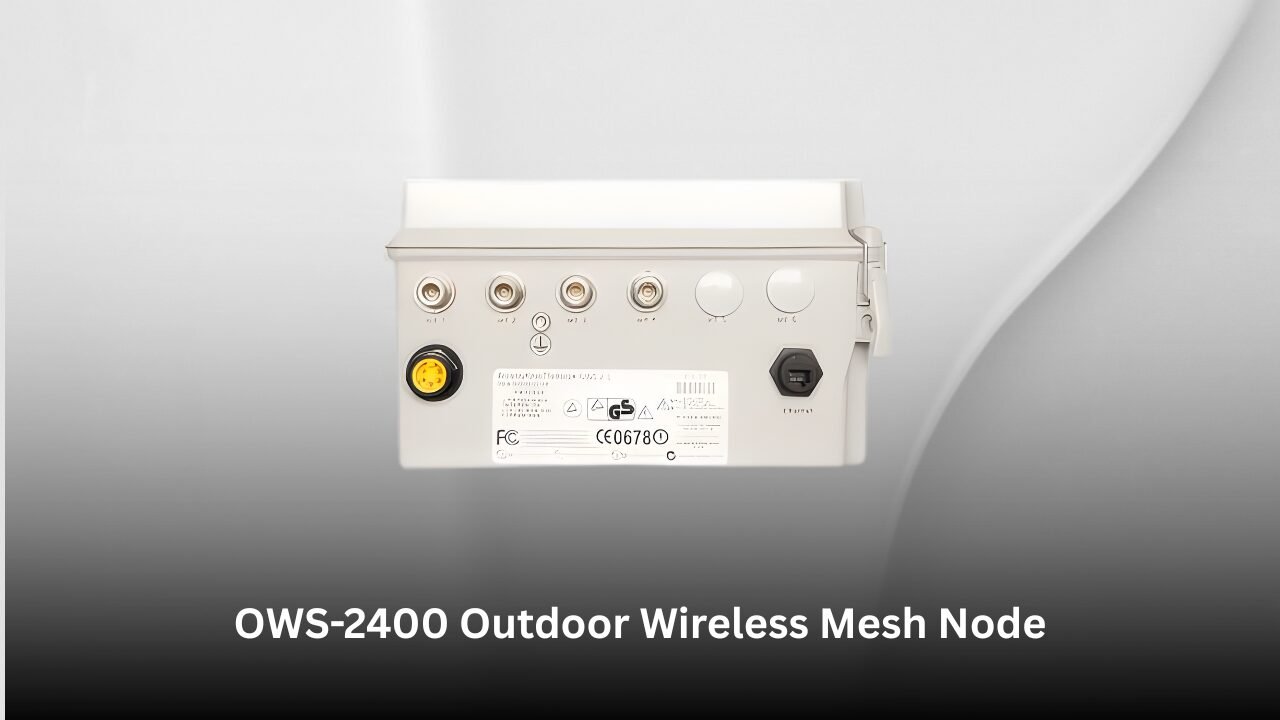
In large outdoor environments, whether sprawling campuses, industrial parks, or remote infrastructure sites, connectivity gaps and network failures can disrupt operations, data flows, and mission-critical systems. Traditional point-to-point links and standalone access points often struggle with coverage and failover resilience. Here’s where a robust mesh wifi router architecture becomes indispensable: devices like the OWS-2400 Outdoor Wireless Mesh Node deliver scalable, self-healing connectivity that keeps distributed systems aligned and online even under harsh environmental conditions.
What Is a Mesh Wi-Fi Router and Why OWS-2400 Matters
A mesh wifi router is a networking device that participates in a mesh network: a decentralized architecture where each node exchanges data with multiple neighboring nodes, creating redundant paths and eliminating single points of failure. In industrial wireless deployments, this architecture enables wide area coverage with high reliability, low latency, and resilience against node outages.
The OWS-2400 Outdoor Wireless Mesh Node fits into this landscape as a rugged, outdoor-rated mesh router designed for demanding enterprise and industrial environments. It supports dual-band operation – typically 2.4/5GHz – and may include additional spectrum such as 4.9GHz for licensed or public safety use.
How Mesh Networks Work: The Basics Explained
At its core, a mesh network is about connectivity diversity, not a single broadcast point. Each node:
- Communicates with several neighbors, creating multiple paths for data to travel.
- Self-heals by rerouting traffic when a device drops or interference occurs.
- Scales easily: adding nodes increases coverage without redesigning the network topology.
This decentralized routing is crucial for industrial scenarios from mining sites spanning kilometres, to smart city infrastructure covering city blocks where continuous connectivity is more important than a centralized Wi-Fi star topology.
What Makes OWS-2400 Suitable for Outdoor Industrial Environments?
Ruggedized Design for Harsh Conditions
Outdoor wireless installations face dust, heat, rain, and wind. Unlike indoor consumer mesh devices, the OWS-2400 is engineered to endure:
- Weatherproof housings
- Wide operating temperature ranges
- High mechanical tolerance for vibration and shock
These elements allow it to be deployed across plant yards, campuses, utility corridors, and remote facilities with minimal maintenance and maximum uptime.
Dual-Band and Multi-Spectrum Support
By supporting both 2.4GHz and 5GHz Wi-Fi bands – and in some implementations even dedicated bands like 4.9GHz for public safety or licensed backhaul – the OWS-2400 facilitates:
- Optimized throughput across different frequencies
- Reduced interference in congested spectrum environments
- Better coexistence with other wireless systems, including industrial IoT radios and critical communication systems.
Architecture Deep Dive: Redundancy, Latency, and Scalability
Industrial wireless mesh networking isn’t just about coverage – it’s about predictable performance.
Redundancy for Continuous Operations
In mesh architecture, each node maintains connections with its neighbours. If one node fails or degrades due to interference, traffic automatically reroutes through alternate paths. This self-healing behaviour ensures network continuity – especially important for real-time systems like automated control or surveillance.
Low Latency for Time-Sensitive Applications
Latency – the time it takes for data to travel from source to destination – is often a bottleneck in multi-node wireless networks. Optimized mesh routers such as OWS-2400 implement intelligent wireless routing so that:
- Data takes the shortest effective path
- Congestion is monitored and mitigated
- Real-time applications (SCADA, VoIP, video analytics) function without lag
These capabilities ensure that latency remains within acceptable thresholds even as the number of hops increases – a critical factor for industrial automation and monitoring systems.
Scalability Across Large Footprints
Adding nodes in a mesh doesn’t require redesigning the underlying network. New OWS-2400 units can be placed where needed – along perimeters, between buildings, in open yards – and they will self-integrate into the existing mesh. This is essential when operations expand or when coverage must evolve with deployments.
Practical Use Cases: India and Global Infrastructure
Smart Cities and Municipal Networks
Cities deploying public Wi-Fi and IoT infrastructure can leverage OWS-2400 mesh routers to:
- Provide blanket outdoor coverage in town centres
- Support surveillance and traffic systems
- Integrate public safety communications with enterprise networks
Industrial Parks and Manufacturing Campuses
In factories and industrial parks, this node supports:
- Wireless connectivity to PLCs and sensors across production lines
- Real-time monitoring of assets and processes
- Secure communication for operational data flow without hard-wired links
Remote Sites and Utility Networks
Utility providers and remote infrastructures – like pipelines or grid stations – benefit from mesh networking by eliminating long cabling runs and enabling adaptive routing in challenging terrains.
Across India’s diverse environments and global remote operations alike, mesh solutions built around nodes like the OWS-2400 help deliver high availability, low maintenance, and scalable coverage.
Performance Considerations: What to Evaluate
When designing a mesh network with outdoor nodes like the OWS-2400, consider the following:
Latency and Throughput
Always balance the number of hops and anticipated traffic loads. Mesh routers must maintain throughput while avoiding latency spikes, especially when supporting video and real-time control streams.
Network Redundancy Strategies
Deploy nodes with overlapping coverage footprints to ensure multiple routing paths and fault tolerance, especially where network uptime is critical.
Spectrum and Interference Management
Outdoor environments are RF-noisy. Select devices capable of dynamic channel selection and interference mitigation to maintain link stability.
Scalability Planning
Plan for future expansion by checking node capacity (number of connected clients, throughput per radio, etc.) and ensuring mesh controllers can handle incremental node additions without manual reconfiguration.
Conclusion
The OWS-2400 outdoor wireless mesh node exemplifies what robust, industrial-grade mesh wifi routers can deliver: resilient connectivity, scalable architecture, and reliable performance across harsh outdoor environments. By leveraging decentralized routing, multi-band support, and self-healing mesh intelligence, it meets the demands of expansive enterprise networks – from industrial automation to large campus deployments – without the fragility of traditional point-to-point systems.
FAQ
A mesh Wi-Fi router is a network device that connects in a decentralized mesh topology, allowing multiple nodes to communicate directly and route traffic redundantly. It eliminates single failures and expands coverage dynamically.
Yes. Outdoor mesh nodes are engineered with rugged housings and wide thermal tolerance, making them suited for harsh industrial conditions and wide outdoor deployments.
Mesh networks automatically reroute traffic through alternate nodes if one node fails, offering continuous connectivity and self-healing paths.
Yes. High-performance mesh routers optimize routes and minimize hops, maintaining low latency suitable for time-critical applications like SCADA and video.
Large campuses, industrial parks, smart cities, utility networks, and sprawling outdoor sites benefit from mesh networks due to their scalable and redundant nature.