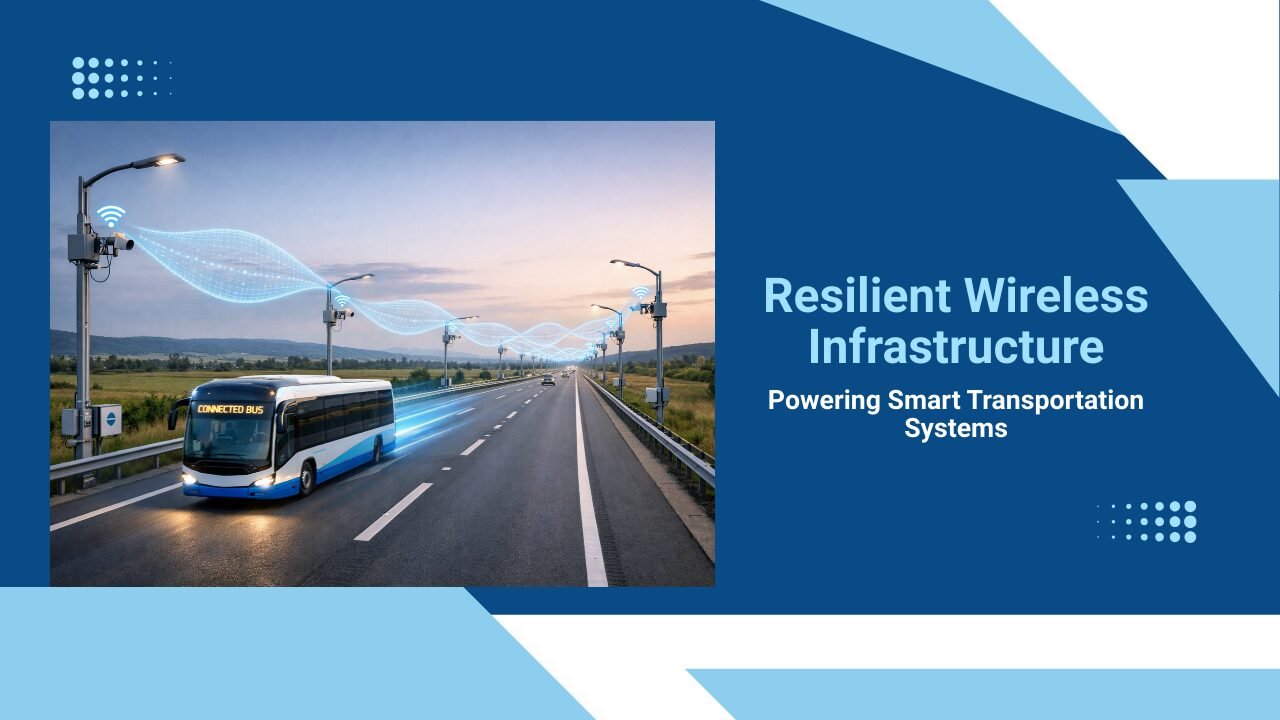
Smart transportation systems are no longer experimental projects. They are operational frameworks that cities and transit authorities depend on every day.
Traffic signals communicate in real time. Buses transmit diagnostics continuously. Surveillance systems stream high-definition video. Highway infrastructure interacts with connected vehicles. Passenger WiFi operates alongside safety systems.
All of it runs on wireless infrastructure.
The challenge is not deploying connectivity. The challenge is making it resilient.
When connectivity drops inside a commercial office, productivity slows. When connectivity drops in a transportation system, safety, coordination, and response time are affected. That difference changes how networks must be designed.
Resilience is not a feature. It is the foundation.
Why Smart Transportation Demands a Different Network Architecture
Transportation environments are unpredictable by nature.
Infrastructure stretches across open highways, dense city corridors, underground tunnels, bridges, depots, and transit hubs. Devices are constantly moving. Environmental interference shifts throughout the day. Usage spikes are dramatic and often sudden.
Traditional centralized wireless models struggle in these conditions. They depend heavily on fixed access points and defined coverage zones. When one segment fails, performance degrades quickly.
A transportation wireless mesh architecture distributes connectivity instead of concentrating it. That difference is what enables continuity.
How a Wireless Mesh Network Builds Resilience
A wireless mesh network connects nodes in a way that allows each one to relay data for others. Instead of relying on a single path back to a central controller, traffic can move across multiple routes.If one node fails, data automatically reroutes. If interference blocks a path, the system adapts. If a segment becomes overloaded, traffic redistributes.
This self-healing behavior is essential in transportation systems where uptime directly affects operations.Resilience in this context means:
- No single point of failure
- Automatic path optimization
- Seamless mobility support
- Distributed intelligence
It is infrastructure that anticipates disruption instead of reacting to it.
Real-World Applications in Smart Transportation
Intelligent Traffic Signal Networks
Modern traffic systems rely on synchronized signals, vehicle detection sensors, and real-time analytics. These systems continuously exchange data to optimize flow and reduce congestion.
A resilient mesh network ensures intersections remain connected even if a roadside unit fails or a fiber link is disrupted. Signal timing adjustments continue without interruption.
Cities implementing adaptive traffic control systems have reported measurable congestion reductions, often between 10 and 25 percent, when consistent connectivity supports real-time decision making.
Connected Public Transit
Public transit fleets generate constant streams of operational data:
- GPS tracking
- Engine diagnostics
- Onboard security video
- Passenger counting metrics
When buses or trains move across corridors, they transition between network nodes. A robust wireless mesh network maintains active sessions without drops, allowing control centers to retain visibility at all times.
This continuity improves fleet efficiency and supports predictive maintenance strategies that reduce service disruptions.
Highway and Corridor Infrastructure
Highways introduce distance and environmental challenges. Deploying fiber across long corridors is expensive and time consuming. Cellular coverage can fluctuate in remote zones.
Mesh nodes mounted on lighting poles or roadside structures create a connected corridor that supports:
- Dynamic message signs
- Incident detection cameras
- Emergency call systems
- Vehicle-to-infrastructure communication
Because nodes relay traffic between each other, coverage extends beyond line-of-sight limitations common in traditional systems.
High-Density Transit Hubs
Airports and train stations operate as complex digital ecosystems. Surveillance systems, digital signage, ticketing kiosks, IoT sensors, and passenger connectivity all share the same environment.
The best mesh WiFi system in these scenarios separates operational traffic from public access while maintaining consistent throughput under heavy demand.
Distributed routing prevents congestion at a single access point, improving both performance and reliability.
Designing for Mobility and Continuity
Transportation networks differ from static enterprise environments in one critical way: movement is constant.
Vehicles travel at speed. Devices connect and disconnect dynamically. Network paths shift in real time.
A well-architected transportation wireless mesh supports:
Seamless Roaming
Devices transition between nodes without renegotiating connections. This prevents session drops during vehicle movement.
Low-Latency Communication
Safety applications, including collision warnings and adaptive signaling, depend on rapid data exchange. Dynamic path selection keeps latency low even when network conditions change.
Edge-Level Processing
Modern mesh nodes increasingly include local computing capabilities. This allows certain decisions, such as traffic signal adjustments or anomaly detection, to occur locally instead of relying entirely on centralized systems.
Reducing dependency on a distant core improves responsiveness and resilience simultaneously.
Managing Scale Without Increasing Fragility
Smart transportation deployments rarely remain small. Pilot projects often expand citywide once value is demonstrated.
A properly implemented mesh architecture scales horizontally. Adding nodes strengthens the network instead of burdening it.
Each new node increases redundancy and coverage, improving overall resilience.
This scalability is one of the defining advantages of a wireless mesh network compared to rigid hierarchical designs.
Security Within Distributed Infrastructure
Public infrastructure demands strict security controls. Wireless systems must protect operational data while remaining flexible.
Resilient deployments typically incorporate:
- Encrypted node-to-node communication
- Network segmentation between operational systems and passenger access
- Secure remote management
- Continuous firmware update mechanisms
Because intelligence is distributed, compromise of a single node does not collapse the entire network.
Resilience includes cybersecurity resilience.
The Strategic Impact of Resilient Connectivity
Smart transportation systems are evolving rapidly. Connected vehicles, AI-driven traffic modeling, electrified fleets, and real-time environmental monitoring are expanding the scope of digital infrastructure.
Without resilient wireless foundations, these innovations remain limited.
A well-designed transportation wireless mesh network enables:
- Continuous operational awareness
- Faster incident response
- Reduced congestion
- Improved passenger experience
- Greater long-term infrastructure flexibility
Connectivity is no longer a support layer. It is a core component of transportation performance.

Conclusion
Smart transportation systems depend on uninterrupted communication between infrastructure, vehicles, sensors, and control platforms.
In environments defined by movement, interference, and scale, centralized wireless models struggle to maintain reliability.
A resilient wireless mesh network distributes connectivity, eliminates single points of failure, and adapts automatically to changing conditions. Whether deployed across urban corridors, transit hubs, or highway networks, mesh architecture provides the durability modern transportation demands.
As cities continue investing in connected mobility, the strength of their wireless foundation will determine how effectively those systems perform under real-world conditions.
If you are planning to upgrade or expand your smart transportation infrastructure, start by evaluating the resilience of your current network architecture. The right best mesh WiFi system will not only extend coverage but also ensure continuity when it matters most.
FAQs
Transportation wireless mesh refers to a mesh-based communication architecture designed specifically for transit corridors, highways, intersections, and mobility infrastructure, ensuring resilient and distributed connectivity.
It creates multiple communication paths between nodes. If one path fails, traffic automatically reroutes, maintaining continuous connectivity.
Yes. Properly designed mesh systems allow seamless roaming, maintaining active sessions as vehicles move across coverage zones.
Strong mobility handling, self-healing routing, scalable architecture, secure communication, and centralized visibility are key characteristics.
Yes. Mesh architecture is particularly effective for long corridors because nodes can relay traffic across extended distances without requiring continuous fiber connections.